Third-Party Validation
Third-Party Citations and External References
Who has cited this work
All 29 sources, across 15 countries
Academic and peer-reviewed
7
Middle East Policy
Wiley, cited at endnote 43
DOI 10.1111/mepo.70106
arXiv preprint
CSIRO Data61 team
Australia
arXiv preprint
Sir Syed CASE and Strathclyde
Pakistan and UK
The Cascade Protocol
Pomona College
United States
LexAI Journal
University of Toronto
Canada
Autonomy taxonomy preprint
Cited in an independent scholarly taxonomy
India
Experimental cosmologist’s newsletter
Tested against that field’s premature-discovery case
3,500 subscribers
Government
1
U.S. Federal Register
Cited by name, public comment
91 FR 30789, note 10
Institutional and policy
4
Foundation for Defense of Democracies
Overnight Brief, three editions
United States
UK Stop Killer Robots
Campaign resource
United Kingdom
Parliamentary Assembly of the Mediterranean
Parliamentary Observatory on AI digest
Malta
Resilient Navigation and Timing Foundation
Featured analysis
United States
Media and curated selection
6
Syndicated investigative feature
Quoted by name, carried by six publications
United States
United Press International
Director’s Corner, three selections
Korea Regional Review
Indian Strategic Studies
Eight selections, five with commentary
India
Géopolitique Profonde
Carried into French under a staff byline
France
NewsFire Global
Cited analysis
Greece
Albanian Institute for Geopolitics
Translated and republished in full
Kosovo
Practitioner
6
Berigo AS
Term operationalised for clients
Norway
Device Security Lab
Cited analysis
Japan
Defense logistics paper
Addressed to ministries of defence
Colombia
Prosthetic Gods
Podcast discussion
United States
Wayfinder Systems Group
Two docket comments built on his recommendations
NHTSA-2026-1552-0022 · NHTSA-2026-1585-0009
Modern War Institute at West Point
Commentary by an Army autonomy adviser
United States
Each source is counted once however many times it has cited the work, and a syndicated article is counted once however many outlets carry it. Dated entries with verifiable links follow below and on the impact record.
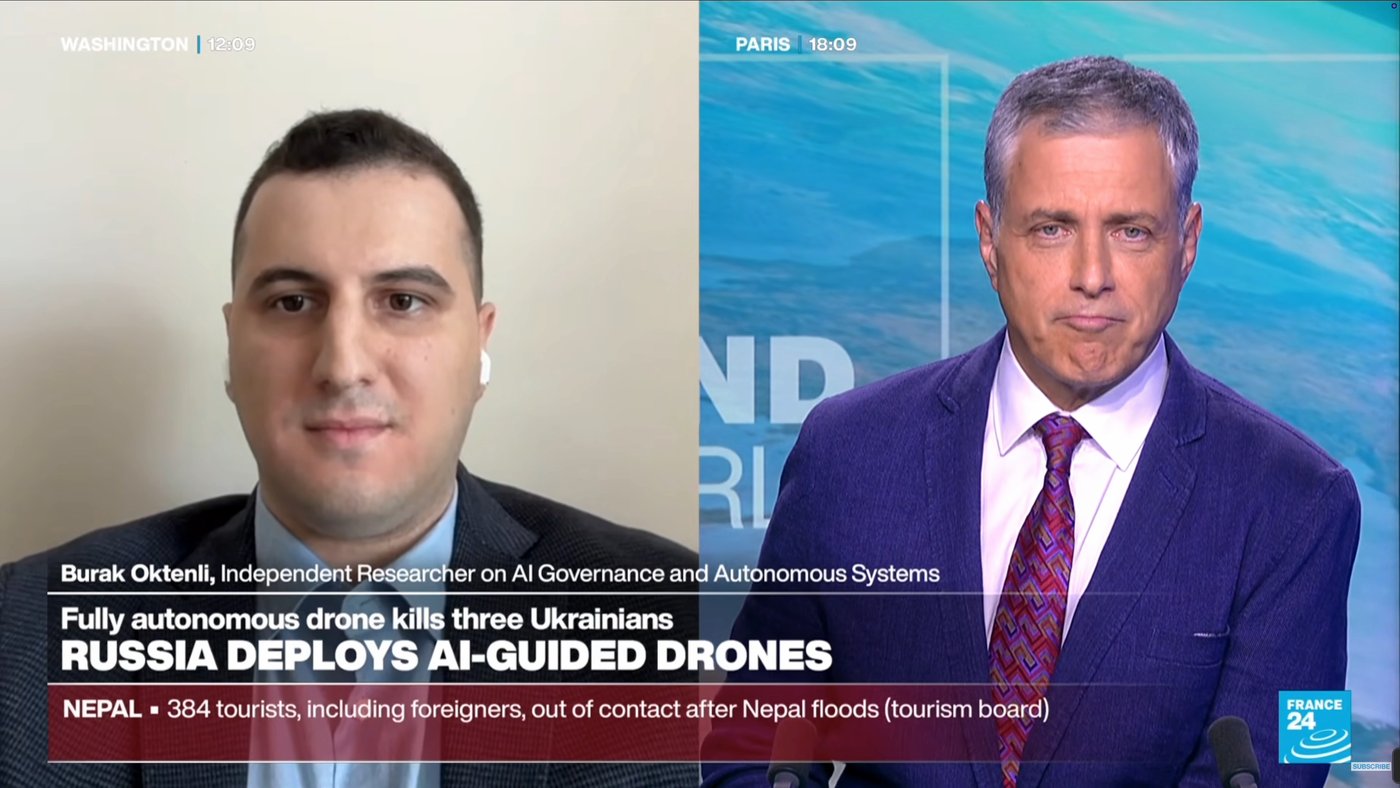
France 24 English
Live two-way from Washington · On-screen identification: “Burak Oktenli, Independent Researcher on AI Governance and Autonomous Systems”
Invited by the French international broadcaster for live analysis of a reported autonomous drone strike, arguing that the demand for a human in the loop is obsolete for weapons that navigate by onboard camera because the link can be jammed, and that a system’s permission to strike should lapse automatically when sensor integrity or target evidence falls below the level that justified the mission. This is an invitation to speak as a subject-matter expert rather than a citation of published work.
United States Federal Register (NHTSA)
Incident Reporting for Automated Driving Systems and Level 2 ADAS
A public comment by Burak Oktenli (NHTSA-2026-0529-0007) is cited by name in footnote 10 of the notice at 91 FR 30789, Docket NHTSA-2026-0529.
Middle East Policy (Wiley)
Peer-reviewed journal article · DOI 10.1111/mepo.70106 · Endnote 43
A peer-reviewed article cites the applicant’s Geopolitical Monitor analysis of counter-drone reciprocity as the source for its account of ten-year security agreements exchanging air-defence capability for counter-drone expertise. His first citation in a peer-reviewed journal issued by a major academic publisher.
University of Toronto, LexAI Journal
University of Toronto Law and Ethics of AI Students' Association
The Escalation Risk Assessment Model (ERAM) is cited as Reference #4 in “The Ethics of AI in U.S. Warfare.”
Cited in a Taxonomy of Advanced AI Systems (Lt Gen (Dr) R S Panwar)
Lt Gen (Dr) R S Panwar (Indian Army, Retired), Doctorate in Computer Science, Indian Institute of Technology Bombay · Academia.edu preprint, June 2026
"Cognition, Agency, and Authority: A Taxonomy of Advanced AI Systems with Military Implications" cites the author's working paper on AI-enabled military decision-making and escalation risk (endnote 39) in support of its analysis of strategic risk in cognitively sophisticated AI systems.
Cited in an arXiv preprint on shadow AI in critical infrastructure
Baruwal Chhetri, Tariq, Aamir, Grobler, Thapa & Singh (CSIRO Data61), arXiv:2606.00088
“From Frontier to Shadow AI: A Simmering Threat to Assurance and Security in Critical Infrastructure” cites the applicant's SSRN analysis of AI outpacing human clearance models (reference 41), in a study of 27 Australian critical-infrastructure organizations.
Cited in an arXiv preprint on unsupervised tunnel detection in ground-penetrating radar
Junaid, Khan & Ahmed (Sir Syed CASE Institute of Technology; University of Strathclyde), arXiv:2607.04882
“Unsupervised Detection of Underground Tunnels in Ground-Penetrating Radar Using Depth-Restricted Reconstruction Scoring” cites the author's SSRN paper Strategic Subterranean Domain Awareness (SSRN 6046594) as reference [1], with two in-body citations on pipeline-monitoring early warning and the tunnel detection problem.
The Intercept, and in syndication across five further publications
TomDispatch feature by a bylined contributing writer
A syndicated investigative feature quotes the applicant’s Articles of War analysis directly on where responsibility for an autonomous system’s actions properly sits, identifies him as an independent researcher on artificial-intelligence systems and their governance, and sets the underlying proposition in display type. Recorded as one citation carried by six outlets.
Foundation for Defense of Democracies, Overnight Brief
Excerpted three times: twice within nine days in August, including in the brief’s Must-Reads selection, and again in September
A Washington national-security policy institute carried the applicant’s analysis in its daily brief on three separate occasions, distributed to a policy and congressional readership.
Albanian Institute for Geopolitics, Pristina
Full translation into Albanian, published in the institute’s Analysis section
A non-governmental research institution translated one of the applicant’s analyses in full, credited the original outlet, linked his author page there, and marked the translation as the institute’s own work. The first instance of his work being translated and republished by a research institution.
Indian Strategic Studies
Eight selections, five carrying original analytical commentary and a question put to readers
A curated research portal maintained by a retired Indian Army major general, formerly senior directing staff at his country’s National Defence College, has selected eight of the applicant’s pieces and, on five occasions, written original analysis extending the argument before inviting its professional readership to debate it.
This is a selection. Twenty-nine distinct external sources across fifteen countries have cited, quoted, republished or built on this work, spanning government, academic, institutional, practitioner and media references. Source links and the full record are on the Citations and Recognition page.