Policy and National Security Research

Burak Oktenli is an independent researcher and analyst working at the intersection of artificial intelligence governance, national security, and critical infrastructure resilience. His public-source research examines how authority, accountability, and human oversight should be structured for autonomous and AI-enabled systems in safety-critical settings. This page collects his published commentary, externally cited work, and governance research relevant to policymakers, researchers, and public-sector institutions.

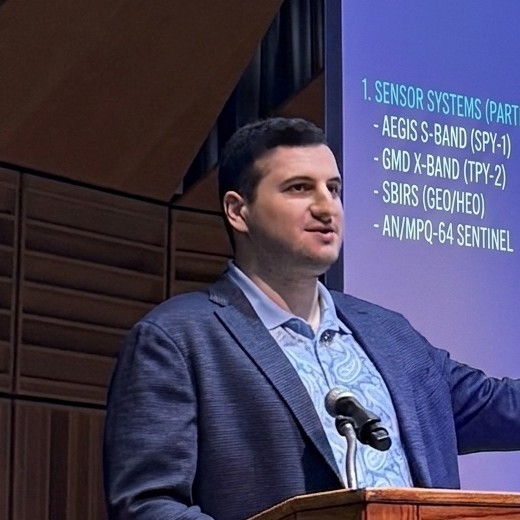
Burak Oktenli presenting on multi-domain missile defense

Researcher Profile

Burak Oktenli is a policy-oriented researcher focused on the governance of autonomous and AI-enabled systems in defense, critical infrastructure, and other safety-critical domains. His work examines a recurring question across these settings: when an automated system acts faster than a person can intervene, under whose authority did it act, and who is accountable for the result. He develops public-source analysis and technical governance frameworks that treat authority, accountability, and auditability as design requirements rather than afterthoughts. His research includes seven governance architectures addressing sensor trust, human-machine authority, escalation risk, and recovery, several of which are formally specified and machine-verified. He has published commentary with the Royal United Services Institute (RUSI) and other defense outlets, and his work has been cited in the United States Federal Register and in academic research. He contributes to standards discussion as a stakeholder participant in a NIST AI Risk Management Framework community of interest. He holds an MBA and is completing a Master of Professional Studies in Applied Intelligence at Georgetown University. He works independently and is not affiliated with, nor does he represent, any government agency or intergovernmental body.

Policy Focus Areas

AI governance and accountability

Examines how decision authority for AI systems should be bounded, assigned, and made reviewable, so responsibility stays clear as autonomy increases.

Critical infrastructure resilience

Studies how safety-critical and operational-technology environments maintain control and continuity under cyber-physical stress and automated failure.

Autonomous systems oversight

Analyzes the human-oversight requirements for systems that can act below human reaction time, including how and when control passes between human and machine.

Operational technology and cyber-physical risk

Focuses on the security and governance of industrial control and OT environments where digital decisions carry physical consequences.

Strategic stability and escalation risk

Considers how machine-speed decision support and autonomy affect crisis stability, escalation dynamics, and the timing of human deliberation.

Public-source national security analysis

Produces analysis built entirely from open and credible sources, with stated assumptions and confidence levels, intended to inform rather than advocate.

Selected Publications and Policy-Relevant Work

Peer-Reviewed ArticleJuly 21, 2026

SATA: Sensor Attestation and Trust Anchoring: A Formally Specified, Simulation-Evaluated Continuous-Trust Protocol for Autonomous-Systems Sensor Edges

Journal of Hardware and Systems Security (Springer Nature) · Vol. 10, Art. 17 · Sole author
AnalysisAugust 19, 2026

The First Clean Signal Is Not Permission to Fire: On Resilience and Governance of Autonomous Systems

Modern War Institute at West Point
Op-EdAugust 19, 2026

Trump Is Right to Send Allies the Bill. Cutting Our Own Drills Is the Wrong Currency

Washington Examiner
Op-EdAugust 18, 2026

Your Company Approved an AI System That No Longer Exists

Eurasia Review
Op-EdAugust 2026

The AI Kill Switch Act Needs a Containment Layer

Techstrong.ai
Op-EdAugust 18, 2026

Every Measurement Has a Physical Limit: Scientific AI Pretends Otherwise

Eurasia Review
AnalysisAugust 18, 2026

Three Sensors, One Witness: The Corroboration Trap in Allied Intelligence

Eurasia Review
Op-EdAugust 2026

Trump Handed Cops the Power to Jam Drones. Bad Software Could Ruin It

Washington Examiner
Op-EdAugust 2026

The Pentagon Is Cutting Red Tape and Setting a Legal Minefield for AI Contractors

Washington Examiner
Op-EdAugust 15, 2026

Antimatter Starships Are Farther Away Than You Think

RealClearScience
AnalysisAugust 15, 2026

The Next Scientific Breakthrough May Depend on AI Saying ‘Unknown’

Eurasia Review
Op-EdAugust 15, 2026

The Next Arms-Control Breakthrough May Be a Proof That Reveals Almost Nothing

Eurasia Review
Op-EdAugust 14, 2026

Trump Says Humans Control the Bomb. The Code Doesn’t Know That Yet

Washington Examiner
Op-EdAugust 13, 2026

The AI Arms Race Will Be Won in Year Two

Geopolitical Monitor
AnalysisAugust 13, 2026

The Red Sea Broke the Escalation Ladder

Eurasia Review
Op-EdAugust 13, 2026

We’re Building Beijing’s Spy Network for Them, One Convenient Device at a Time

Washington Examiner
Op-EdAugust 12, 2026

Medical AI Can Pass the Test and Still Fail Patients

Eurasia Review
Op-EdAugust 10, 2026

Who Will Believe the Space Logs in 2040? Space Governance and the Quantum Audit Problem

The Space Review (in association with SpaceNews)
AnalysisAugust 10, 2026

America Is Exporting AI to Allies: It Needs Rules for Turning Access Off

Eurasia Review
Op-EdAugust 10, 2026

Defense Networks Will Split. The Requirement Should Say Who Decides.

RealClearDefense
Op-EdAugust 6, 2026

Trump’s AI Exemption Isn’t an Oversight Gap. It’s a National Security Masterstroke

Washington Examiner
Op-EdAugust 6, 2026

Europe’s Military AI Gap Begins at Fielding

Geopolitical Monitor
AnalysisAugust 5, 2026

America’s Drone Standards Will Travel Far Beyond America

Eurasia Review
Op-EdAugust 5, 2026

Trump Isn’t John Lennon. That’s Why His Iran Strategy Might Actually Work

Washington Examiner
Op-EdAugust 4, 2026

The Race to Write NATO’s Military AI Rulebook Has Begun

Eurasia Review
Op-EdAugust 4, 2026

Silicon Valley Can’t Own the Pentagon’s Kill Switch

Washington Examiner
AnalysisAugust 3, 2026

Chokepoint Coercion in the Next Phase of the Iran Conflict

Eurasia Review
Op-EdAugust 3, 2026

The Vulnerability of Autonomous Warfare Systems

RealClearDefense
Op-EdAugust 2, 2026

Europe Delayed Its AI Rules Because the Institutions Were Not Ready

Eurasia Review
AnalysisJuly 31, 2026

Zero Trust Stops at the AI

Security Boulevard (Techstrong Group)
Op-EdJuly 30, 2026

What Trump’s Record Border Numbers Are Hiding

Washington Examiner
CommentaryJuly 30, 2026

The Human-in-the-Loop Is Becoming a Rubber Stamp. Acquisition Can Fix It.

Military AI
Op-EdJuly 29, 2026

Six Governments Wrote One Driverless Rule, But They Kept Four Regulators

Geopolitical Monitor
AnalysisJuly 29, 2026

From Fordow to New York: What Force Cannot Verify in Iran’s Nuclear Program

Eurasia Review
Op-EdJuly 29, 2026

Arming Local Police With Drones. Who Pulls the Trigger?

RealClearDefense
Op-EdJuly 28, 2026

Today’s Hydra Problem: Decapitation Without Degradation

Eurasia Review
Invited OpinionJuly 27, 2026

Adversaries Don’t Need a Zero-Day — They Read Your Rulebook

Dark Reading (Informa TechTarget)
Invited AnalysisJuly 24, 2026

Whose Decision Was It? Drone Swarms and the Accountability Gap in Ukraine

Lieber Institute for Law and Warfare, United States Military Academy at West Point · Articles of War
Op-EdJuly 24, 2026

America Just Did the World’s Dirty Work

Washington Examiner
Op-EdJuly 23, 2026

The Wax Was Melting: AI Speed and the Nuclear Decision

Geopolitical Monitor
Op-EdJuly 23, 2026

Binders Won’t Stop Bullets: When Military AI Can’t Say ‘No’

Washington Examiner
Op-EdJuly 23, 2026

Allied Autonomy Is Creating a New Seam in Extended Deterrence

Global Security Review · National Institute for Deterrence Studies
Op-EdJuly 22, 2026

The Iran War Began With Biden, Not Trump

Washington Examiner
Op-EdJuly 22, 2026

Who Yields in Orbit? Autonomous Satellites Need a Right-of-Way Rule

Eurasia Review
Op-EdJuly 21, 2026

Why We Punish the Protection That Works

Eurasia Review
Op-EdJuly 21, 2026

America’s Allies Should Test the AI They Plan to Depend On

Geopolitical Monitor
Op-EdJuly 21, 2026

The Next Offset Won’t Be a Smarter AI, It Will Be a Governable One

Eurasia Review
Op-EdJuly 20, 2026

We Guarded China’s Oil for Free. Trump Sent Them the Bill

Washington Examiner
Op-EdJuly 19, 2026

Two Years After CrowdStrike, We Are Still Afraid of the Wrong AI Apocalypse

Eurasia Review
Op-EdJuly 17, 2026

The Reciprocity Inversion: How Ukraine Became the Gulf’s Counter-Drone Lifeline

Geopolitical Monitor (Situation Reports)
Op-EdJuly 16, 2026

What Six Years of Drone Proliferation Means for the Next Fight

Eurasia Review
Op-EdJuly 16, 2026

Military AI - The Confidence You Cannot See

RealClearDefense
Op-EdJuly 14, 2026

The Governance Gap Hiding in Plain Sight Across Eight Industries

Eurasia Review
Op-EdJuly 13, 2026

Your AI Agent’s Permission Model Is Built on a Boolean. Irreversible Actions Need More Than That.

IT Ops Times (D2 Emerge)
Op-EdJuly 13, 2026

The Cruel Economics of the 19-Day Anthropic Ban

RealClearMarkets
Op-EdJuly 13, 2026

Who Fires the Shot? Closing the Authority Gap in Indo-Pacific Autonomous Warfare

Geopolitical Monitor · syndicated on Eurasia Review
Op-EdJuly 2, 2026

The One Clause in Trump's AI Memo That Could Encumber the Off-Switch

RealClearDefense
Op-EdJune 30, 2026

When the Machine Decides and the Human Signs

The Defense Post
Op-EdJune 26, 2026

When the Machine Acts First: Closing the Authority Gap on the Autonomous Battlefield

Modern War Institute at West Point
Editorial RecognitionJune 26, 2026

Featured in UPI's Korea Regional Review Director's Corner

United Press International (UPI), Korea Regional Review · Director's Corner, June 26, 2026 · Editorially curated national-security review; the author's Modern War Institute op-ed was selected alongside analyses from Foreign Affairs, The Wall Street Journal, the Financial Times, War on the Rocks, and Small Wars Journal, with editorial commentary engaging the argument directly.
Editorial RecognitionJune 23, 2026

Featured in the Parliamentary Observatory on AI of the Parliamentary Assembly of the Mediterranean

Centre for Global Studies, Parliamentary Assembly of the Mediterranean · Weekly Digest on AI and Emerging Technologies, June 23, 2026 · The author's RUSI commentary on Operation Midnight Hammer and AI-era command was selected for the observatory's curated digest, summarized alongside analyses from Defense One, Defense News, and Breaking Defense.
Op-EdJune 22, 2026

Space Autonomy Needs an Authority Architecture Before 2027

The Space Review (in association with SpaceNews)
Policy CommentaryJune 16, 2026

The Hour That Worked: What Midnight Hammer Teaches About AI-Era Command

Royal United Services Institute (RUSI), Guest Commentary
Op-EdJune 4, 2026

The Quantum Clock Is Already Ticking on America's Autonomous Arsenal

RealClearDefense
Policy CommentaryJune 12, 2026

When an AI Agent Fires First, Who Answers for It?

Military AI

These commentaries draw on a broader body of governance research, including seven governance architectures and 48 open-access works (31 Zenodo DOIs and 17 SSRN working papers). The complete catalogue is on the Publications page.

Third-Party Citations and External References

Government RecordMay 26, 2026

United States Federal Register (NHTSA)

Incident Reporting for Automated Driving Systems and Level 2 ADAS

A public comment by Burak Oktenli (NHTSA-2026-0529-0007) is cited by name in footnote 10 of the notice at 91 FR 30789, Docket NHTSA-2026-0529.

Academic Citation2026

University of Toronto, LexAI Journal

University of Toronto Law and Ethics of AI Students' Association

The Escalation Risk Assessment Model (ERAM) is cited as Reference #4 in “The Ethics of AI in U.S. Warfare.”

Academic CitationJune 2026

Cited in a Taxonomy of Advanced AI Systems (Lt Gen (Dr) R S Panwar)

Lt Gen (Dr) R S Panwar (Indian Army, Retired), Doctorate in Computer Science, Indian Institute of Technology Bombay · Academia.edu preprint, June 2026

"Cognition, Agency, and Authority: A Taxonomy of Advanced AI Systems with Military Implications" cites the author's working paper on AI-enabled military decision-making and escalation risk (endnote 39) in support of its analysis of strategic risk in cognitively sophisticated AI systems.

arXiv PreprintMay 2026

Cited in an arXiv preprint on shadow AI in critical infrastructure

Baruwal Chhetri, Tariq, Aamir, Grobler, Thapa & Singh (CSIRO Data61), arXiv:2606.00088

“From Frontier to Shadow AI: A Simmering Threat to Assurance and Security in Critical Infrastructure” cites the applicant's SSRN analysis of AI outpacing human clearance models (reference 41), in a study of 27 Australian critical-infrastructure organizations.

arXiv PreprintJuly 2026

Cited in an arXiv preprint on unsupervised tunnel detection in ground-penetrating radar

Junaid, Khan & Ahmed (Sir Syed CASE Institute of Technology; University of Strathclyde), arXiv:2607.04882

“Unsupervised Detection of Underground Tunnels in Ground-Penetrating Radar Using Depth-Restricted Reconstruction Scoring” cites the author's SSRN paper Strategic Subterranean Domain Awareness (SSRN 6046594) as reference [1], with two in-body citations on pipeline-monitoring early warning and the tunnel detection problem.

Source links and the full record are on the Citations and Recognition page.
The Governance Gap

As autonomous and AI-enabled systems take on time-critical decisions in defense and critical infrastructure, a gap is opening between what these systems can do and the frameworks meant to hold them accountable. When a system acts faster than a person can intervene, existing oversight models struggle with a basic question: under whose authority did it act, and who is responsible for the outcome? Closing that gap means separating evidence-based risks from speculation and defining clear criteria for bounded authority, accountability, and auditable control. These are the questions this research examines.

Credibility and Evidence

This research is built on public and openly available sources, credible institutional and government reports, and peer-reviewed literature where available. Assumptions are stated, confidence levels are noted, and claims are verifiable through the cited sources. The work does not rely on, claim, or imply access to classified information, and it has not been reviewed or endorsed by any government agency.

Contact

Inquiries: info@burakoktenli.com

This page presents independent research and analysis. Burak Oktenli is not an elected official, government official, or agency representative, and is not affiliated with any government agency or intergovernmental body. References to institutions are analytical and do not imply affiliation or endorsement.