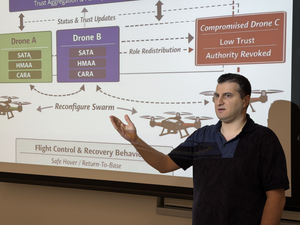
Evidence of provisional patent applications, publications, education, and professional experience. Publications can be checked through Springer Nature (peer-reviewed journal DOIs), Zenodo, ORCID, Google Scholar, and SSRN. The eight provisional patent applications are not published, so USPTO Patent Center cannot display them; filing receipts are available on request, as is confirmation of employment.
Peer-reviewed: the SATA architecture is published in the Journal of Hardware and Systems Security (Springer Nature), Vol. 10, Art. 17 (2026), DOI 10.1007/s41635-026-00190-4 ↗.
This experience reflects progressive work across data governance, infrastructure security, operational technology, and critical infrastructure systems. Each role contributed domain-specific insights that informed the development of the AUTHREX governance framework.
Formal education across applied intelligence, international business, and computer science. Two STEM-designated programs (Georgetown M.P.S. Applied Intelligence, in progress; USF B.S. in Computer Science).
Active participation in defense, aerospace, AI, and autonomous systems communities through trade shows, technical conferences, professional society events, and continuing education. Sustained engagement across these communities ensures that AUTHREX governance architectures remain aligned with operational requirements, emerging standards, and the evolving needs of the U.S. defense and critical infrastructure sectors.
Independent third-party citations, academic references, and professional community recognition of AUTHREX governance research, generated without solicitation by university journals, defense communities, and academic platforms across multiple countries.
Burak Oktenli received First Prize in the 2026 Naval Intelligence Essay Contest, conducted by Naval Intelligence Professionals (NIP) with the U.S. Naval Institute, for “Audit the Machine: The Unarticulated Risk in AI-Era Naval Intelligence” ($5,000 and publication in Proceedings). The contest, with winners listed since 2003, is open to military and civilian authors; recent first-place winners have predominantly been serving U.S. Navy and Marine Corps officers. The Editor-in-Chief of Proceedings confirmed the result in writing on October 13, 2026 (2026 winners list). The essay is not yet published, and therefore not counted among the published commentary pieces recorded elsewhere on this site.
Interviewed live on the English-language channel of the French international broadcaster in August 2026 about a reported autonomous drone strike in Ukraine, appearing from Washington and identified on screen as “Burak Oktenli, Independent Researcher on AI Governance and Autonomous Systems.” He argued that the demand for a human in the loop is obsolete for weapons that navigate by onboard camera because the link can be jammed, that the human decision must therefore be made before launch as limits the machine carries, and that a system’s permission to strike should lapse automatically when sensor integrity or target evidence falls below the level that justified the mission.
A public comment by Burak Oktenli (Docket NHTSA-2026-0529-0007) is cited by name in the U.S. Federal Register: NHTSA, Incident Reporting for Automated Driving Systems (ADS) and Level 2 ADAS, 91 FR 30789, 30792 n.10 (May 26, 2026), among the comments that raised issues with the reporting requirements; the notice also references comments from Virginia DOT, the Alliance for Automotive Innovation, and Consumer Reports. Verify on federalregister.gov.
Berigo AS, an Oslo-based cybersecurity advisory firm, cited Burak Oktenli by name one day after publication of his Dark Reading analysis, attributing the term “cap weaponization” and converting it into client guidance tied to the EU NIS2 directive: read the analysis (Norwegian).
Reviewer offer acknowledged by the Editor-in-Chief and circulated to Associate Editors at the Journal of Responsible Technology (Elsevier, ISSN 2666-6596), and two published open peer reviews at F1000Research (Taylor & Francis Group) on the same article, each under his own name with its own citable DOI: the first, issued August 2026 (10.5256/f1000research.202374.r507419), and the second, on the revised version, issued October 10, 2026 (10.5256/f1000research.211354.r528512), which approved the revision after the author addressed the six major concerns he had raised. He is named among the five peer reviewers displayed on the public article record and on the platform’s AI and machine-learning gateway. An assigned review for Connections: The Quarterly Journal, the peer-reviewed journal of the Partnership for Peace Consortium of Defense Academies and Security Studies Institutes, was completed in August 2026 for issue 25-1 and confirmed in writing by the journal’s senior editor, who described it as an exhaustive and highly professional review. In September 2026 a department editor of IEEE Engineering Management Review, a journal of the Institute of Electrical and Electronics Engineers, invited him to review a submitted manuscript; he accepted the assignment the same morning and completed the review ahead of its October due date, and on 30 September 2026 the journal issued him an IEEE Certificate of Reviewer Recognition. In October 2026 the lead guest editor of the International Journal of System Assurance Engineering and Management (Springer Nature, ISSN 0975-6809), a journal on the reliability, safety, quality and risk of large engineered systems, invited him in view of his expertise to review a submitted manuscript; he accepted the same morning and completed the review on October 16, 2026, ahead of its November 18 due date, and the journal’s editorial office acknowledged it the same day. In October 2026 the Editor-in-Chief of The Journal of Space Safety Engineering (Elsevier, for the International Association for the Advancement of Space Safety; ISSN 2468-8967) invited him to review a submitted manuscript; he accepted the same day and completed the review on October 21, 2026, ahead of its October 28 due date, and the Editor-in-Chief acknowledged it in writing the same day. Also in October 2026, an editor of Multimedia Systems (Springer Nature, ISSN 1432-1882), a journal on multimedia systems, communications, processing and applications, invited him to review a submitted manuscript within his area of expertise; he accepted, and the review is under way, with his report due within 21 days of acceptance. Also in October 2026, an editor of the Journal of Information, Communication and Ethics in Society (Emerald Publishing, ISSN 1477-996X), a journal on the social and ethical issues raised by information and communication technologies, invited him to review a submitted manuscript within his expertise and interest; he accepted, and the review is under way.
In September 2026 a handling editor of a diamond open-access geophysics journal invited him to review a submitted manuscript, citing his expertise; he accepted the same day. Peer review is confidential, so the manuscript is not described here. The invitation is recorded because it came from outside defence and security.
“Assurance-Bounded Space Power Beaming: A Measurement-Grounded Runtime-Assurance Architecture for Autonomous Orbital Wireless Power Transfer,” accepted for publication in October 2026 by The Journal of Space Safety Engineering (Elsevier, for the International Association for the Advancement of Space Safety; ISSN 2468-8967) after one round of minor revision, and now in production. Not yet published, and therefore not counted toward the four peer-reviewed journal articles recorded elsewhere on this site; its field, space safety engineering, is distinct from those of the four published articles (hardware-security engineering, security theory, digital war studies, and test and evaluation).
“Bounded AI and a Layered Assured-PNT Architecture for Jamming-Resilient PNT,” published in The ITEA Journal of Test and Evaluation, volume 47, issue 3 (September 2026), ISSN 1054-0229, as a technical article. The journal operates a formal open peer-review model aligned to Committee on Publication Ethics principles; the manuscript was assessed by two reviewers, the chief editor and an external statistician, and passed through two rounds of substantive revision before acceptance. This is his fourth discipline after hardware-security engineering, security theory and digital war studies.
“The Authority Gap: Why Meaningful Human Control Fails at the Tier Where It Is Signed,” published in Digital War (Springer Nature / Palgrave Macmillan), volume 7, article 6 (2026), on 31 August 2026 following peer review, DOI 10.1057/s42984-026-00113-1, ISSN 2662-1983, published with his ORCID attached to the record. This is his third peer-reviewed journal article and his third discipline, after hardware-security engineering and security theory, and it places his central research claim in a war-studies venue.
“The Ingratitude Paradox: A Causal Mechanism of Democratic Discounting of Successful Protection,” International Journal of Contemporary Security Studies (Faculty of Security Studies, University of Belgrade), Vol. 2 No. 2 (2026), pp. 55–68, double-blind peer reviewed, published Online First 24 August 2026, with the DOI to be registered when the issue is finalised in December 2026: read the article. A second peer-reviewed venue in a second discipline, following the protocol paper in Springer’s Journal of Hardware and Systems Security.
Accepted as a volunteer in the technical program and workshops area for the IEEE International Conference on Communications 2027 (Washington, DC), one of the two flagship conferences of the IEEE Communications Society, with attendance scheduled at the September 2026 organizing meeting.
Documentation: most records below link to an external system operated by an independent third party (Zenodo, ORCID, Google Scholar, SSRN, ResearchGate). The provisional patent applications are not published; filing receipts are available on request.
HMAA: U.S. Provisional No. 63/999,105 (March 7, 2026)
CARA: U.S. Provisional No. 64/000,170 (March 9, 2026)
SATA: U.S. Provisional No. 64/002,453 (March 11, 2026)
FLAME: U.S. Provisional No. 64/005,607 (March 14, 2026)
ADARA: U.S. Provisional No. 64/110,218 (July 13, 2026)
MAIVA: U.S. Provisional No. 64/110,221 (July 13, 2026)
ERAM: U.S. Provisional No. 64/110,225 (July 13, 2026)
EBCC (Evidence-Bounded Assertion Control): U.S. Provisional No. 64/144,399 (August 30, 2026)
All eight filed via USPTO Patent Center; they are provisional applications, not examined or published, and no patent has been granted. The eighth (EBCC) is distinct from the seven governance architectures.
HMAA: 10.5281/zenodo.18861653 ↗
CARA: 10.5281/zenodo.18917790 ↗
SATA: 10.5281/zenodo.18936251 ↗
MAIVA: 10.5281/zenodo.19015517 ↗
FLAME: 10.5281/zenodo.19015618 ↗
ADARA: 10.5281/zenodo.19043924 ↗
HMAA-UAV: 10.5281/zenodo.19128769 ↗
Testbed: 10.5281/zenodo.19143190 ↗
BLADE-EDGE: 10.5281/zenodo.19177472 ↗
BLADE-AV: 10.5281/zenodo.19232130 ↗
BLADE-MARITIME: 10.5281/zenodo.19246785 ↗
BLADE-INFRA: 10.5281/zenodo.19277887 ↗
BLADE-SPACE: 10.5281/zenodo.20183269 ↗ (TRL 2-3 Preliminary Design Phase, 15-document engineering package)
BLADE-CUAS: 10.5281/zenodo.20299604 ↗ (counter-UAS, TRL 2-3 hardware / 3-4 simulation)
BLADE-AGENT-HSM: 10.5281/zenodo.20299821 ↗ (agentic-AI hardware root of trust, TRL 2-3 silicon / 3-4 emulator)
BLADE-SWARM: 10.5281/zenodo.20351198 ↗ (attritable swarm autonomy, TRL 3-4 simulator / spec, TRL 2 testbed design, not built)
BLADE-INFRA-OT: 10.5281/zenodo.20342067 ↗ BLADE-FINANCE: 10.5281/zenodo.20374692 ↗ (IT/OT bridge governance, TRL 2-3 hardware / 3-4 simulation)
Cyber Confidence Half-Life (EMBER2018 dataset): 10.5281/zenodo.20854771 ↗
From Detection to Understanding (anomaly interpretation): 10.5281/zenodo.21111461 ↗
Levelized Cost of Reliability (Monte Carlo code): 10.5281/zenodo.21266887 ↗
HMAA Formal Verification Artifacts: 10.5281/zenodo.21300977 ↗
Verifiable Autonomy in Practice: 10.5281/zenodo.21307610 ↗
Verifiable Autonomy (AI Arms Control Verification): 10.5281/zenodo.21307785 ↗
View All on Zenodo ↗M.P.S. in Applied Intelligence (STEM-designated), Georgetown University School of Continuing Studies, in progress. Some Zenodo records list Georgetown University as the author’s affiliation because he is enrolled there; the research is his own independent work and is not sponsored by the university.
ORCID 0009-0001-8573-1667, a persistent researcher identifier linking publications and other records; its entries are self-reported.
Verify on ORCID ↗Publication index with citation tracking and research metrics.
Verify on Google Scholar ↗Citation 1 (May 2026): SSRN paper AI-Enabled Military Decision-Making and Escalation Risk: Human-Machine Command Authority in Great Power Competition (SSRN ID 6082847) cited in Hernandez, J. (2026), The Cascade Protocol (Pomona College, Department of Economics), ISBN 979-8195946579, DOI 10.5281/zenodo.20113664. Reference #36 of 36, alongside the U.S. Department of War AI Strategy (January 2026), King's College London, US Army War College, Harvard Law School PILAC, Lieber Institute West Point, Carnegie Endowment for International Peace, Atlantic Council, and NDU Press.
Citation 2 (April 2026): SSRN paper ERAM: Escalation Risk in AI-Enabled Command and Control (SSRN ID 6176802) cited as Reference #4 in "The Ethics of AI in U.S. Warfare," LexAI Journal, University of Toronto Law and Ethics of Artificial Intelligence Students' Association.
Citation 3 (May 2026): SSRN paper The strategic convergence: AI has outpaced human clearance models (SSRN 5940814) cited as reference [41] in Baruwal Chhetri, M., Tariq, S., Aamir, T., Grobler, M., Thapa, C., & Singh, R. (2026), From Frontier to Shadow AI: A Simmering Threat to Assurance and Security in Critical Infrastructure, arXiv:2606.00088, an empirical study of 27 Australian critical-infrastructure organisations. Oktenli's work is cited twice, on shadow AI at the interaction layer and as an insider-risk condition.
Citation 4 (June 2026): SSRN paper AI-Enabled Military Decision-Making and Escalation Risk: Human-Machine Command Authority in Great Power Competition (SSRN ID 6082847) cited in endnote 39 of Panwar, R.S. (2026), Cognition, Agency, and Authority: A Taxonomy of Advanced AI Systems with Military Implications, an Academia.edu preprint by a retired Indian Army Lieutenant General and computer-science doctorate from the Indian Institute of Technology Bombay.
Citation 5 (July 2026): SSRN paper Strategic Subterranean Domain Awareness: A Comprehensive Technical and Operational Evaluation of Next-Generation AI-Fused Counter-Tunnel Architectures (SSRN 6046594) cited as reference [1] in Junaid, M., Khan, S.A., & Ahmed, N. (2026), Unsupervised Detection of Underground Tunnels in Ground-Penetrating Radar Using Depth-Restricted Reconstruction Scoring, arXiv:2607.04882 (Sir Syed CASE Institute of Technology, Islamabad, and University of Strathclyde, Glasgow), cited twice in the body.
Citation 6 (July 2026): A Norwegian information-security advisory firm in Oslo named Oktenli and his term “cap weaponization” in a client-facing analysis and converted the concept into recommended controls tied to the EU NIS2 directive.
Citation 7 (August 2026): A technology-ethics podcast hosted by a bioethicist and a philosopher listed his RealClearDefense analysis among the source materials for a full episode on autonomous weapons, alongside references from CSIS, the ICRC, and Military Review.
Citation 8 (August to September 2026): The Foundation for Defense of Democracies excerpted his work in its Overnight Brief on three occasions, twice within nine days in August, including a listing in the brief’s Must-Reads selection, and again in its Defense section on September 25.
Citation 9 (August 2026): The United Kingdom coalition campaigning on autonomous weapons included his Eurasia Review analysis, named and summarised, among twelve selected items in the inaugural issue of its curated news roundup.
Citation 10 (July 2026): A Japanese security-engineering publication named him in its daily report, summarised the “cap weaponization” mechanism in Japanese, converted it into three recommended reader actions, and indexed the term among that day’s attack methods.
Citation 11 (August 2026): A named staff journalist at the English edition of a Greek news publication built an original news article on his Washington Examiner analysis, attributing it to him in the text and in a closing source line.
Citation 12 (August 2026): A peer-reviewed article in Middle East Policy (Wiley), DOI 10.1111/mepo.70106, cites his Geopolitical Monitor analysis at endnote 43 in support of its account of reciprocal ten-year security agreements. This replaces a duplicate entry: The Cascade Protocol is already recorded at Citation 1.
Citation 13 (2025): His work is cited in a defense logistics paper addressed to ministries of defense.
Citation 14 (August 2026): A syndicated investigative feature quotes his Articles of War analysis directly and identifies him by name; carried by five publications.
Citation 15 (June to October 2026): A curated Indian strategic-studies portal maintained by a retired major general has selected nine of his pieces, six carrying original analytical commentary.
Citation 16 (August 2026): The Resilient Navigation and Timing Foundation featured his RealClearDefense analysis on its blog.
Citation 17 (August 2026): A Balkan geopolitics institute in Pristina translated one of his analyses into Albanian and republished it in full, crediting the original outlet.
Citation 18 (August 2026): A French geopolitics publication carried his argument into French under a staff byline, attributing it by name and quoting it in display type.
Citation 19 (June to September 2026): United Press International selected his work four times for the Director’s Corner of its Korea Regional Review, each selection carrying editorial commentary.
Citation 20 (August 2026): The Parliamentary Observatory on AI of the Parliamentary Assembly of the Mediterranean featured his analysis in its weekly digest.
Citation 21 (May 2026): His public comment is cited by name in the U.S. Federal Register at 91 FR 30789, 30792 n.10, Docket NHTSA-2026-0529, among the comments that raised issues with the reporting requirements.
Citation 22 (September 2026): An experimental cosmologist and laboratory principal investigator featured his analysis of evidence-graded discovery in a subscriber newsletter, corroborating it against the canonical premature-discovery case in his own field.
Citation 23 (September 2026): An independent author writing on agentic artificial intelligence and financial regulation cited him by name in the objections section of a long-form essay, summarised his argument on narrow revocable authority, recorded that it arrived first, and recommended the two arguments be read together.
Citation 24 (September 2026): An independent defence commentator opened a long-form critique of a national science and technology strategy with his analysis of it, describing his argument that authority should contract as evidence degrades as sharper than most artificial-intelligence governance analysis he receives, and crediting him with surfacing the autonomy-governance angle before the trade press. The same piece disputes the scope of his reading, and that criticism is recorded alongside the credit in the impact record.
Citation 25 (June 2026): An independent Indo-Pacific geopolitics and strategy analysis service carried his Space Review article on autonomy in space in its news record, naming him, summarising the argument in its own words, and writing its own headline stating that space autonomy needs an authority architecture, which is his own term. Recorded as an editorial curation rather than an analytical engagement.
Citation 26 (September 2026): A Chinese-language analysis service that explains overseas commentary to a Chinese-reading audience devoted a full article to his Washington Examiner op-ed on artificial-intelligence diplomacy, naming him throughout and reconstructing his argument in sequence, including his reciprocal principle that an institution excluding either major power could not claim to govern global artificial intelligence. His first treatment in Chinese.
Citation 27 (September 2026): A Russian-language technology and broadcasting review published a complete two-part translation of his Space Review analysis on autonomous collision avoidance, crediting his authorship and the originating outlet throughout, carrying his biography in its correct form, and adding its own explanatory annotations defining the technical terms for a non-specialist readership. His first treatment in Russian, and the fifteenth country in the citation record.
Citation 28 (August 2026): A software company that builds runtime governance for automated systems filed a reply comment in the federal automated-vehicle framework docket that names his comment in the same docket among four it supports, builds its central argument on his recommendation that the authority state in force at any moment of operation be reconstructable, and reports a finding from its own graduated-authority implementation on how that recommendation should be written. The same day it filed a second comment, in a separate docket on vehicle exemptions, naming his comment there and supporting his recommendations on previously manufactured vehicles; the two filings are counted as one source.
Citation 29 (October 2026): A retired Army Special Forces lieutenant colonel who now advises the Army’s autonomy portfolio office cited him by name in a Modern War Institute at West Point commentary arguing that lethal decisions in close ground combat must stay with a human, linking his own Modern War Institute commentary and presenting his authority enforcement layer, which sits outside the artificial-intelligence system, pauses before irreversible action and fails toward inaction when authorization is absent, as what governance built as an engineering requirement looks like in practice.
Citation 30 (October 2026): The co-founder of a company that builds enforceable decision boundaries and audit records for artificial-intelligence systems, a former Canadian Army officer, cited him by name in his professional newsletter’s military and defence series, attributing to his June 2026 Modern War Institute commentary the authority gap between the authority a commander holds and the authority a fielded autonomous system exercises before anyone can intervene, and summarizing the three features of machine-speed operation that, in his analysis, make that gap a command problem rather than a technology problem: an authority vacuum created by review latency, individually permissible steps that combine into decisive harm, and restraint that an adversary can exploit.
Citation 31 (October 2026): A registered Seoul newspaper led its Korean-language security-briefing column with his RealClearDefense op-ed on the Pentagon’s quantum programmes, naming him as its author, quoting five of its sentences and translating them into Korean with explanatory notes, crediting him with its central point that the measure is a scorecard from the warfighter’s perspective rather than the size of the spending, and citing the op-ed again as the source for the American post-quantum deadlines against which it assessed South Korea’s own preparations. His first treatment in Korean.
Citation 32 (October 2026): The online newspaper of the Vietnam Economic Magazine, the Hanoi publication of the Vietnam Economic Association, ran a Vietnamese-language technology feature built on his Eurasia Review analysis of AI-designed quantum circuits the day after it appeared, following its argument closely from the opening to the closing lines and attributing two of its conclusions to him by name: that organizations should not wait for a new AI breakthrough before preparing for the post-quantum transition, and that quantum hardware must still overcome major physical barriers that AI cannot remove. His first treatment in Vietnamese.
View Full Citation Detail ↗17 distributed scholarly papers on AI governance, escalation risk, and national security. 8,395 cumulative downloads as of September 11, 2026; SSRN Author Rank 14,528 of 2,808,007 (top 0.52%).
Verify on SSRN ↗Research profile with full-text access and academic networking. Hosts public PDFs of distributed research and policy papers.
View on ResearchGate ↗Ten-volume technical reference series across three book series under the Authority & Architecture publisher imprint: The Authority Equation (3 volumes), The Authority Discipline (4 volumes), and Autonomous Authority (3 volumes). All volumes assigned ISBNs registered through Bowker, distributed via Amazon and IngramSpark in print and ebook formats. Library of Congress Control Numbers assigned to each series: The Authority Equation 2026912260, Autonomous Authority 2026922204, and The Authority Discipline 2026922201.
View Catalog at Authority & Architecture ↗IEEE Member (#102193505) · IEEE Computer Society Member · AIAA Student Member (#1936005) · ACM Member (#9952787) · AAAI Member (#656504) · INFORMS Member (#2009712) · NDIA Member (#1700222) · Naval Intelligence Professionals Member (#83168071) · Sigma Beta Delta Lifetime Member (#2007930) · DARPAConnect (public DARPA outreach program, no affiliation) · NIST AI RMF Trustworthy AI in Critical Infrastructure Profile Community of Interest (Member, 2026). Plus 220+ additional credentials from 25+ institutions.
View All 220+ Credentials ↗