| README.md | Repository overview, adjudication model, and reference hardware | May 2026 |
| blade-infra-ot-simulation.html | Interactive deterministic OT-bridge governance simulator (Simulation Engine v5) · four authority regimes · fail-closed handling · SHA-256 audit ledger | May 2026 |
| blade-infra-ot-paper.pdf | Zenodo research paper, full methodology and results | May 2026 |
| blade-infra-ot-ICD-001.pdf | Interface control document ICD-INFRA-OT-001 | May 2026 |
| blade-infra-ot-assembly-guide.pdf | Hardware assembly guide | May 2026 |
| blade-infra-ot-VnV.md | Simulation verification and validation documentation | May 2026 |
| blade-infra-ot-schematic.svg | Electrical design system schematic (vector, node-graph view) | May 2026 |
| blade-infra-ot-schematic.pdf | Electrical design system schematic (PDF) | May 2026 |
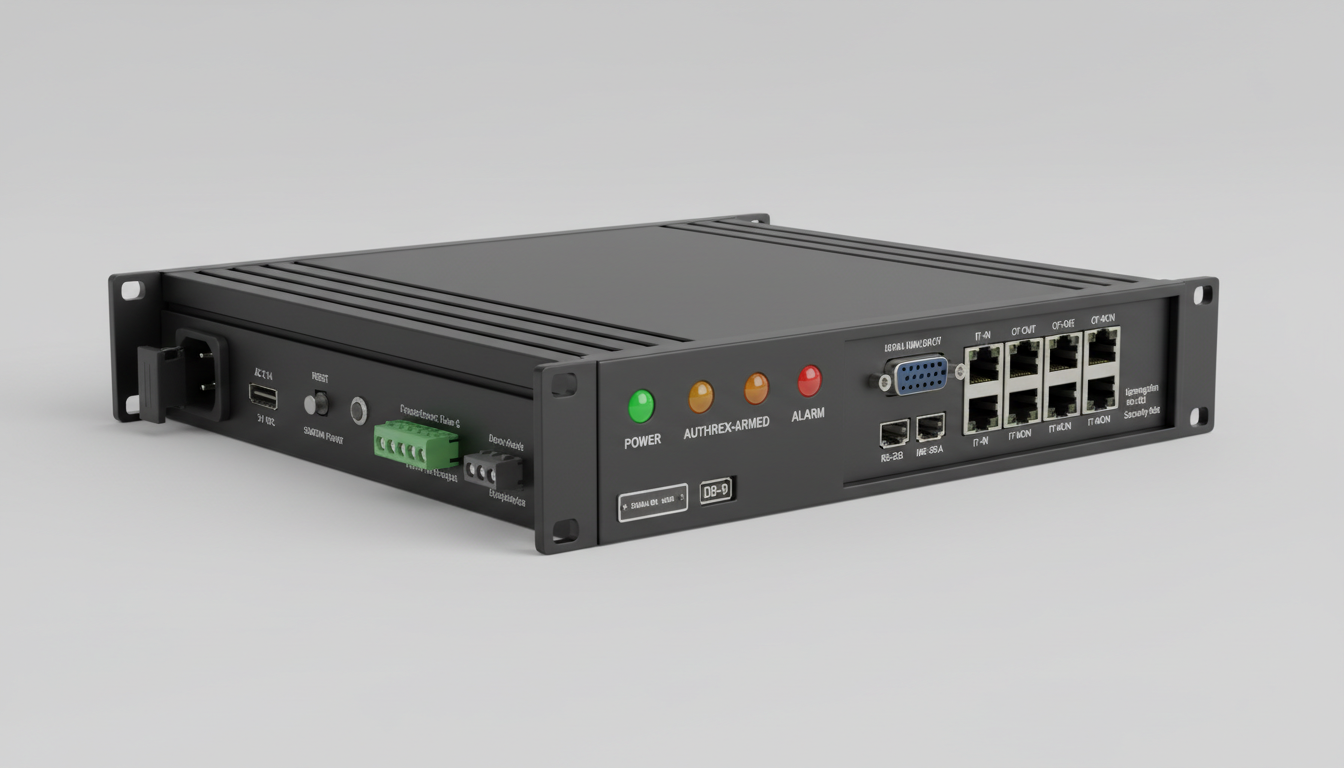
| blade-infra-ot-render.png | Reference appliance rendering (1U fanless) | May 2026 |
| blade-infra-ot-PARTS.csv | Bill of materials, 48 line items (CSV) | May 2026 |
| blade-infra-ot-ELECTRICAL.json | Electrical connection graph (35 connections) | May 2026 |
| blade-infra-ot-MECHANICAL.json | Mechanical connection graph (42 connections) | May 2026 |
| blade-infra-ot-CONFIG.json | Project configuration and node metadata | May 2026 |
| LICENSE | CC BY 4.0 | May 2026 |
BLADE-INFRA-OT Governance Node
Authority-Governed IT/OT Bridge for Cross-Boundary OT Command Adjudication
A research prototype and reference implementation of a fail-closed, bump-in-the-wire governance appliance positioned at the segmentation boundary between corporate information-technology (IT) networks and operational-technology (OT) control assets. Each cross-boundary message is parsed, scored, and adjudicated through the AUTHREX authority-governance pipeline before it is propagated, held for deliberation, or isolated. Ninth platform in the BLADE family; the operational-technology companion to BLADE-INFRA.
This is a research reference design and seeded simulation study (Hardware TRL 2-3; Simulation TRL 3-4). No hardware has been fabricated. No production deployment, live operational-technology corpus, penetration test, regulatory certification, or hardware-in-the-loop validation is claimed. All quantitative results are derived from the included seeded simulation environment.
Publication
DOI: 10.5281/zenodo.20342067
Author: Burak Oktenli · Georgetown University, M.P.S. Applied Intelligence (in progress)
ORCID: 0009-0001-8573-1667
License: CC BY 4.0 · Version: v1.0 · May 2026 · Document ID: ICD-INFRA-OT-001
Adjudication
Each cross-boundary command is resolved to one of three actions:
- Propagate - authorised under the current regime; forwarded to the OT side.
- Hold - ambiguous or elevated; held for human deliberation and operator clearance.
- Isolate - unauthorised, malformed, or failing a safety check; blocked and the source isolated.
Four OT authority regimes (NOMINAL, ELEVATED, LOCKDOWN, SAFE-HALT) change how strictly commands are adjudicated. Malformed input fails closed by default. Every decision is written to a seed-deterministic, SHA-256 hash-chained, tamper-evident audit ledger; the included simulator can verify the chain to detect tampering.
Reference Hardware (1U fanless)
- 48 BOM line items, 35 electrical connections, 42 mechanical connections.
- Governance plane and network plane: dual Xilinx Kria K26 industrial system-on-modules.
- Network fabric: managed industrial Ethernet switch with SFP+ ports (IT side and OT side).
- Root of trust: Microchip ATECC608 secure element; TPM 2.0 measured boot and authority-tier state.
- Safe state: Form C fault relay for fail-closed isolation of the OT segment.
- Power: primary DC/DC unit and secondary 24V input; system alarm and power indicator LEDs.
Commercial off-the-shelf components; selections are research reference placeholders.
Simulation Engine
- Four OT authority regimes and three adjudication outcomes.
- Fail-closed malformed-input handling; Byzantine and fault-injection scenarios.
- Time-dependent clock drift and operator-clearance delay modeling.
- Replay-grade traffic export, CSV metrics export, and external-dataset ingestion.
- Seed-deterministic SHA-256 tamper-evident audit ledger with chain verification.
Standards Alignment
- NIST SP 800-82 (Guide to Operational Technology Security).
- ISA/IEC 62443 (zones, conduits, and security levels for industrial control systems).
- NERC CIP (electronic security perimeter and access control concepts).
- NIST AI Risk Management Framework 1.0 (govern, map, measure, manage).
Alignment is a design-intent mapping for this research reference design; no certification or audit against these standards is claimed.
Related Work
- SATA:
10.5281/zenodo.18936251 - HMAA:
10.5281/zenodo.18861653 - CARA:
10.5281/zenodo.18917790 - ADARA:
10.5281/zenodo.19043924 - MAIVA:
10.5281/zenodo.19015517 - FLAME:
10.5281/zenodo.19015618 - BLADE-EDGE (defense):
10.5281/zenodo.19177472 - BLADE-AV (automotive):
10.5281/zenodo.19232130 - BLADE-MARITIME (maritime):
10.5281/zenodo.19246785 - BLADE-INFRA (critical infrastructure):
10.5281/zenodo.19277887 - BLADE-SPACE (orbital):
10.5281/zenodo.20183269 - BLADE-CUAS (counter-UAS):
10.5281/zenodo.20299604 - BLADE-AGENT-HSM (agentic AI):
10.5281/zenodo.20299821 - BLADE-SWARM (swarm autonomy):
10.5281/zenodo.20351198 - BLADE-FINANCE (financial sector):
10.5281/zenodo.20374692
Author
Burak Oktenli
Georgetown University, M.P.S. Applied Intelligence (in progress)
ORCID: 0009-0001-8573-1667
Website: burakoktenli.com