| blade-edge-simulation.html | Interactive governance simulator · 9-module pipeline v5.0.3 · 6 threat scenarios | Mar 2026 |
| blade-edge-project-repo.zip | Complete project files: schematics, BOM, config, diagrams | Mar 2026 |
| blade-edge-BLUEPRINT.pdf | Full engineering blueprint (72 components, 103 connections) | Mar 2026 |
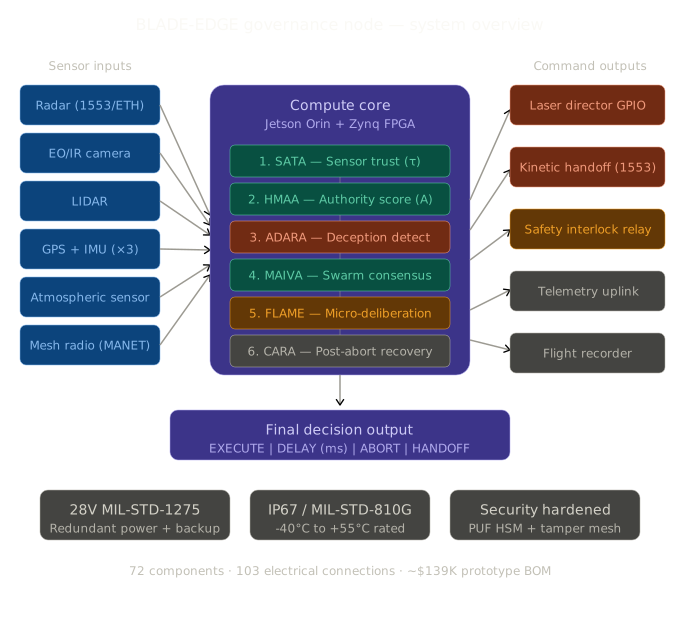
| blade-edge-system-overview.svg | System architecture diagram (sensor inputs → compute core → command outputs) | Mar 2026 |
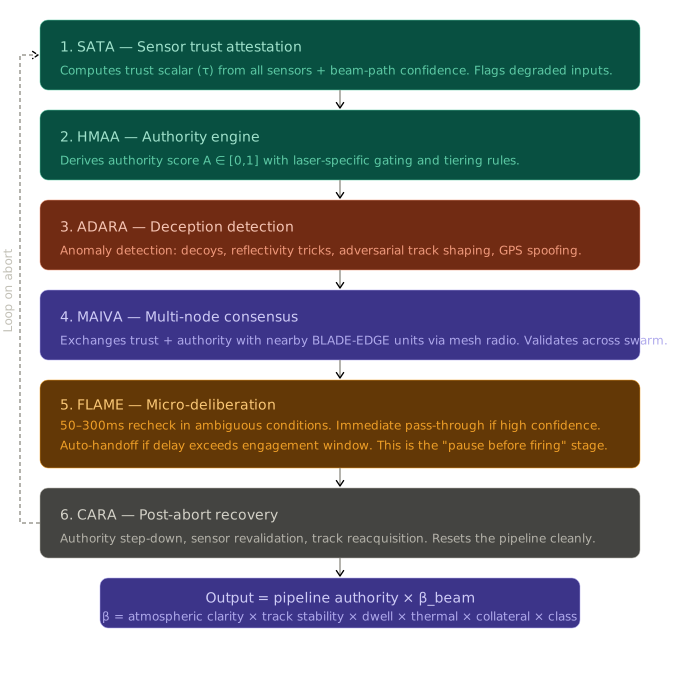
| blade-edge-pipeline.svg | 9-module governance pipeline diagram (SATA → ADARA → IFF → HMAA → MAIVA → FLAME → CARA → BDA → EFFECTOR) | Mar 2026 |
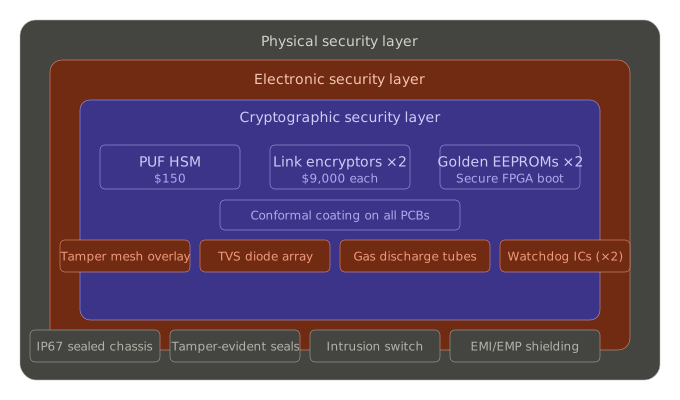
| blade-edge-security.svg | Three-layer security architecture (physical, electronic, cryptographic) | Mar 2026 |
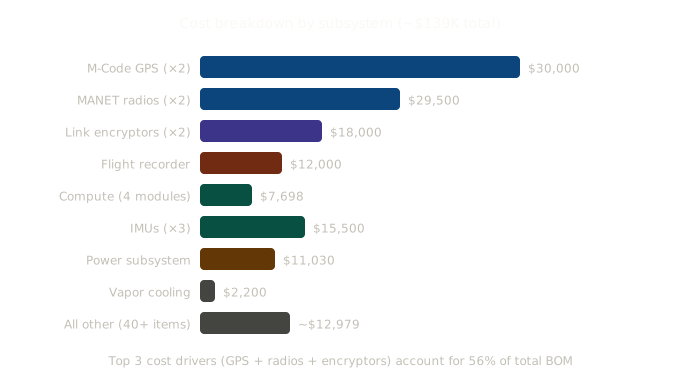
| blade-edge-bom.svg | BOM cost breakdown visualization ($138,908 across 8 subsystems) | Mar 2026 |
| blade-edge-schematic.png | Full system schematic (72 components, color-coded by type) | Mar 2026 |
| blade-edge-render.png | 3D render (ruggedized chassis, MIL-DTL-38999 connectors, vapor chamber) | Mar 2026 |
| LICENSE | CC BY 4.0 | Mar 2026 |
BLADE-EDGE Governance Node
Beam-Layer Authority for Directed Engagements, Edge Node
A rugged, portable edge computing device serving as the ethical decision-making authority for autonomous defense platforms. Implements the complete 9-module governance pipeline (SATA → ADARA → IFF → HMAA → MAIVA → FLAME → CARA → BDA → EFFECTOR) on dual-redundant compute hardware, determining in real-time whether systems should EXECUTE, DELAY, ABORT, or HANDOFF.
Publication
DOI: 10.5281/zenodo.19177472
Author: Burak Oktenli · Georgetown University, MPS Applied Intelligence
ORCID: 0009-0001-8573-1667
License: CC BY 4.0 · Version: v5.0.3 · March 2026
Key Specifications
- Compute: Dual NVIDIA Jetson AGX Orin 64GB + Dual Xilinx Zynq UltraScale+ FPGA
- Sensors: Radar, EO/IR, LIDAR, dual M-Code GPS, triple IMU, atmospheric
- Comms: Dual MANET mesh radios (MPU5 + AN/PRC-158), dual MIL-STD-1553 link encryptors
- Security: PUF HSM, tamper mesh, TVS/GDT protection, conformal coating
- Environment: IP67, MIL-STD-810G, -40°C to +55°C, <8kg, ~300×250×150mm
- Safety: Hardwired normally-open safety interlock relay (weapon cannot fire without full pipeline authority)
- BOM: ~$138,908 prototype, ~$60-80K at production scale (100+ units)
9-Module Pipeline (v5.0.3)
- SATA: Sensor trust attestation with beam-path confidence integration
- ADARA: Adversarial deception detection (kinematic anomaly, thermal gap, RCS variance, GPS spoofing)
- IFF: Identification Friend-or-Foe (Mode-4/5 crypto challenge, 3-cycle interrogation)
- HMAA: Authority computation with laser-specific gating and tiering
- MAIVA: Multi-agent swarm consensus over encrypted mesh (Byzantine bound as design basis)
- FLAME: Latency-aware micro-deliberation (50-300ms hold windows)
- CARA: Control authority regulation (Alert → Degraded → Lockout → Restoring)
- BDA: Battle damage assessment with re-engagement authorization
- EFFECTOR: Hungarian algorithm WTA optimizer for heterogeneous multi-effector assignment
Threat Scenarios (Simulator)
- Ballistic, clean single-missile engagement
- Saturation attack, 3 simultaneous targets
- IFF friendly, friendly aircraft identification and engagement block
- GPS spoofing, GPS-IMU disagreement detection
- Dust storm, atmospheric degradation and beam handoff
- HOTL veto, human-on-the-loop override
Related Work
- SATA:
10.5281/zenodo.18936251 - HMAA:
10.5281/zenodo.18861653 - CARA:
10.5281/zenodo.18917790 - ADARA:
10.5281/zenodo.19043924 - MAIVA:
10.5281/zenodo.19015517 - FLAME:
10.5281/zenodo.19015618
Author
Burak Oktenli
Georgetown University, M.P.S. Applied Intelligence (in progress)
ORCID: 0009-0001-8573-1667
Website: burakoktenli.com