Defense Hardware Research Platform

BLADE-EDGE Governance Node

BLADE-EDGE = Beam-Layer Authority for Directed Engagements — Edge Node

A rugged, portable edge computing device that serves as the ethical decision-making authority for autonomous defense platforms — determining in real-time whether systems should EXECUTE, DELAY, ABORT, or HANDOFF based on multi-sensor trust consensus.

Design Complete · Published on Zenodo · DOI: 10.5281/zenodo.19177472

This is NOT a weapon. It is a governance layer — a hardware-enforced ethical checkpoint that sits between autonomous defense systems and lethal action. It implements the human-judgment requirements mandated by DoD Directive 3000.09 directly in silicon and firmware.

Launch Governance Simulator Zenodo Record Repository Evaluation Protocol SDK Integration
Type: Defense Hardware Research Focus: Autonomous Weapons Governance · Edge AI · Directed-Energy Systems Status: Design Complete · Prototype Specification DOI: 10.5281/zenodo.19177472

Key Contributions

  • Hardware-enforced ethical checkpoint implementing DoDD 3000.09 in silicon
  • Complete 9-module governance pipeline (SATA → ADARA → IFF → HMAA → MAIVA → FLAME → CARA → BDA → EFFECTOR) on edge hardware
  • Dual-redundant compute architecture: NVIDIA Jetson AGX Orin + Xilinx Zynq UltraScale+ FPGA
  • Physically hardwired normally-open safety interlock — weapon cannot fire without full pipeline authority
  • Byzantine fault-tolerant swarm consensus over encrypted MANET mesh radio
  • Multi-sensor deception detection across radar, EO/IR, LIDAR, GPS, IMU, and atmospheric sensors
  • Production-path design: 72 components, MIL-STD-810G rated, ~$139K prototype (~$80K at scale)

Zenodo Publication: Oktenli, B. (2026). BLADE-EDGE: A Deterministic Governance Simulation Framework for Multi-Agent Decision Systems (5.0.3). Zenodo. https://doi.org/10.5281/zenodo.19177472
72
Components
103
Connections
6
Pipeline Stages
~$139K
Prototype BOM
<300ms
Decision Latency
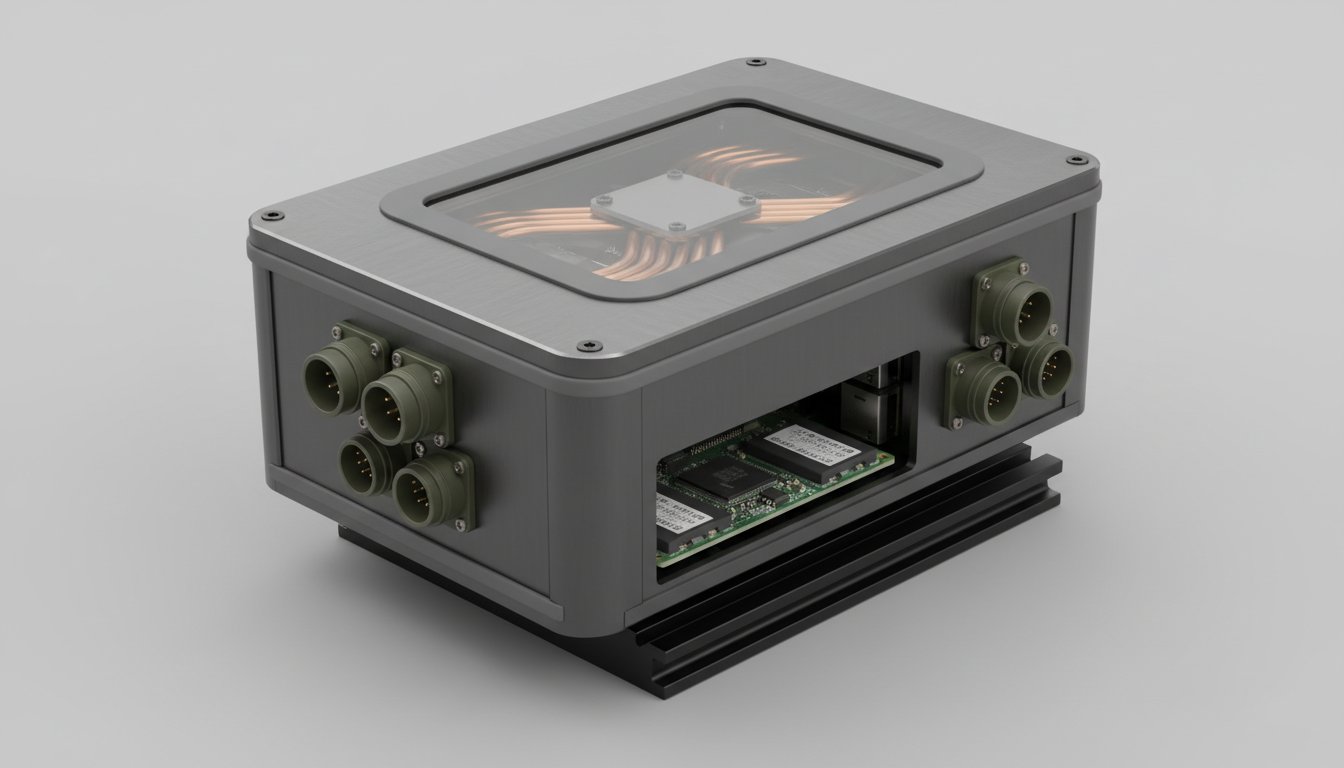
BLADE-EDGE Governance Node 3D render showing ruggedized aluminum chassis with MIL-DTL-38999 military connectors, vapor chamber cooling, and NATO rail mounting
BLADE-EDGE Governance Node: Ruggedized aluminum chassis, MIL-DTL-38999 connectors, vapor chamber cooling, NATO rail mount. ~300x250x150mm, under 8kg.

National Importance

Autonomous defense systems — directed-energy weapons, interceptor drones, and swarm platforms — can react in milliseconds, far faster than any human operator. As these systems proliferate, the critical question shifts from "can they act?" to "should they act?"

Current autonomous systems face critical governance challenges: no standardized hardware governance layer exists (most rely on software-only rules that can be bypassed or fail silently), single-sensor systems are vulnerable to spoofing and deception, individual platforms make isolated decisions without cross-validating with friendly units, and cloud-based governance introduces unacceptable latency for tactical engagements.

The BLADE-EDGE Governance Node directly addresses DoD Directive 3000.09, which requires "appropriate levels of human judgment" in autonomous weapon systems. This device implements that requirement at the hardware level — with a physically hardwired normally-open safety interlock that literally cannot close unless the full 9-module governance pipeline confirms authority.

Research Problem

Autonomous defense systems face a fundamental governance challenge: they can react in milliseconds, but no standardized hardware exists to enforce rules of engagement at machine speed. Current approaches rely on software-only governance that can be bypassed, corrupted, or fail silently under adversarial conditions.

The BLADE-EDGE Governance Node addresses five specific capability gaps:

No standardized hardware governance layer for autonomous weapons
Single-sensor systems vulnerable to spoofing and deception
No cross-platform consensus — isolated decision-making
Cloud governance introduces unacceptable latency (50-300ms budget)
DoDD 3000.09 requires "appropriate levels of human judgment" but no hardware enforces this

This platform demonstrates that authority-governed autonomy can be implemented at the hardware level for defense applications, with physically enforced safety interlocks, multi-sensor cross-validation, and swarm consensus — capabilities that software-only approaches cannot guarantee.

Directed-Energy Weapon Governance Platform

The BLADE-EDGE extends the authority-governed autonomy framework to directed-energy weapon systems, where engagement decisions must account for beam-specific factors that kinetic weapons do not face. The final authority computation includes a beam suitability scalar (β_beam) that gates the pipeline output based on physical engagement feasibility.

Beam-Path Confidence Factors

Atmospheric clarity (humidity, obscurants, turbulence), track stability, dwell feasibility, thermal cooldown margin, collateral exclusion confidence, target classification

Handoff Capability

If beam conditions are unfavorable (atmospheric turbulence, thermal limits exceeded), the system can automatically HANDOFF to a kinetic interceptor via MIL-STD-1553, maintaining engagement authority while switching effectors

This extension demonstrates that authority-governed autonomy is not limited to navigation or surveillance systems but can govern lethal engagement decisions where the governance layer must operate at machine speed while maintaining human-judgment requirements.

System Overview

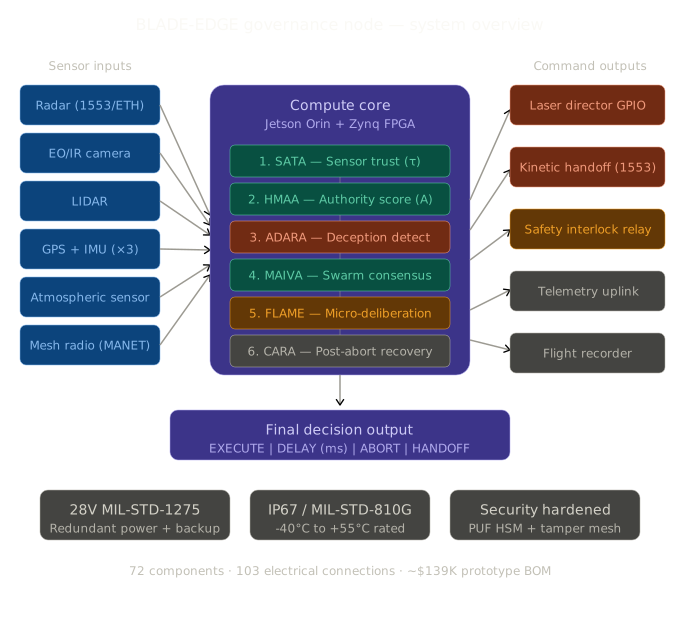
The BLADE-EDGE receives data from six sensor categories, processes it through a 9-module governance pipeline on dual-redundant compute hardware, and outputs one of four decisions: EXECUTE, DELAY, ABORT, or HANDOFF.

BLADE-EDGE System Overview showing sensor inputs, compute core, and command outputs

9-Module Governance Pipeline

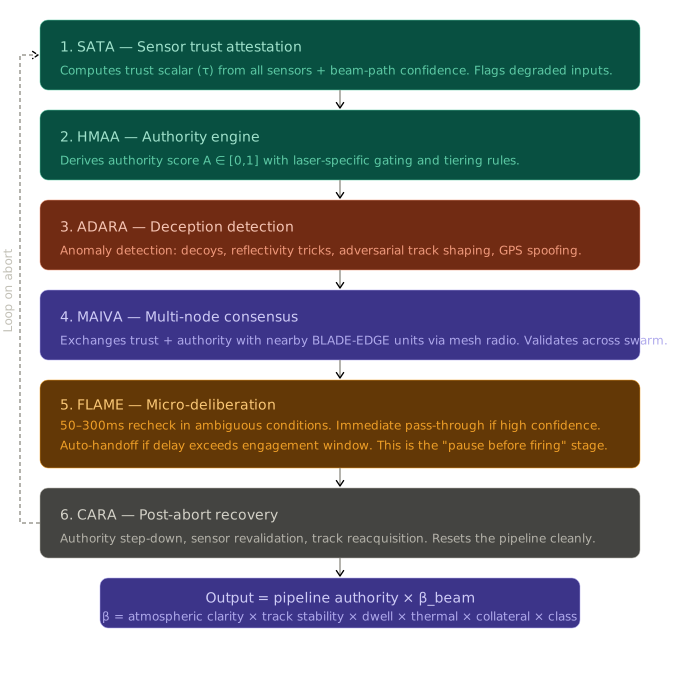
Every engagement decision passes through nine sequential modules targeting 50-300ms end-to-end latency. Each stage can independently trigger an ABORT, preventing downstream execution.

BLADE-EDGE 9-module governance pipeline: SATA, HMAA, ADARA, MAIVA, FLAME, CARA

Stage 1: SATA — Sensor Trust Attestation

Computes trust scalar τ from ALL sensor inputs combined with beam-path confidence scoring. Atmospheric sensors measuring humidity, obscurants, and turbulence feed directly into trust computation because a clear sensor picture is useless if the beam cannot reach the target.

Stage 2: ADARA — Adversarial Deception-Aware Risk Assessment

GPU-accelerated anomaly detection targeting decoys, reflectivity manipulation, adversarial track shaping, GPS spoofing, and sensor-to-sensor inconsistency. Any deception flag independently triggers ABORT.

Stage 3: IFF — Identification Friend or Foe

Verifies target classification against known friendly signatures. Prevents fratricide through cryptographic IFF challenge-response before authority confirmation.

Stage 4: HMAA — Human-Machine Authority Architecture

Derives authority score A with laser-specific gating: target classification tiers, engagement authorization levels, dwell feasibility, atmospheric propagation, and thermal management before granting authority.

Stage 5: MAIVA — Multi-Agent Integrity Verification

Exchanges trust and authority values with nearby BLADE-EDGE units via encrypted MANET mesh radio. Byzantine fault-tolerant consensus ensures no single compromised node can fool the swarm.

Stage 6: FLAME — Flash War Latency Architecture

Enforces 50-300ms recheck windows before firing in ambiguous conditions. Three modes: immediate pass-through (high confidence), micro-deliberation (ambiguous), auto-handoff (engagement window exceeded).

Stage 7: CARA — Control Authority Regulation

Post-abort recovery: steps authority to zero, revalidates all sensors from scratch, re-acquires target track, feeds back to SATA for fresh trust computation. Prevents false confidence buildup from abort cycling.

Stage 8: BDA — Battle Damage Assessment

Post-engagement sensor revalidation. Confirms engagement outcome, updates target track state, and feeds back to SATA for trust recomputation before next engagement cycle.

Stage 9: EFFECTOR — Hardware Safety Interlock

Normally-open hardwired safety relay. Closes ONLY when the full 9-module pipeline confirms authority. Physical circuit break prevents engagement without verified governance chain.

Final Decision = Pipeline Authority × β_beam

β_beam factors: atmospheric clarity, track stability, dwell feasibility,
thermal cooldown margin, collateral exclusion confidence, target class,
handoff availability

Output: EXECUTE | DELAY (ms) | ABORT | HANDOFF (effector ID)

Authority Decision Model

The BLADE-EDGE outputs one of four decisions based on pipeline authority and beam suitability. Unlike binary fire/no-fire systems, the governance model provides graduated response with automatic effector handoff.

EXECUTE

Full pipeline authority confirmed. Beam conditions favorable (β_beam > threshold). Safety interlock relay closes. Engagement authorized.

DELAY (ms)

Ambiguous conditions detected by FLAME. System holds for 50-300ms micro-deliberation, re-queries sensors, re-runs ADARA, re-checks MAIVA consensus.

ABORT

Trust collapse, deception detected, or consensus failure. Safety interlock remains open. CARA recovery initiates: authority zeroed, sensors revalidated from scratch.

HANDOFF (effector ID)

Pipeline authority confirmed but beam conditions unfavorable (atmospheric turbulence, thermal limits). Engagement transferred to kinetic interceptor via MIL-STD-1553.

The safety interlock relay is physically hardwired normally-open — the weapon literally cannot fire unless the BLADE-EDGE actively confirms full authority through all six pipeline stages. This is hardware-enforced governance, not software-only.

Sensor-Anchored Trust Assessment (SATA)

The BLADE-EDGE implements SATA trust evaluation across six sensor categories simultaneously. Each feed is independently evaluated for signal integrity, noise floor, expected pattern consistency, and cross-correlation with other sensors. The output is a single trust scalar τ ∈ [0,1].

Trust(s_i) = weighted belief function with beam-path confidence integration.
Cross-sensor validation: radar + EO/IR + LIDAR + GPS/IMU + atmospheric.
A degraded GPS signal reduces τ even if radar is strong.
Atmospheric sensors feed directly into trust computation (beam propagation feasibility).

Key innovation: beam-path confidence is integrated at the trust layer rather than post-pipeline. Atmospheric sensors measuring humidity, obscurants, and turbulence feed directly into SATA because a clear sensor picture is useless if the directed-energy beam cannot reach the target. This tight coupling between sensing and beam physics is unique to BLADE-EDGE.

Hardware Architecture

72 components across 8 subsystems with full dual-redundancy on all critical paths.

Compute Subsystem ($10,948)

ComponentProductQtyCostRole
Primary GPUNVIDIA Jetson AGX Orin 64GB1$1,999AI inference: ADARA, SATA, sensor fusion
Backup GPUNVIDIA Jetson AGX Orin 64GB1$1,999Hot standby failover
Primary FPGAXilinx Zynq UltraScale+1$1,850Real-time deterministic preprocessing
Backup FPGAXilinx Zynq UltraScale+1$1,850Hot standby failover
Carrier BoardBLADE-EDGE Custom PCB1$500Jetson + FPGA bridge, all interfaces
MIL-STD-1553Condor PCIe Card1$700Legacy military bus communication

Sensor Subsystem ($47,480)

ComponentQtyCostRole
M-Code GPS Receiver (BAE Systems)2$15,000 eaEncrypted military GPS, immune to jamming/spoofing
Tactical MEMS IMU (Honeywell HG1120)1$8,500Primary inertial navigation
Tactical MEMS IMU (ADI ADIS16505)2$3,500 eaTriple-redundant IMU voting
Industrial LIDAR1$1,800Point cloud target verification
Atmospheric Sensor (BME688)1$180Beam-path confidence scoring

Communications ($47,500)

ComponentQtyCostRole
MANET Radio (Persistent Systems MPU5)1$11,500Swarm consensus mesh
MANET Radio (L3Harris AN/PRC-158)1$18,000Redundant mesh
MIL-STD-1553 Link Encryptor2$9,000 eaMilitary bus encryption

Power and Redundancy Architecture

Every critical subsystem has a backup. The system continues operating with any single component failure. Power is fully dual-redundant with OR-diode isolation, battery backup for 5-minute graceful shutdown, and supercapacitor ride-through for power transients.

Redundancy Matrix

PrimaryBackupFailover
Jetson AGX OrinJetson AGX Orin (backup)Hot standby, auto switchover
Zynq UltraScale+Zynq UltraScale+ (backup)Hot standby
NVMe SSDNVMe SSD (redundant)RAID-1 mirroring
Ethernet SwitchEthernet Switch (redundant)Failover routing
MANET Radio (MPU5)MANET Radio (AN/PRC-158)Auto frequency hopping
M-Code GPS 1M-Code GPS 2Cross-validation + failover
IMU 1 (HG1120)IMU 2 + 3 (ADIS16505)Triple-redundant voting (2-of-3)
MIL-STD-1275 PSURedundant PSUOR-diode isolation
Battery Backup 1Battery Backup 2Automatic failover
Link Encryptor 1Link Encryptor 2Bus A/Bus B redundancy

Power Flow

28V DC Input (MIL-STD-1275)
  ├→ EMI Filter 1 → Power Module 1 ─┐
  └→ EMI Filter 2 → Power Module 2 ─┤
                                       ├→ OR-Diode → PDU
Battery Backup 1 ─────────────────────┤
Battery Backup 2 ─────────────────────┘
Supercapacitor Bank ── (ride-through) ──→ PDU
PDU → DC-DC Converters → 12V / 5V / 3.3V → All Subsystems

Three-Layer Security

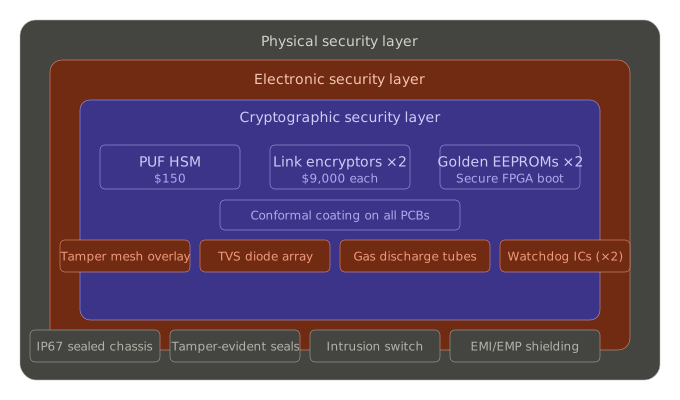
BLADE-EDGE three-layer security: physical, electronic, cryptographic

Layer 1: Physical

IP67 sealed aluminum chassis, MIL-STD-810G rated, tamper-evident seals, chassis intrusion switch, EMI/EMP shielding with BeCu gaskets + TVS diodes + gas discharge tubes.

Layer 2: Electronic

Tamper mesh overlay (breaks if probed), TVS protection array, antenna surge protection, dual hardware supervisor/watchdog ICs forcing reset on compromise.

Layer 3: Cryptographic

PUF HSM generating unclonable keys from silicon variations, dual MIL-STD-1553 link encryptors ($9K each), dual secure FPGA EEPROMs, conformal coating on all PCBs.

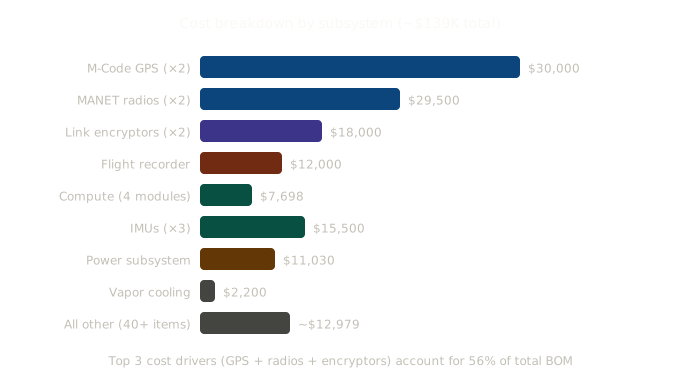
Bill of Materials: $138,908

BLADE-EDGE BOM cost breakdown by subsystem
SubsystemCost%
Communications (MANET + Encryptors)$47,50034.2%
Sensors (GPS + IMU + LIDAR + Atmo)$47,48034.2%
Power (PSU + Battery + Caps + PDU)$12,4809.0%
Actuation (Flight Recorder + GPIO + Relay)$12,0658.7%
Compute (Jetson + Zynq + SSD + Switch)$10,9487.9%
Enclosure and Thermal$3,8252.8%
Connectors and Wiring$3,5312.5%
Security (PUF + Tamper + TVS)$1,0790.8%

The top 3 cost drivers (GPS + radios + encryptors) account for 56% of the BOM. These are military-controlled items whose cost decreases significantly in production quantities. Production units (100+) estimated at $60-80K per unit.

Physical Specifications

Dimensions~300 x 250 x 150mm
Weight< 8 kg
EnvironmentalIP67 / MIL-STD-810G
Temperature-40°C to +55°C
Power28V MIL-STD-1275
Power Draw150-250W
CoolingVapor chamber + sealed fan
MountingNATO rail / drone hardpoint

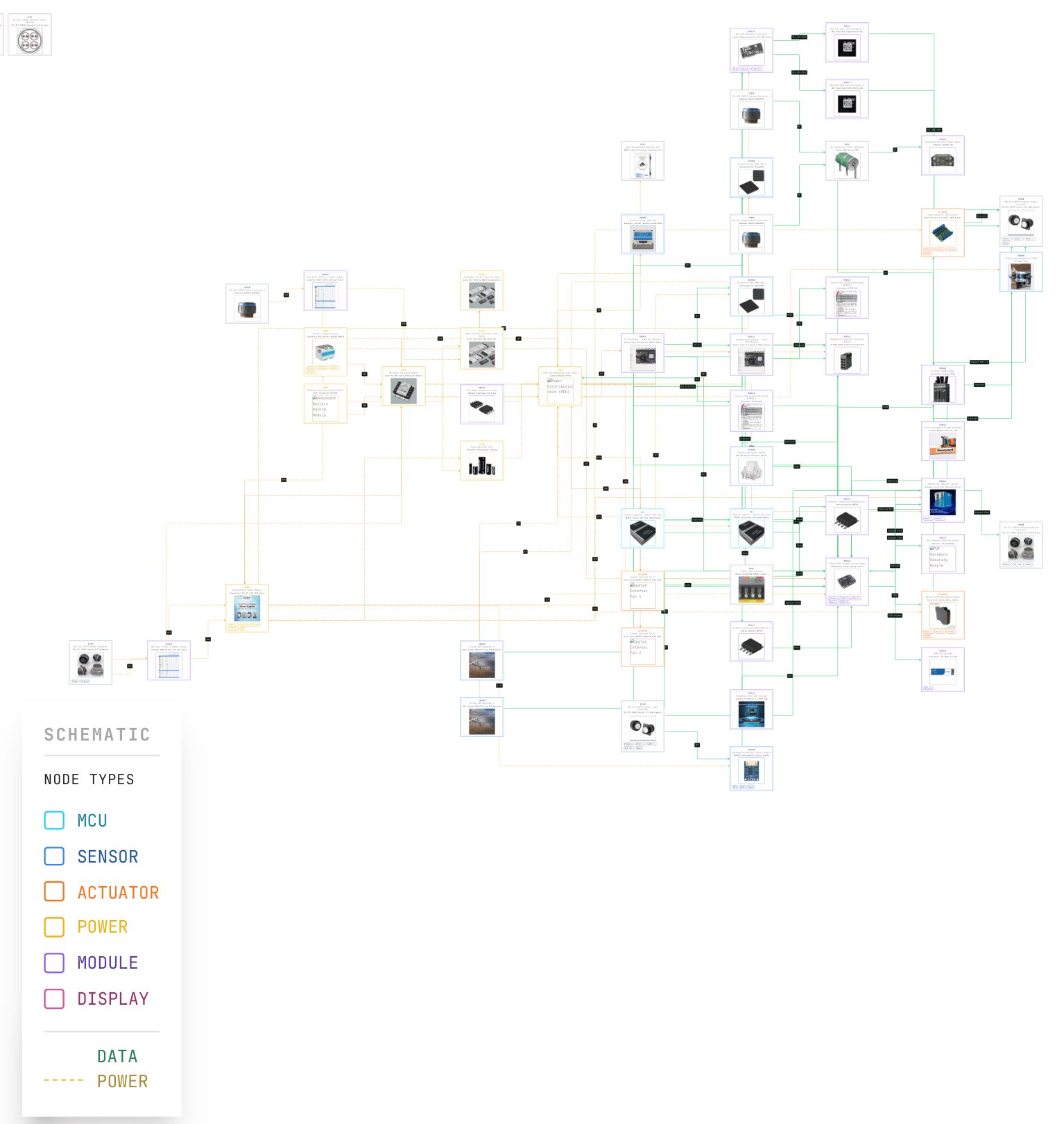
System Schematic

72 components, 103 electrical connections (53 power + 50 data). Full dual-redundancy on all critical paths.

BLADE-EDGE full system schematic showing all 72 components and 103 connections
Download Full Blueprint (PDF) ↗

Governance Simulation Environment

The BLADE-EDGE simulation environment executes the complete 9-module governance pipeline in real-time with configurable scenarios, multi-target tracking, and heterogeneous effector assignment. The simulator mirrors the hardware pipeline architecture, enabling direct validation of governance behavior before physical prototype fabrication.

This simulation demonstrates executable validation of the defense-grade governance pipeline — not conceptual design alone. Every decision visible in the simulator corresponds to the exact same pipeline logic that would execute on the Jetson AGX Orin + Zynq UltraScale+ hardware.

9-Module Pipeline

SATA → ADARA → IFF → HMAA → MAIVA → FLAME → CARA → BDA → EFFECTOR

6 Threat Scenarios

Ballistic, saturation attack, IFF friendly, GPS spoofing, dust storm, human-on-the-loop veto

Multi-Effector WTA

Hungarian algorithm optimizer assigning laser, kinetic, and dazzle effectors to simultaneous targets

Simulation Capabilities

Pipeline versionBLADE-EDGE v5.0.3 Pipeline modules9 (SATA, ADARA, IFF, HMAA, MAIVA, FLAME, CARA, BDA, EFFECTOR) Sensor modelingRadar, EO/IR, LIDAR, GPS/IMU, atmospheric, MANET mesh Deception detectionADARA: kinematic anomaly, thermal gap, RCS variance, GPS spoofing, LIDAR sparse IFF integrationMode-4/5 crypto challenge, 3-cycle interrogation, transponder timeout Threat scenariosBallistic, saturation (3 targets), IFF friendly, GPS spoof, dust storm, HOTL veto Effector assignmentHungarian algorithm WTA: laser (Pk 0.85-0.90), kinetic (Pk 0.40-0.70), dazzle Beam physicsβ_beam: LOS clarity, atmospheric, track stability, thermal cooldown, collateral exclusion MAIVA consensus3-node mesh with packet loss, latency jitter, Byzantine divergence detection CARA recoveryAlert → Degraded → Lockout → Restoring states with clean-frame tracking Latency budget50-300ms FLAME hold window with automatic handoff on expiry Battle damage assessmentPost-engagement BDA with re-engagement authorization if target survives

Research Simulation Environment (v5.0.3). This environment validates governance behavior across all 9 pipeline modules with real-time multi-target tracking and heterogeneous effector assignment. All computations run client-side in the browser.

Launch Governance Simulator (v5.0.3)

Role in the Governance Stack

The BLADE-EDGE Governance Node represents the defense-grade implementation of the authority-governed autonomy framework. All seven governance architectures (SATA, HMAA, ADARA, MAIVA, FLAME, CARA, ERAM) are deployed in hardware form within this platform, extending the research from simulation to a production-specification system designed for real-world contested environments.

Related platforms: Rover Testbed (~$484) · UAV Platform (~$4,200) · BLADE-EDGE (defense, ~$139K) · BLADE-AV (automotive, ~$16K) · BLADE-MARITIME (maritime, ~$43K) · BLADE-INFRA (infrastructure, ~$12K). Six platforms demonstrating governance stack portability across four domains.

Validation Metrics

72
Hardware components specified
103
Electrical connections defined
6
Governance pipeline stages
8
Subsystems with full BOM
10
Redundant component pairs
6
Sensor categories fused

Experimental Program

Seven planned experiments designed to validate the BLADE-EDGE governance pipeline under increasingly adversarial conditions. Each experiment measures decision correctness, latency compliance, and safety interlock behavior.

  1. 1Single-Sensor Spoofing: Inject false LIDAR returns while radar and EO/IR remain clean. Measure SATA cross-validation penalty and trust decay rate.
  2. 2GPS Spoofing Detection: Inject false GPS coordinates. Verify ADARA detects GPS-IMU disagreement and triggers authority reduction.
  3. 3Swarm Consensus Failure: Compromise one BLADE-EDGE node in a multi-unit mesh. Verify MAIVA Byzantine consensus rejects the compromised unit.
  4. 4Atmospheric Degradation: Simulate turbulence and obscurant conditions. Verify beam suitability scalar β_beam drops and system issues HANDOFF to kinetic effector.
  5. 5FLAME Micro-Deliberation: Create ambiguous target conditions. Measure deliberation window timing (50-300ms) and verify re-query of ADARA and MAIVA before decision.
  6. 6Compound Attack: Simultaneous GPS spoofing + LIDAR injection + atmospheric degradation. Verify pipeline issues ABORT, safety interlock remains open, CARA recovery activates.
  7. 7End-to-End Recovery: Full scenario — compound attack, trust collapse, ABORT, CARA recovery, sensor revalidation, trust restoration, mission resumption. Measure total recovery latency.

Each experiment targets minimum 30 trials for statistical significance. Metrics: decision correctness, end-to-end latency, safety interlock state, false positive rate, recovery time.

Project Status

System architecture design (72 components)
Full electrical design (103 connections)
Bill of materials verified ($138,908)
9-module governance pipeline specified
Security architecture (3-layer)
Redundancy matrix (10 pairs)
Thermal management design
MIL-STD compliance mapping
Custom carrier board fabrication
ITAR-controlled component procurement
Prototype assembly and integration
Physical testing and data collection
Current Limitations: Prototype not yet fabricated. Custom carrier board requires design and validation. M-Code GPS receivers and link encryptors are ITAR-controlled and require appropriate procurement channels. Software pipeline development depends on hardware availability. Full MIL-STD-810G certification requires independent testing facility.

Project Documentation

Complete engineering documentation for the BLADE-EDGE Governance Node. All files are original work by Burak Oktenli.

Complete Project Files (ZIP) — Schematics, BOM, config, blueprint Governance Simulator (v5.0.3) Full Blueprint (PDF) System Overview (SVG) Pipeline Diagram (SVG) Security Architecture (SVG) BOM Breakdown (SVG) System Schematic (PNG) 3D Render (PNG)

Reproducible Research Artifacts

This project provides complete reproducible artifacts enabling independent verification of the system design, component selection, and governance architecture.

System Design

Full blueprint PDF, system overview SVG, pipeline diagram SVG, security architecture SVG, 3D render. Complete electrical schematic with all 103 connections.

Hardware

72-component BOM with verified sources across 8 subsystems. All components commercially available (some ITAR-controlled). Cost breakdown with production scaling estimates.

Experiment Protocol

7 defined experiments targeting sensor spoofing, GPS manipulation, swarm consensus failure, atmospheric degradation, and compound attacks. 30+ trials each.

Standards Compliance

MIL-STD-810G (environmental), MIL-STD-1275 (power), IP67 (sealing), MIL-DTL-38999 (connectors), MIL-DTL-27500 (wiring), DoDD 3000.09 (autonomy).

Future Work

The BLADE-EDGE design specification represents the first phase. Future work focuses on physical realization and operational validation.

Prototype Fabrication

Custom carrier board design and validation, ITAR component procurement, system assembly and integration testing

Directed-Energy Integration

Field evaluation with directed-energy weapon platforms and counter-UAS systems in controlled test environments

Swarm Validation

Multi-unit MAIVA consensus testing over encrypted MANET mesh, Byzantine fault injection, swarm governance validation

MIL-STD Certification

Independent MIL-STD-810G environmental testing, EMI/EMP validation, and safety certification at accredited facility

Production Scaling

Cost optimization for 100+ unit production runs (~$60-80K per unit), defense procurement pathway, ITAR compliance documentation

SDK Integration

The BLADE Governance SDK provides a unified API across all four domains. The same blade_governance library drives defense weapons governance (BLADE-EDGE), autonomous vehicle authority (BLADE-AV), maritime surveillance (BLADE-MARITIME), and critical infrastructure protection (BLADE-INFRA). Only the domain configuration file changes.

blade_edge.yaml Defense (Directed Energy)
domain: defense
pipeline: SATA → ADARA → IFF → HMAA → MAIVA → FLAME → CARA → BDA → EFFECTOR

sensors:
  - id: radar_track
    type: phased_array_radar
    weight: 0.30
    cross_validate: [eo_ir, lidar_ranger]
  - id: eo_ir
    type: electro_optical_infrared
    weight: 0.25
    cross_validate: [radar_track, lidar_ranger]
  - id: lidar_ranger
    type: beam_path_lidar
    weight: 0.25
    cross_validate: [radar_track, eo_ir]
  - id: iff_transponder
    type: mode_5_crypto
    weight: 0.20
    cross_validate: [radar_track]

effector:
  type: directed_energy_weapon
  relay: normally_open_interlock
  safety_standard: DoDD_3000_09
  engagement_gate: HOTL_required
  fail_safe: beam_disable_on_loss

authority:
  A3_threshold: 0.80  # Full engagement authority
  A2_threshold: 0.55  # Tracking only, no engagement
  A1_threshold: 0.30  # Passive monitoring
  A0_action: beam_safe  # Hardware interlock opens
  hysteresis_up_s: 10
  hysteresis_down_s: 0  # Immediate downgrade
integration_example.py Python
import blade_governance as bg

# Initialize with defense domain config
pipeline = bg.GovernancePipeline("blade_edge.yaml")

# In your weapon system control loop (100Hz):
while mission_active:
    sensors = get_sensor_readings()
    
    result = pipeline.evaluate(sensors)
    # result.trust         → 0.87
    # result.authority     → "A3"
    # result.deception_p   → 0.04
    # result.flame_hold_ms → 0
    # result.execute       → True
    
    if result.execute:
        effector.engage(result.envelope)
    elif result.authority == "A0":
        pipeline.cara_recover()  # GREP phases
ROS 2 Topic Map
# ROS 2 Topic Map — Defense
/blade/sata/fused_trust          # Float64 τ ∈ [0,1]
/blade/hmaa/authority_level      # UInt8 {A3,A2,A1,A0}
/blade/hmaa/command_envelope     # EnvelopeMsg
/blade/flame/circuit_breaker     # UInt8 state
/blade/flame/deliberation_ms     # UInt32 hold time
/blade/cara/grep_phase           # String {GUARD,REDUCE,EVALUATE,PROMOTE}
/blade/effector/interlock_state  # Bool (relay open/closed)
/blade/adara/deception_prob      # Float64 P(adversarial)
/blade/bda/revalidation          # TrustRevalidation
Unified API Surface SAME ACROSS ALL 4 DOMAINS
# Core API — domain-agnostic
pipeline = bg.GovernancePipeline(config)
result   = pipeline.evaluate(sensors)
recovery = pipeline.cara_recover()

# result object — universal fields
result.trust          # Float64  τ ∈ [0,1]
result.authority      # String   {A3,A2,A1,A0}
result.deception_p    # Float64  P(adversarial)
result.flame_hold_ms  # UInt32   deliberation window
result.execute        # Bool     action permitted
result.relay_state    # Bool     hardware interlock
result.grep_phase     # String   CARA state

# Lifecycle
pipeline.get_audit_chain()   # Hash-chained log
pipeline.export_forensics()  # BLADE-BLACKBOX
pipeline.get_config()        # Current domain cfg

Cross-Domain Portability: The blade_governance SDK uses the same evaluate()result API across all four domains. Switching from defense weapons governance to autonomous vehicle authority requires changing only the YAML configuration file — not the application code. This is how the same governance pipeline operates under DoDD 3000.09, ISO 26262 ASIL-D, MIL-STD-810G, and SIL 3 / NERC CIP simultaneously.

About This Project

The BLADE-EDGE Governance Node is part of the authority-governed autonomy research program by Burak Oktenli at Georgetown University (M.P.S. Applied Intelligence). It demonstrates mastery across 12 technical domains: GPU-accelerated edge AI, FPGA real-time processing, multi-sensor fusion, military standard compliance, hardware security architecture, distributed consensus, thermal management, power systems engineering, EMI/EMP hardening, real-time operating systems, autonomous systems ethics, and defense systems integration.

Related research architectures: SATA (sensor trust), HMAA (authority computation), CARA (recovery), MAIVA (multi-agent trust), FLAME (latency control), ADARA (deception-aware risk).

View full research portfolio →