BLADE-SWARM = Beam-Layer Authority for Directed Engagements, Swarm Node
A reference architecture and N=10 physical testbed that governs decision authority and audit across an attritable autonomous swarm. Each agent runs a Byzantine-fault-tolerant two-phase consensus, gated by computed peer trust (SATA), authority tier (HMAA), and weighted multi-agent voting (MAIVA), before the swarm commits to a coordinated action. The architecture is parameterised over N = 10 (physical testbed baseline), N = 50 (small-scale combined operation), and N = 500 (DAWG-class). It governs decision authority and audit; it does not govern weapons.
Reference Architecture (TRL 3-4 simulator and formal spec; TRL 2 testbed design) · Eighth BLADE Platform · DOI 10.5281/zenodo.20351198This is NOT a weapon and not a swarm-control autopilot. It is an authority-gating governance layer that sits between the swarm autonomy stack and any coordinated action, computing peer trust, authority tier, and a tamper-evident distributed audit ledger. It tolerates up to f = (N-1)/3 compromised agents per quorum and defaults to a safe halt under denied or degraded radio-frequency conditions.
BLADE-SWARM is the swarm-scale instantiation of the AUTHREX authority-governance architecture. Where the single-node BLADE platforms govern one autonomous system, BLADE-SWARM governs the collective decision: before a swarm commits to a coordinated action, a quorum of agents must agree, and that agreement must pass the same authority checks that govern a single node. The contribution is the protocol that makes this agreement Byzantine-fault-tolerant, authority-bound, and provable after the fact.
Each agent independently computes peer trust (SATA), evaluates the current authority tier (HMAA), and casts a weighted vote (MAIVA). A two-phase commit then requires an intersecting quorum to agree before the action proceeds. The protocol tolerates up to f = (N-1)/3 compromised or faulty agents per quorum, resists Sybil attacks through attested per-node identity, and halts safely by default when the radio-frequency environment is denied or degraded. Every step writes a signed entry into a hash-chained distributed audit ledger that is gossiped across the mesh, so the swarm's decisions remain reconstructable and tamper-evident.
Attritable autonomy at scale has moved from concept to acquisition priority. Public programs and challenges in this area, including DAWG-class autonomous operations, the Replicator initiative, and open swarm-autonomy challenges, emphasise large numbers of low-cost autonomous platforms acting in coordination. As these systems scale, the unsolved problem shifts from flying the swarm to governing it: who, or what, is authorized to commit the collective to an action, on what evidence, and how is that decision proven afterward, especially when communications are contested and some agents may be compromised.
BLADE-SWARM is a fundamental-research contribution toward that authority-governance problem. It treats the swarm as a distributed decision-maker whose commits must be both Byzantine-fault-tolerant and authority-gated, and whose actions must leave a tamper-evident record. The architecture governs decision authority and audit; it does not govern weapons and makes no empirical claims about specific systems, operations, or named officials.
Each agent runs a two-phase consensus protocol gated by three of the seven AUTHREX architectures. The protocol is designed so that no single compromised agent, and no minority faction up to the Byzantine bound, can cause the swarm to commit to an unauthorized action or to escalate its authority tier without an intersecting quorum.
Each agent computes a continuous trust score for every peer from attested identity, behavioural consistency, and audit-chain integrity. Low-trust peers are down-weighted in voting and excluded from quorum formation.
Four tiers (T3 autonomous, T2 supervised, T1 confirmed, T0 halt). Tier escalation requires quorum agreement; tier downgrade is asymmetric and can be triggered unilaterally for safety.
Sub-quorum decomposition with Dempster-Shafer weighted voting. A quorum-intersection bound guarantees safety as long as no more than f = (N-1)/3 agents per quorum are compromised.
FLAME contracts the deliberation window under threat density and expands it under ambiguity; CARA provides bounded-liveness recovery and isolates misbehaving agents with a corrective audit entry.
The same protocol and simulator are parameterised over three operating scales. The physical testbed validates the N=10 baseline; the simulator extends the analysis to combined-operation and DAWG-class scales.
BLADE-SWARM instantiates the AUTHREX governance pipeline at swarm scale. The pipeline runs once per proposed coordinated action; the consensus and authority stages require an intersecting quorum before the action is allowed to commit.
The protocol is specified in TLA+ (AUTHREX_SWARM.tla), refining the existing AUTHREX_MAIVA module with sub-quorum decomposition, Byzantine fault bounds, FLAME deliberation-window contraction, tier-downgrade asymmetry, and CARA bounded liveness. The specification was model-checked on a reduced-scale instance.
Tier ceiling, no-unauthorized-commit, quorum intersection, audit-chain integrity, and the Byzantine bound (S1 through S5). Each holds across all reachable states in the checked instance.
Eventual commit-or-abort, eventual tier restoration, and CARA termination (L1 through L3), establishing that the protocol makes progress and recovers under fault.
Model checking on a reduced-scale instance establishes the safety and liveness properties for that instance; it is not a proof for arbitrary N. The full specification, configuration, and verification report are included in the repository and the Zenodo deposit.
BLADE-SWARM is framed against the public policy and standards instruments that govern autonomous systems and AI risk. These are cited as context that the architecture is designed to support; no empirical claims are made about specific programs or officials.
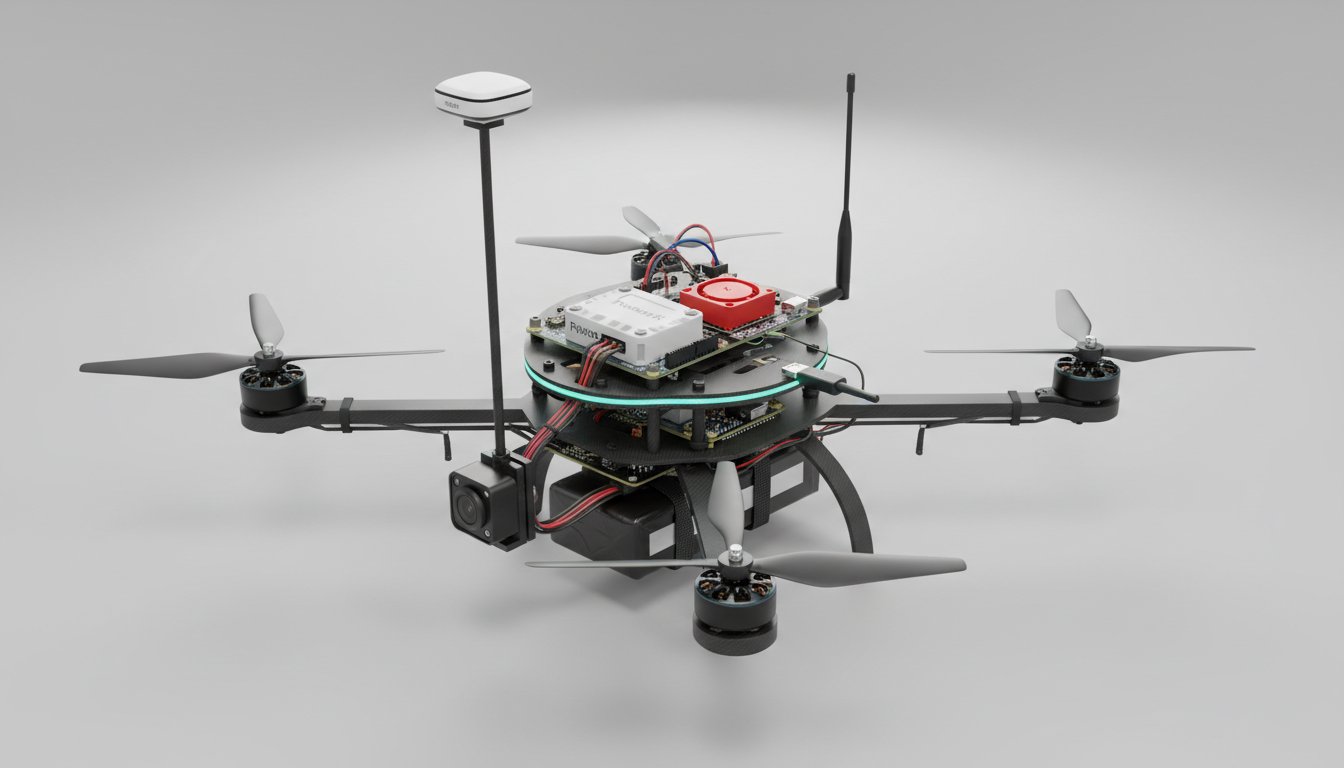
The reference node is a Holybro X500 V2 quadrotor with a COTS governance stack. One node is approximately $1,333; the N=10 testbed baseline is approximately $13.3K. The full parts list, electrical and mechanical connection maps, and assembly guide are in the repository.
| Subsystem | Component | Cost |
|---|---|---|
| Frame + propulsion | Holybro X500 V2 kit (motors, ESCs, props, PDB) | ~$400 |
| Flight controller | Pixhawk 6X autopilot | ~$300 |
| Companion compute | Raspberry Pi 5 8GB + active cooler | ~$120 |
| Mesh radio | LoRa SX1276 (915 MHz) + Wi-Fi 6 USB | ~$55 |
| Navigation | Holybro M9N GNSS + magnetometer | ~$60 |
| Root of trust | Microchip ATECC608B secure element | ~$15 |
| Power | 4S 5000 mAh LiPo + monitor | ~$80 |
| Indicator + mounting | Addressable LED ring, dampers, hardware, masts | ~$53 |
| Per-node total | approx. (optional camera +$50) | ~$1,333 |
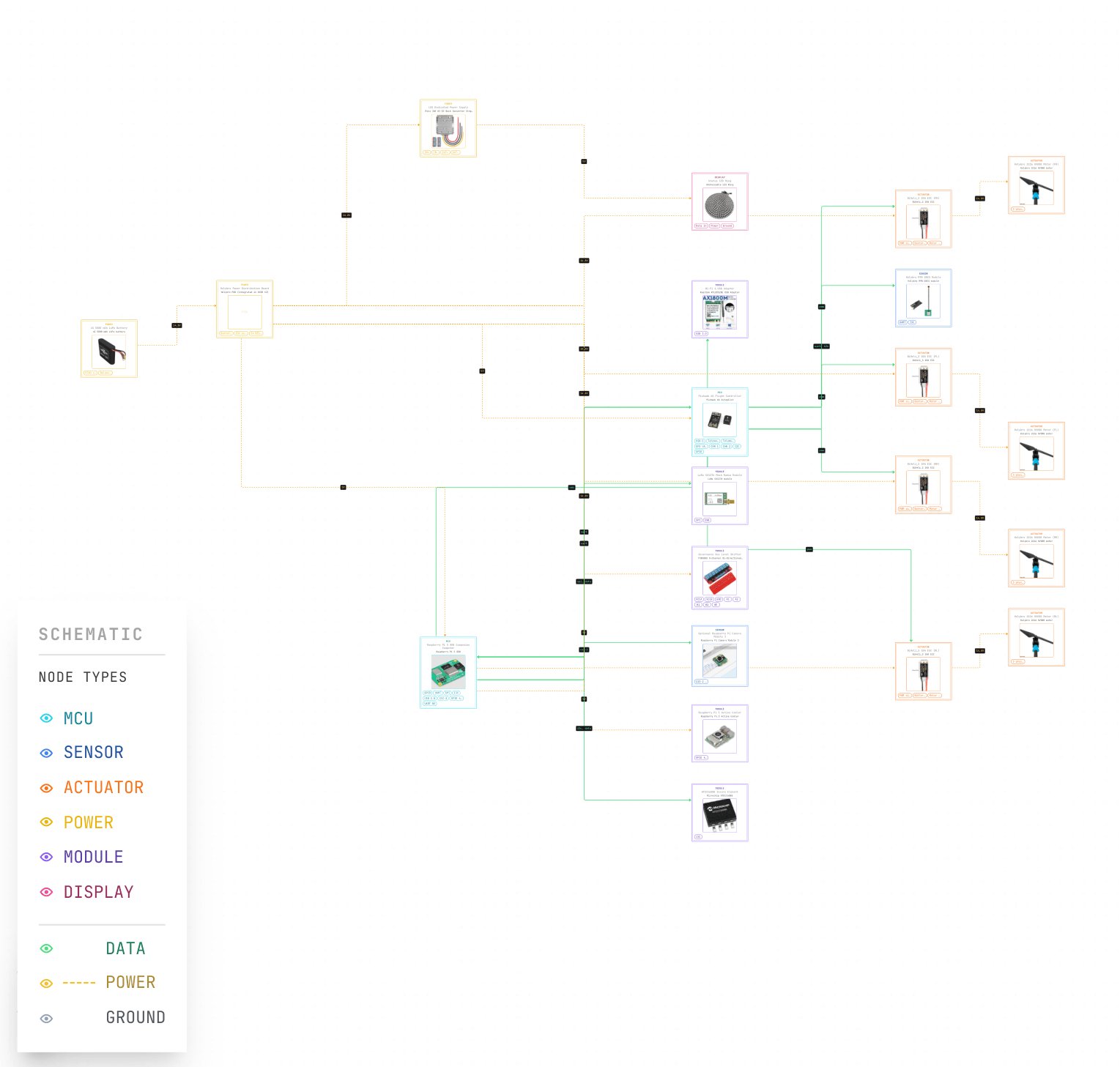
The node electrical design, power rails, data interfaces, and the governance-bus level shifter that bridges the Pixhawk 6X, the Raspberry Pi 5, and the ATECC608B secure element. The full-resolution schematic is available as a download.
A single-file, deterministic discrete-event simulator runs the full consensus and authority protocol in the browser, parameterised over N = 10, 50, and 500, with five scripted scenarios from nominal operation through denied and degraded conditions. It visualises the live pipeline, the per-node tier state, and the growing distributed audit ledger.
Launch Swarm SimulatorBLADE-SWARM is the eighth platform in the BLADE family, each instantiating the AUTHREX authority pipeline in a different domain. It develops the swarm-governance direction first set out in the single-agent Authority-Governed UAV Platform (HMAA-UAV) program, carrying the shared SATA-HMAA-CARA governance lineage from one autonomously governed drone to coordinated swarms of N = 10 to N = 500 agents; the two platforms are intended to complement each other, HMAA-UAV as the single-agent foundation and BLADE-SWARM as the multi-agent extension.
Single-agent foundation: Authority-Governed UAV Platform (HMAA-UAV) · Authority-Governed Rover Testbed
If you reference BLADE-SWARM in scholarly or policy work, please cite as follows.