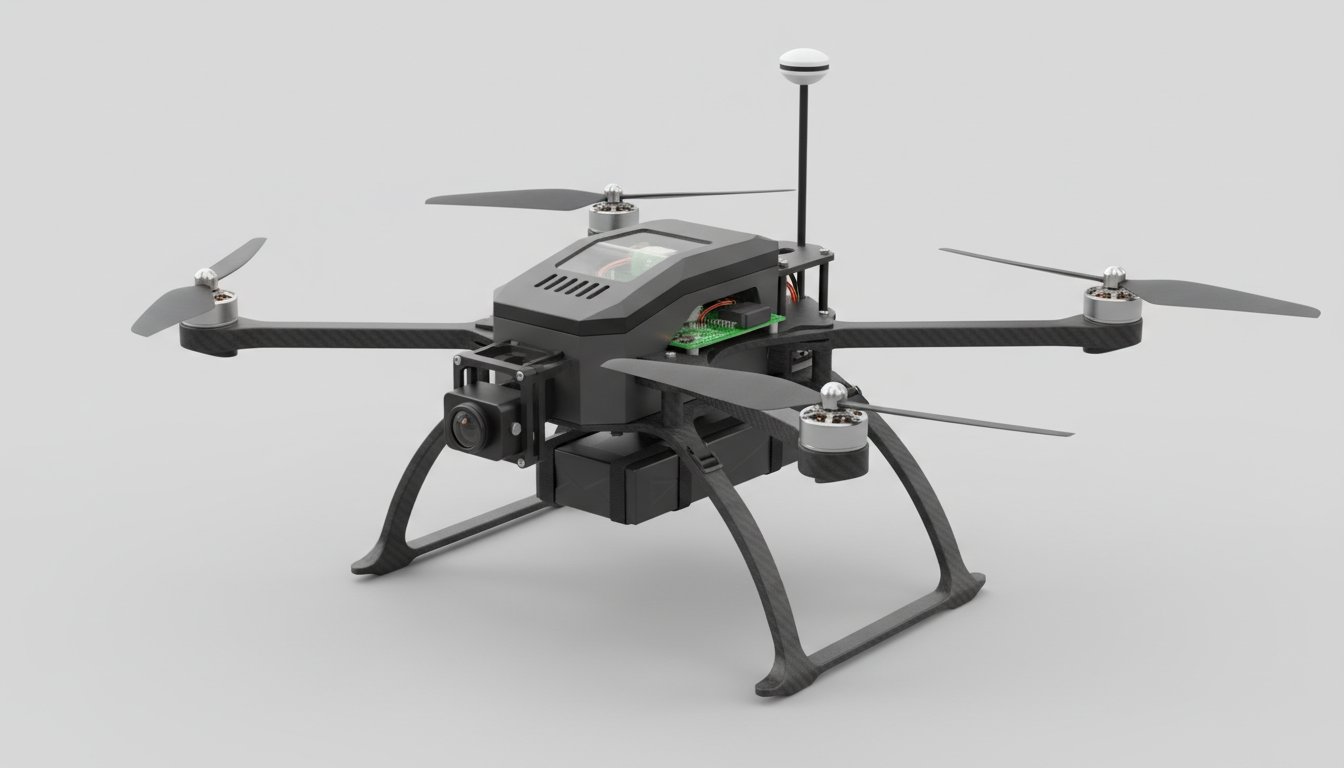
A trust-governed autonomous drone designed for contested environments, where every flight decision is evaluated by SATA sensor trust fusion, HMAA authority governance, and CARA recovery logic. The platform implements trust-governed flight and recovery-driven autonomy with a Cube Orange+ flight controller, NVIDIA Jetson Orin NX AI companion computer, and comprehensive multi-sensor perception suite. The broader research program extends this architecture to multi-agent drone swarm governance, where each drone's participation is conditioned on trust and authority rather than assumed.
This platform demonstrates a complete authority-governed autonomy pipeline for UAVs, from multi-sensor trust evaluation to authority-constrained flight execution and recovery enforcement.
This platform represents an implemented experimental system integrating hardware architecture, governance software, and simulation-based validation.
Design Complete · Implementation In ProgressZenodo Publication: Oktenli, B. (2026). Authority-Governed UAV Autonomy for Contested Environments: Integrating Sensor Trust Fusion, Dynamic Authority Control, and Deterministic Recovery (v1.0). Zenodo. https://doi.org/10.5281/zenodo.19128769
Unmanned aerial vehicles are rapidly proliferating in defense, infrastructure inspection, disaster response, and contested-environment reconnaissance. Current UAV autonomy systems lack formal governance mechanisms that dynamically regulate flight authority based on computed sensor trust, creating vulnerabilities when operating under GPS denial, RF jamming, or adversarial sensor manipulation.
Authority-governed flight autonomy addresses this gap by making trust assessment, authority computation, and recovery enforcement first-class components of the UAV control stack. Research in resilient UAV autonomy has been identified as a strategic priority by organizations including DARPA, NASA, and the U.S. Air Force Research Laboratory. DoD Directive 3000.09 explicitly requires autonomous weapons systems to maintain appropriate levels of human judgment over the use of force.
Autonomous UAVs increasingly operate in environments where GPS denial, sensor spoofing, RF jamming, and adversarial interference threaten flight safety. Current commercial autopilot systems use simple threshold-based failsafes (return-to-home, emergency land) that lack formal authority governance. They cannot dynamically degrade autonomy based on computed trust or enforce graded authority constraints on flight behavior.
This project extends the authority-governed autonomy concept from ground vehicles (Project 1: Rover Testbed) to aerial platforms. The UAV implements the same SATA/HMAA/CARA governance pipeline, demonstrating that authority-governed autonomy is platform-independent and applicable across robotic domains.
The UAV implements a complete authority-governed flight pipeline. Every autonomous flight command passes through trust evaluation, authority computation, and recovery logic before reaching the flight controller.
This project extends authority-governed autonomy from single-agent systems to coordinated multi-agent aerial platforms. Building directly on the rover and UAV testbeds, each drone operates as an individually governed autonomy node using SATA trust evaluation, HMAA authority control, and CARA recovery logic, while participating in a mission governed by a higher-level authority layer.
Unlike conventional swarm systems that assume continuous participation of all agents, this platform introduces trust-conditioned participation, where each drone's ability to contribute to the mission is dynamically constrained by its current trust and authority state.
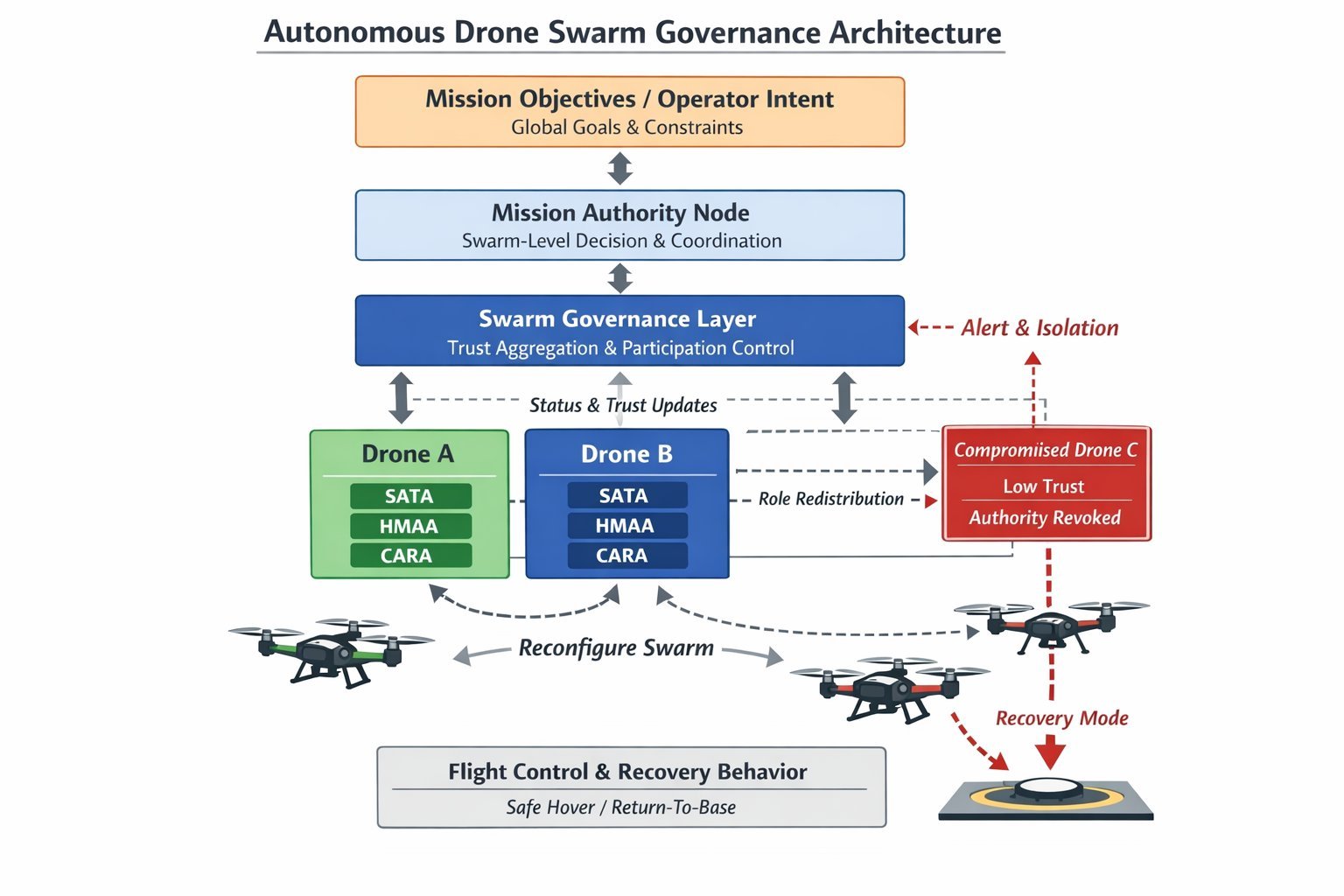
Each drone continuously evaluates its own sensor trust and computes a local authority level. These local states are transmitted to the mission authority node, which evaluates swarm-wide conditions and determines whether individual drones may continue participating, must operate under constrained authority, or must be removed from the active mission.
Determines whether a specific drone can safely act based on its own sensor trust and authority state
Determines whether a drone should continue contributing to the swarm based on fleet-wide trust conditions
This platform demonstrates that authority-governed autonomy is not limited to individual systems, but can regulate coordinated autonomous teams operating under uncertainty, adversarial interference, and partial system compromise. The approach proposes a framework for swarm governance in which autonomy is continuously conditioned on trust, authority, and recovery state rather than assumed by default.
The proposed swarm governance platform extends authority-governed autonomy from single-agent systems to coordinated multi-agent environments. Each drone executes a local governance stack (SATA-HMAA-CARA) to evaluate sensor trust, compute authority levels, and enforce recovery behavior. These local authority states are integrated through a swarm governance layer that performs distributed trust aggregation and mission-level decision-making.
Unlike conventional swarm architectures that assume reliable participation of all agents, this system introduces trust-conditioned participation, where each drone's role in the mission is continuously evaluated and dynamically constrained. Compromised or unreliable agents are automatically isolated, while the swarm adapts by redistributing tasks among trusted drones. The architecture supports both degradation and recovery, enabling agents to be reintegrated under constrained authority once trust is restored.
"This work introduces authority-governed swarm autonomy, where each agent's participation is dynamically controlled based on trust, authority, and recovery state rather than assumed coordination."
This architecture addresses a critical gap in current autonomous systems, where multi-agent coordination lacks formal mechanisms for trust-aware participation control and structured recovery under adversarial conditions.
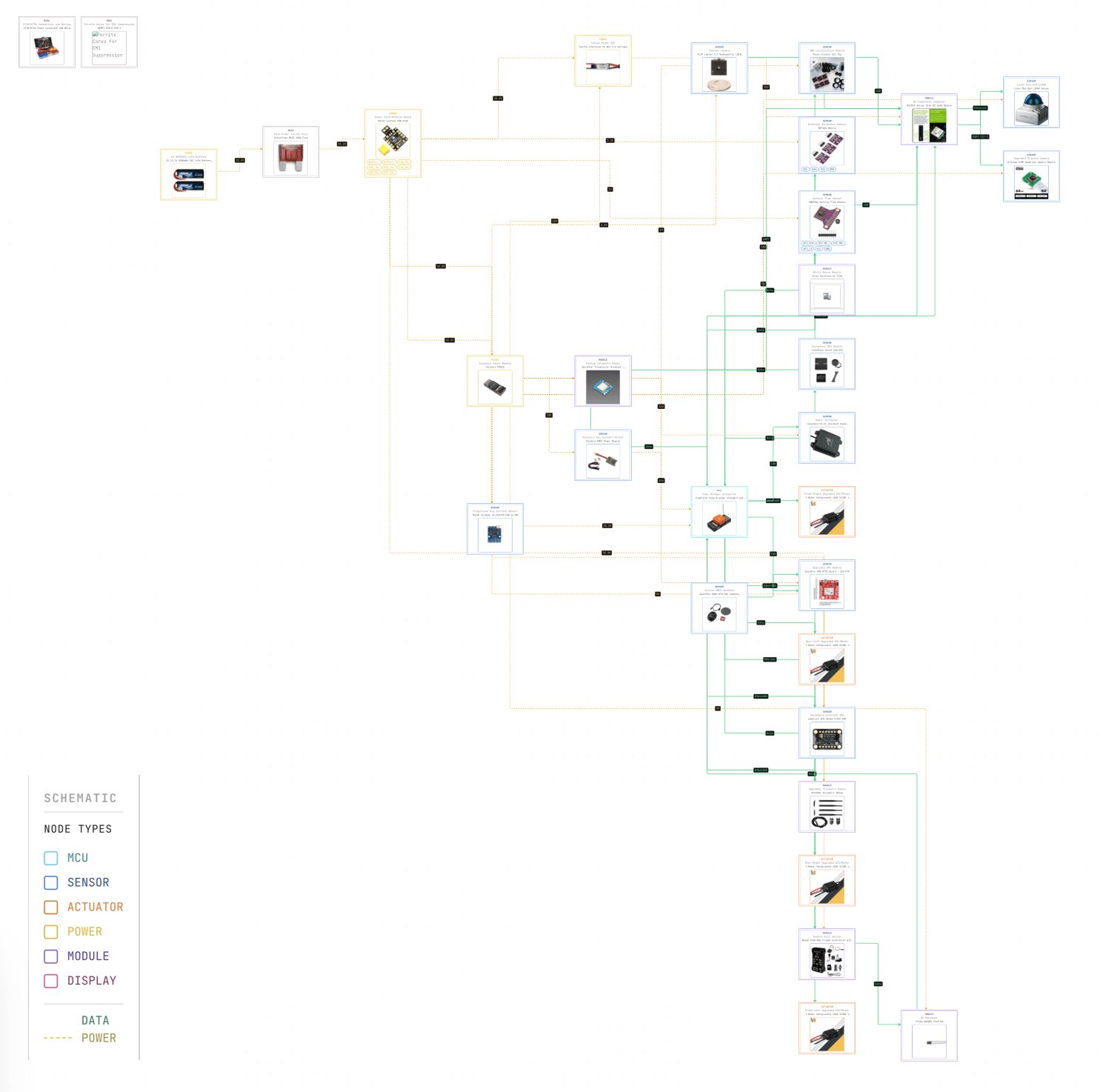
Full electrical schematic showing flight controller, AI companion computer, sensor, actuator, power, and module interconnections. Color-coded by node type: blue (MCU), teal (Sensor), orange (Actuator), yellow (Power), green (Module), purple (Display).
The HMAA-UAV simulation environment provides a controlled experimental platform for evaluating authority-governed flight autonomy under adversarial and degraded conditions. The simulator executes the complete SATA trust fusion, HMAA authority computation, command gating, and CARA recovery logic in real-time with configurable fault injection.
This simulation demonstrates executable validation of authority-governed autonomy rather than conceptual design alone. The simulation environment mirrors the real UAV hardware architecture, enabling direct transfer of validated governance behaviors from simulation to physical flight testing.
GPS spoofing, GPS jamming, RF signal loss, motor cut, compound failures
Real-time trust fusion, HMAA authority display, command gating, CARA recovery activation
MAVLink / HIL bridge for Cube Orange+ and ArduPilot-PX4 workflow compatibility
Experimental Simulation Environment (Research Use). This environment serves as a primary validation layer for testing authority transitions and recovery behaviors, enabling repeatable experimentation prior to real-world flight deployment.
Launch Governance Simulator Zenodo Record RepositoryThe UAV trust evaluation subsystem computes a continuous trust scalar from multi-sensor fusion across GPS, LiDAR, camera, IMU, barometer, optical flow, radar altimeter, and UWB inputs using weighted Dempster-Shafer belief functions with cross-sensor validation:
Trust(s_i) = weighted belief function with cross-sensor consistency checks, disagreement penalties, asymmetric decay (fast) and recovery (slow), and single-sensor veto capability
For UAV operations, trust fusion is critical because GPS spoofing can create false position confidence while visual odometry and UWB provide ground truth. The SATA engine cross-validates localization sources and penalizes inconsistencies, ensuring that spoofed GPS cannot maintain high trust when other sensors disagree.
All sensors trusted. Autonomous waypoint mission, full speed, full maneuver envelope. No operator input required.
Partial trust degradation. Speed limits enforced, altitude ceiling reduced, conservative pathing only. Operator alerted.
Significant trust loss. Hover-hold or slow reposition only. Operator supervision required for any flight command.
Critical trust failure. CARA activates safe-land or return-safe protocol. All autonomous flight commands disabled.
The UAV uses a dual-compute architecture separating flight control (Cube Orange+ autopilot) from AI governance (Jetson Orin NX), connected via MAVLink over UART.
Cube Orange+ with ArduPilot/PX4: ESC control (DShot600), sensor fusion, GPS/IMU integration, RC receiver, kill switch
NVIDIA Jetson Orin NX: SATA trust engine, HMAA authority, CARA recovery, camera/LiDAR processing, digital twin, ROS 2
RGB camera (CSI), thermal camera, LiDAR (Ethernet), dual GPS (CAN), BMP280 barometer, PMW3901 optical flow, radar altimeter, secondary IMU, UWB
500mm carbon fiber frame, 6S 8000mAh LiPo (22.2V), 15-inch props, 4x upgraded ESC/motors, inline 100A fuse, redundant power distribution, kill switch
| Component | Model | Purpose |
|---|---|---|
| Flight Controller | Cube Orange+ | Autopilot, sensor fusion, ESC control |
| AI Companion | NVIDIA Jetson Orin NX | Governance engine, perception, ROS 2 |
| LiDAR | Upgraded LiDAR Sensor | 3D obstacle mapping (Ethernet) |
| Primary Camera | Upgraded RGB Camera | Visual perception (MIPI CSI-2) |
| Thermal Camera | Thermal Imaging Module | Night/adverse weather sensing |
| GPS (Primary) | Upgraded GPS (CAN) | Position and navigation |
| GPS (Secondary) | Secondary GPS Module | Redundant localization, cross-validation |
| Radar Altimeter | Radar Alt (CAN) | Precision altitude measurement |
| UWB Module | UWB Localization | Indoor/GPS-denied positioning |
| Communication | Telemetry Radio + WiFi | MAVLink telemetry, debug interface |
| Power | 6S 8000mAh LiPo + PDB + BECs | 22.2V propulsion, regulated avionics power |
Full BOM available as downloadable CSV.
Five core experiments designed to validate trust-governed flight autonomy under adversarial and degraded conditions.
The platform design and specification are complete. Hardware procurement and implementation are currently underway.
Complete engineering documentation for the HMAA-UAV Authority-Governed Drone Platform.
This project provides reproducible artifacts enabling researchers to replicate the authority-governed UAV experiments and system architecture. All documentation, schematics, and specifications are available for download.
Complete blueprint PDF, electrical schematic SVG, wiring connections JSON, mechanical assemblies JSON, system configuration
52-component BOM with verified sources. All commercially available. Total cost approximately $4,200. Assembly guide included.
5 defined experiments with fault injection procedures, expected authority transitions, and measurement requirements.
Fused trust scores, per-sensor trust values, authority state transitions, recovery latency, flight command clamping data.
The UAV platform operates from a 6S LiPo battery (22.2V nominal) with regulated power distribution for compute, sensors, and motor controllers.
6S LiPo → Cube Orange+ autopilot power module → 5V BEC (Jetson Orin NX) → 3.3V regulated (sensors). ESCs powered directly from battery.
MAVLink failsafe triggers on governance authority loss. CARA GREP phases command RTL or land. Cube Orange+ maintains independent flight safety.
The UAV platform integrates SATA-HMAA-CARA governance with Cube Orange+ autopilot safety systems via MAVLink/HIL bridge.
MAVLink/HIL bridge connects Jetson Orin NX governance engine to Cube Orange+ autopilot. Authority commands translated to MAVLink COMMAND_LONG.
250 simulation runs across 5 adversarial scenarios. 6DOF physics engine with EKF2 navigation filter. Zero unsafe actions.
Multi-agent integrity verification for swarm authority coordination. Byzantine fault tolerance (f<n/3) across mesh network.
| Subsystem | Cost | % of Total |
|---|---|---|
| Compute (Jetson Orin NX + Cube Orange+) | $1,200 | 29% |
| Sensors (GPS/GNSS + IMU + barometer + camera) | $450 | 11% |
| Airframe & Motors (frame + ESCs + propellers) | $850 | 20% |
| Communications (telemetry + RC + mesh radio) | $380 | 9% |
| Power (6S LiPo + BEC + power module) | $320 | 8% |
| Structure, wiring, connectors | $1,000 | 24% |
52-component UAV platform with MAVLink/HIL integration. Estimated platform cost ~$4,200. All COTS components.
| Parameter | Value |
|---|---|
| Components | 52 (Jetson Orin NX + Cube Orange+ autopilot) |
| Simulation runs | 250 across 5 adversarial scenarios, zero unsafe actions |
| Physics engine | 6DOF with EKF2 navigation filter |
| Governance pipeline | SATA → HMAA → CARA (with MAIVA for swarm) |
| Autopilot interface | MAVLink/HIL bridge to Cube Orange+ |
| Power | 6S LiPo (22.2V nominal) |
| BOM | ~$4,200 |
The HMAA-UAV extends the authority-governed autonomy research program from ground to aerial platforms.
Distributed authority coordination across UAV fleet with trust-conditioned participation, compromised agent isolation, and dynamic reconfiguration
Adversarial deception detection for proactive authority adjustment during GPS spoofing attacks
Deliberation windows for critical flight commands to prevent flash-escalation scenarios
Unified authority framework governing rover + UAV + future platforms under single HMAA stack
Controlled reintroduction of previously compromised drones under constrained participation before full authority restoration
This project is the second platform in the authority-governed autonomy research program by Burak Oktenli at Georgetown University (M.P.S. Applied Intelligence). It extends the SATA/HMAA/CARA governance architectures from ground vehicles to aerial platforms, demonstrating platform-independent authority governance. The next phase scales this architecture from single-UAV governance to multi-agent drone swarm authority coordination, where each drone's participation is conditioned on trust and recovery state.
Related: Project 1: Rover Testbed · Full Research Portfolio → · Zenodo Record → · Repository →