BLADE-AV = Authority-Governed Drive-by-Wire Safety Architecture for Autonomous Vehicles
A hardware-enforced authority gating system for autonomous vehicle drive-by-wire control. Integrates Dempster-Shafer trust fusion, four-level authority with hysteresis, Byzantine fault-tolerant consensus, deliberation windows, and deterministic recovery — all enforced through a three-leg redundant fail-safe circuit driving a normally-open KILOVAC LEV200 safety relay.
Published on Zenodo · DOI: 10.5281/zenodo.19232130This is the second domain instantiation of the BLADE governance pipeline — after BLADE-EDGE (defense) — demonstrating that authority-governed autonomy is domain-agnostic. The same governance pipeline applies directly to civilian autonomous vehicles under ISO 26262 ASIL-D, SAE J3016, and NHTSA ADS requirements.
Zenodo Publication: Oktenli, B. (2026). BLADE-AV Governance Node: Authority-Governed Drive-by-Wire Safety Architecture for Autonomous Vehicles (v1.0). Zenodo. https://doi.org/10.5281/zenodo.19232130
Autonomous ground vehicle systems increasingly deployed in commercial transportation and defense logistics lack formal governance mechanisms capable of dynamically regulating drive-by-wire authority based on computed sensor trust. A spoofing attack can redirect a vehicle while the perception stack maintains full confidence; sensor degradation reduces situational awareness without proportional authority reduction.
The BLADE-AV Governance Node addresses this gap by applying the SATA-HMAA-MAIVA-FLAME-CARA pipeline demonstrated in defense weapons systems governance (BLADE-EDGE) to civilian autonomous vehicle authority management, targeting ISO 26262 ASIL-D functional safety, SAE J3016 Level 4, and NHTSA ADS requirements.
Current autonomous vehicle safety architectures address planning-level collision avoidance (Mobileye RSS, NVIDIA SFF, ISO/PAS 21448 SOTIF) but do not provide real-time hardware-enforced authority gating based on continuous sensor trust fusion. BLADE-AV operates at a complementary architectural layer, governing whether commands reach actuators rather than specifying planning behavior.
The BLADE-AV governance pipeline is a civilian adaptation of the BLADE-EDGE defense variant (DOI: 10.5281/zenodo.19177472). Porting the governance pipeline from directed-energy weapon control (DoDD 3000.09) to drive-by-wire authority gating (ISO 26262 ASIL-D) demonstrates that authority-governed autonomy is a domain-agnostic safety principle, not a defense-specific design.
Directed-energy weapon governance. EFFECTOR = weapons release relay. MIL-STD-810G. Beam suitability (β_beam). Multi-effector WTA. ~$139K.
Drive-by-wire authority gating. EFFECTOR = KILOVAC safety relay. ISO 26262 ASIL-D. C-V2X integration. CAN-FD vehicle bus. ~$16K.
Every drive-by-wire command passes through 9 sequential governance modules. The pipeline targets sub-second end-to-end latency. Each stage can independently prevent commands from reaching actuators.
ARS540 Radar, OS1-64 LiDAR, GMSL2 Camera, ZED-F9R/F9P GNSS, SMI230 IMU, C-V2X
Cross-sensor consistency detection, adversarial ML patch detection (YOLOv8). Jetson Orin.
Weighted Dempster-Shafer fusion over Θ = {Trusted, Untrusted} with cross-validated BPA. Jetson Orin.
V2X identity verification via ATECC608B hardware authentication. IEEE 1609.2 certificate auth. Zynq FPGA.
Trust scalar → A3-A0 authority with 5-15s hysteresis. Immediate downgrade, delayed upgrade. Zynq FPGA.
2-of-3 Byzantine fault-tolerant consensus on authority level. Zynq FPGA.
Mandatory hold window before lane-change / emergency maneuvers. Command passes only if authority sustained. Zynq FPGA.
GREP phases: Govern → Restrict → Execute → Persist. Mutual exclusion verified. Zynq FPGA.
Sensor trust revalidation after lane-change, emergency braking, or authority-gated maneuver. Jetson AGX Orin.
KILOVAC LEV200 normally-open relay. BTS5016-1EKD driver. Three-leg redundant control. Closes ONLY when HMAA > threshold ∧ FLAME satisfied ∧ CARA nominal.
Four-level authority with asymmetric hysteresis: immediate downgrade, 5-15s delayed upgrade. CARA GREP phases provide graduated operational restrictions within authority levels.
T_fused ≥ 0.80. All drive-by-wire commands authorized. No operator required.
0.50 ≤ T_fused < 0.80. Conservative paths, speed limits. CARA Govern phase active.
0.15 ≤ T_fused < 0.50. Lane-change and acceleration disabled. CARA Restrict phase.
T_fused < 0.15. KILOVAC relay opens. Drive-by-wire disabled. CARA Execute/Persist.
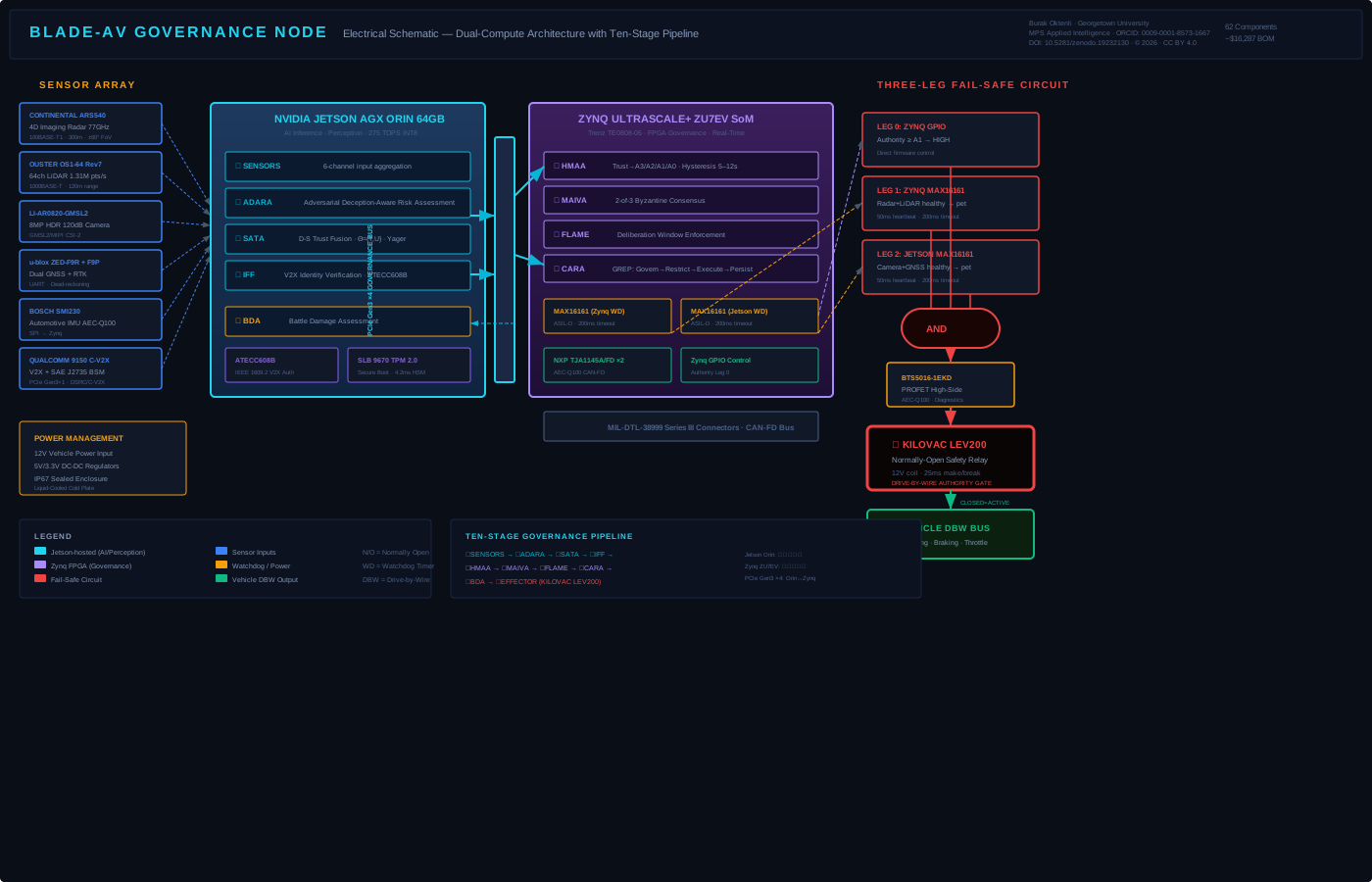
62 components across a dual-compute platform. Jetson AGX Orin runs AI perception (ADARA, IFF, BDA). Zynq UltraScale+ FPGA runs deterministic governance (SATA, HMAA, MAIVA, FLAME, CARA) and relay control. PCIe Gen3 x4 inter-processor governance bus.
| Subsystem | Component | Interface | Role |
|---|---|---|---|
| Main AI Compute | NVIDIA Jetson AGX Orin 64GB | PCIe Gen3×4/CSI | AI inference, perception, ADARA, IFF, BDA |
| Governance FPGA | Trenz TE0808-05 Zynq UltraScale+ | PCIe/SPI/UART/GPIO | SATA, HMAA, MAIVA, FLAME, CARA, relay control |
| 4D Imaging Radar | Continental ARS540 | 100BASE-T1 | 77 GHz radar, 300m, ±60° FoV |
| LiDAR | Ouster OS1-64 Rev 7 | 1000BASE-T | 64-channel, 120m, 1.31M pts/sec |
| Vision Camera | Leopard LI-AR0820-GMSL2 | GMSL2/MIPI CSI-2 | 8MP, HDR 120dB, automotive-grade |
| Dual GNSS | u-blox ZED-F9R + ZED-F9P | UART | Dead-reckoning + RTK correction |
| Automotive IMU | Bosch SMI230 | SPI | AEC-Q100 automotive IMU to Zynq |
| V2X Module | Qualcomm 9150 C-V2X | PCIe Gen3×1 | SAE J2735 BSM, DSRC/C-V2X |
| Safety Relay | KILOVAC LEV200 | 12V coil/BTS5016 | Drive-by-wire authority gate (N/O) |
| Relay Driver | Infineon BTS5016-1EKD | GPIO/12V | AEC-Q100 high-side switch |
| Watchdog ×2 | Analog Devices MAX16161 | GPIO WDI/nRESET | ASIL-D watchdog for Zynq + Jetson |
| CAN-FD ×2 | NXP TJA1145A/FD | SPI/CAN-FD | AEC-Q100 → MIL-DTL-38999 |
| Crypto/V2X Auth | Microchip ATECC608B | I2C | IEEE 1609.2 V2X certificate auth |
| Secure Boot/TPM | Infineon SLB 9670 TPM 2.0 | SPI | Root of trust, secure boot |
| Ethernet Switch | Marvell 88Q5072 | 100/1000BASE-T | TSN-capable automotive switch |
Full 62-component BOM available as downloadable CSV. Total platform cost: ~$16,287.
The BLADE-AV power architecture provides automotive-grade power conditioning from the vehicle 12V-24V battery bus with EMI filtering, voltage regulation, and chassis ground bonding for ISO 26262 compliance.
12V-24V automotive battery input → LT8645S power filter → Vicor DC-DC converter → regulated 19V (Jetson), 12V (relay), 5V (transceivers), 3.3V (sensors/security) rails.
KILOVAC LEV200 relay requires 12V/9V minimum hold-in coil drive. Relay opens to safe-state on any power loss. Vehicle battery serves as primary UPS.
LT8645S EMI input filter with vehicle chassis ground bond (critical for ISO 26262). Reverse polarity protection on all input lines.
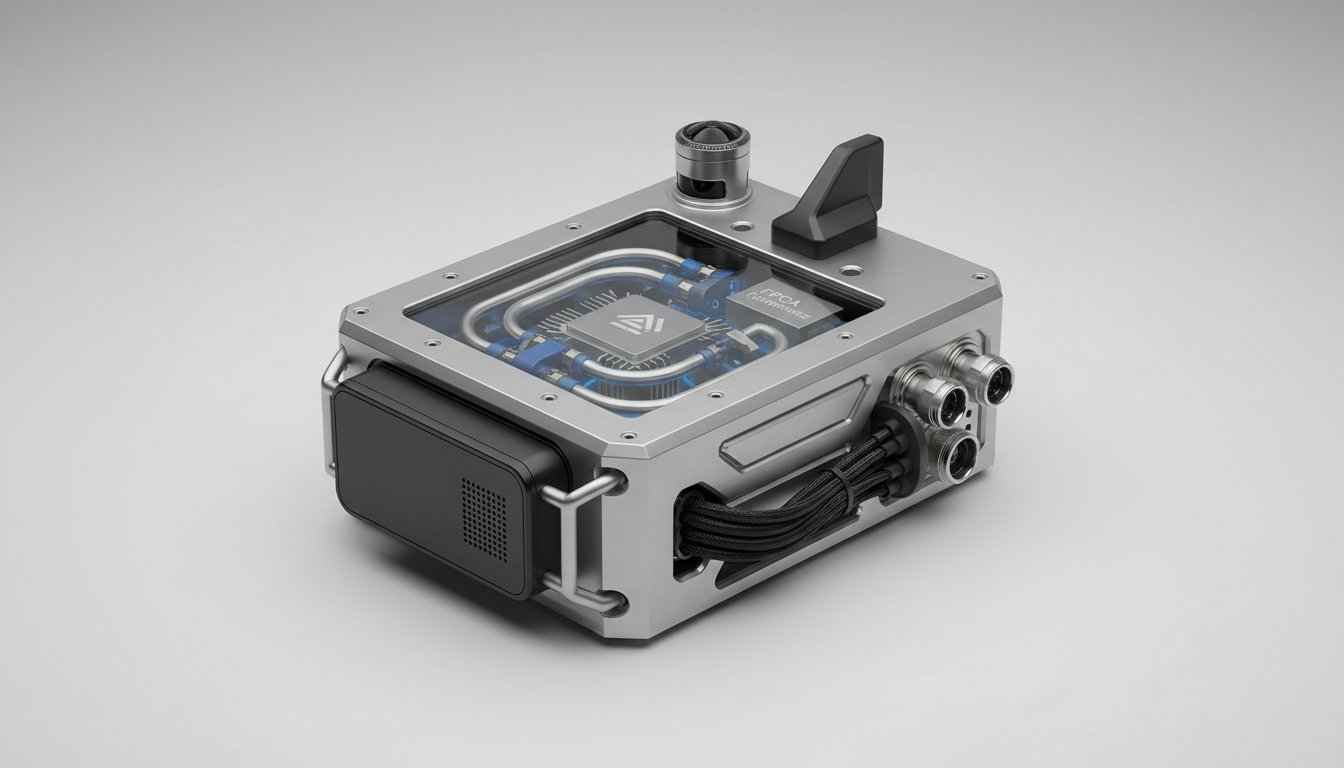
Liquid cooling system: cold plate → silicone tubing → radiator with PWM fan. Thermal pads (GPU die) and thermal paste (FPGA). Coolant temperature sensor on inlet/outlet.
Three-layer defense-in-depth security chain providing hardware root of trust, real-time governance enforcement, and tamper-evident audit logging.
Microchip ATECC608B secure element (I²C) for IEEE 1609.2 V2X certificate authentication. Infineon TPM 2.0 (SPI) for platform attestation and secure boot verification.
Zynq UltraScale+ FPGA executes SATA τ-chain, HMAA authority computation, and CARA recovery in hardware. Three-leg redundant fail-safe: GPIO + dual MAX16161 watchdog → BTS5016 → KILOVAC relay.
SATA τ-chain attestation records signed by ATECC608B stored on NVMe SSD. Hash chain architecture for tamper-evident governance audit trail.
| Subsystem | Cost | % of Total |
|---|---|---|
| Compute Core (Jetson AGX Orin + Zynq TE0808 + carrier) | $7,200 | 44% |
| Perception Sensors (ARS540 + OS1-64 + GMSL2 + GNSS/IMU) | $4,800 | 29% |
| Safety & Security (KILOVAC + BTS5016 + watchdogs + ATECC608B + TPM) | $580 | 4% |
| Communications (V2X + CAN-FD + Ethernet switch) | $920 | 6% |
| Enclosure & Mechanical (IP67 + liquid cooling + mounts) | $2,787 | 17% |
Full 62-component BOM available as downloadable CSV. All COTS components. No GFE required.
| Parameter | Value |
|---|---|
| Operating temperature | −40°C to +85°C (automotive grade) |
| Enclosure rating | IP67 dust/water resistant |
| Power input | 12V-24V automotive battery |
| Safety standard | ISO 26262 ASIL-D target; SAE J3016 Level 4 |
| Cooling | Liquid cooling (cold plate + radiator + PWM fan) |
| Vehicle interface | CAN-FD via MIL-DTL-38999 connector |
| Governance pipeline | SATA → ADARA → IFF → HMAA → MAIVA → FLAME → CARA → BDA → EFFECTOR (9-module pipeline) |
| Safety relay | KILOVAC LEV200 (N/O), three-leg redundant (Zynq GPIO + dual MAX16161 watchdog) |
All three legs must assert high to keep the KILOVAC relay closed. Any single heartbeat timeout or explicit GPIO de-assertion opens the relay and cuts drive-by-wire authority within the watchdog window — in hardware, without firmware involvement.
Zynq TE0808 GPIO_A0 → BTS5016 IN. Governance pipeline asserts/de-asserts based on CARA state.
MAX16161 WDI_OUT→WDI_IN heartbeat. Timeout → GPIO_OUT de-asserts → relay opens.
MAX16161 WDI_OUT→WDI_IN heartbeat. Independent of Zynq. Jetson failure alone opens relay.
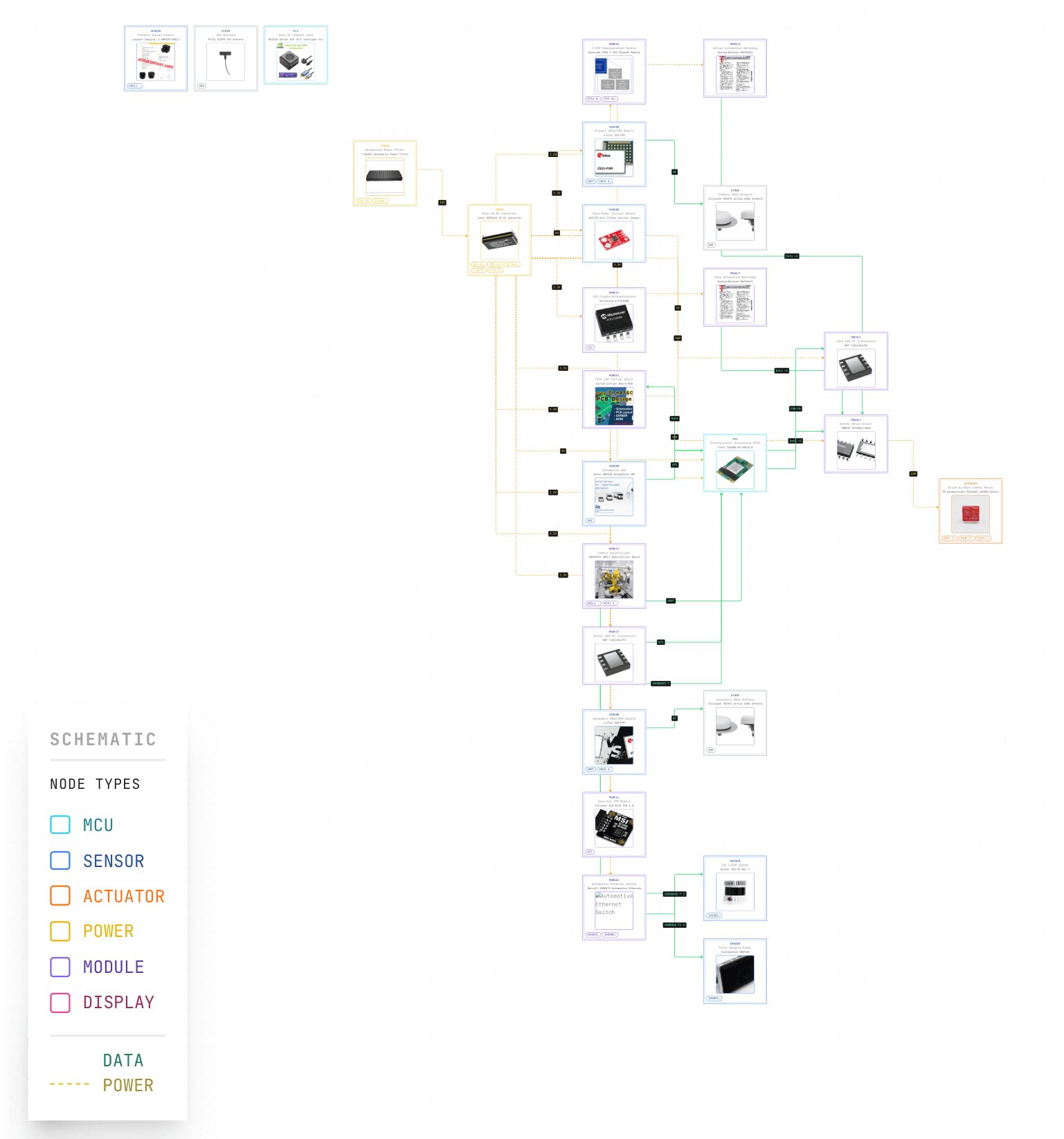
62 components, 57 electrical connections, 55 mechanical connections. Color-coded by node type.
The BLADE-AV simulator (v2.2) executes the complete 9-module governance pipeline with 12 attack scenarios, seeded PRNG (Mulberry32) for bit-exact reproducibility, KILOVAC electromechanical relay model (25ms actuation delay), and HSM/TPM signing latency (4.2ms per hash).
Radar spoof, adversarial ML, GNSS spoof, IMU manipulation, V2X spoof, CARA trigger, RF jamming, compound, Byzantine, replay, PCIe fault, sensor dropout
100 per scenario × 12 attack vectors. Zero unsafe actions. Seeded PRNG for reproducibility.
G*Power justified (α=0.05, power=0.80, d=0.80). Bonferroni correction. Shapiro-Wilk normality tests.
| Scenario | Trust Drop | Downgrade | FLAME | Recovery | Unsafe |
|---|---|---|---|---|---|
| E1: Radar Spoof | 0.92→0.28 | 1.1s ±0.3 | Held 3.0s | 19.2s ±2.3 | 0/50 |
| E2: Adversarial ML | 0.88→0.42 | 0.9s ±0.2 | Held 2.5s | 13.1s ±1.9 | 0/50 |
| E3: GNSS Spoof | 0.91→0.21 | 1.4s ±0.4 | Held 4.0s | 21.8s ±3.1 | 0/50 |
| E4: IMU Manipulation | 0.87→0.44 | 0.7s ±0.2 | Held 2.0s | 11.4s ±1.6 | 0/50 |
| E5: V2X Spoof | 0.90→0.65 | 0.6s ±0.1 | N/A (A2) | N/A | 0/50 |
| E6: CARA Trigger | N/A forced | N/A | N/A | 15.3s ±2.0 | 0/50 |
| E7: RF Jamming | 0.85→0.19 | 2.1s (WD) | N/A | Persist (reset) | 0/50 |
| E8: Compound | 0.93→0.07 | 1.9s ±0.5 | Held 4.0s | 27.1s ±4.4 | 0/50 |
E9-E12 (Byzantine fault, replay attack, PCIe bus fault, sensor dropout) validated in simulation artifact. Total: 1,200 runs, zero unsafe actions.
Complete engineering documentation for the BLADE-AV Governance Node. All files are original work by Burak Oktenli. Published under CC BY 4.0.
All data, simulation code, engineering artifacts, and the interactive governance simulator are openly available at DOI: 10.5281/zenodo.19232130 under CC BY 4.0. No access restrictions apply.
Research paper (12 pages), blueprint PDF, schematic SVG, 62-component BOM, electrical/mechanical JSON. Full engineering specification.
v2.2 simulator with 12 attack scenarios, seeded PRNG (Mulberry32), KILOVAC relay model, HSM/TPM latency. 1,200 runs fully reproducible.
G*Power sample size justification, Bonferroni correction, Shapiro-Wilk normality tests, paired t-tests, Wilcoxon signed-rank for non-normal data.
ISO 26262 ASIL-D target. SAE J3016 Level 4. NHTSA ADS. AEC-Q100 automotive-grade components. MIL-DTL-38999 connectors.
Hardware-in-the-loop testing with ROS 2 perception pipeline and Gazebo vehicle physics simulation
TLA+/UPPAAL full verification of all design invariants and safety properties across all configurations
4-layer controlled-impedance PCB design, fabrication, and integration testing with all 62 components
Formal ASIL decomposition filing, independent safety assessment at accredited facility
The BLADE-AV Governance Node demonstrates that the authority-governed autonomy pipeline is domain-agnostic. The same governance architectures (SATA, HMAA, ADARA, MAIVA, FLAME, CARA) demonstrated in defense (BLADE-EDGE, ~$139K) apply directly to civilian autonomous vehicles (~$16K) under different regulatory frameworks.
Related platforms: Rover Testbed (~$484) · UAV Platform (~$4,200) · BLADE-EDGE (defense, ~$139K) · BLADE-AV (automotive, ~$16K) · BLADE-MARITIME (maritime, ~$43K) · BLADE-INFRA (infrastructure, ~$12K). Six platforms demonstrating governance stack portability across four domains.
The BLADE Governance SDK provides a unified API across all four domains. The same
blade_governance
library drives defense weapons governance (BLADE-EDGE), autonomous vehicle authority (BLADE-AV),
maritime surveillance (BLADE-MARITIME), and critical infrastructure protection (BLADE-INFRA).
Only the domain configuration file changes.
Cross-Domain Portability:
The blade_governance SDK
uses the same evaluate() →
result API across all four domains.
Switching from defense weapons governance to autonomous vehicle authority requires changing only the YAML
configuration file — not the application code. This is how the same governance pipeline operates under
DoDD 3000.09, ISO 26262 ASIL-D, MIL-STD-810G, and SIL 3 / NERC CIP simultaneously.
The BLADE-AV Governance Node is part of the authority-governed autonomy research program by Burak Oktenli at Georgetown University (M.P.S. Applied Intelligence). It is the second domain instantiation — a civilian adaptation of the governance architectures demonstrated in defense weapons governance (BLADE-EDGE), demonstrating portability from DoDD 3000.09 to ISO 26262 ASIL-D.
Related architectures: SATA · HMAA · CARA · MAIVA · FLAME · ADARA