Maritime Defense Research Platform

BLADE-MARITIME Governance Node

BLADE-MARITIME = Authority-Governed ASV Governance Node for Maritime Surveillance

A hardware-enforced authority gating system for maritime autonomous surface vehicle control. Integrates Dempster-Shafer trust fusion, four-level authority with hysteresis, Byzantine fault-tolerant consensus, deliberation windows, and deterministic recovery — all enforced through a dual-GPIO safety interlock circuit driving a normally-open SPDT 24VDC safety relay.

Published on Zenodo · DOI: 10.5281/zenodo.19246785

This is the third domain instantiation of the BLADE governance pipeline — after BLADE-EDGE (defense) and BLADE-AV (automotive) — extending authority-governed autonomy to maritime autonomous surface vehicles under MIL-STD-810G / IP68, MIL-STD-461G CE102, and DoDD 3000.09.

Launch Governance Simulator Zenodo Record Repository Evaluation Protocol SDK Integration
Type: Maritime Defense Research Focus: Maritime ASV Governance · IP68 · MIL-STD-810G Status: Design Complete · Simulation Validated DOI: 10.5281/zenodo.19246785

Key Contributions

  • 9-module authority-governed pipeline: SATA → ADARA → IFF → HMAA → MAIVA → FLAME → CARA → BDA → EFFECTOR
  • Formal Dempster-Shafer trust fusion with binary frame Θ = {threat, non-threat} with hydroacoustic + MAD per-sensor mass functions
  • Dual-GPIO hardware safety interlock: Zynq PASS + Jetson APPROVE + TPS3823 watchdog (500ms timeout) → normally-open SPDT relay (24VDC coil)
  • Dual-compute: NVIDIA Jetson AGX Orin 64GB (AI/perception) + Zynq UltraScale+ ZU7EV (FPGA governance)
  • Thirteen fault injection scenarios with multi-select compose in browser simulation (v3.11, 4,897 lines)
  • IP68 / MIL-STD-810G / MIL-STD-461G CE102 target architecture with MIL-spec power chain (300W Vicor DCM5614, 32% margin)
  • Cross-domain portability validated against BLADE-EDGE defense variant

Zenodo Publication: Oktenli, B. (2026). BLADE-MARITIME Governance Node: Authority-Governed Maritime Surveillance Node with Hydroacoustic, Magnetic Anomaly Detection, and Multi-Modal Sensor Fusion (v2.3). Zenodo. https://doi.org/10.5281/zenodo.19246785
84
Hardware Nodes
13
Fault Scenarios
9
Pipeline Modules
~$43K
Prototype BOM
IP68
Enclosure Rating
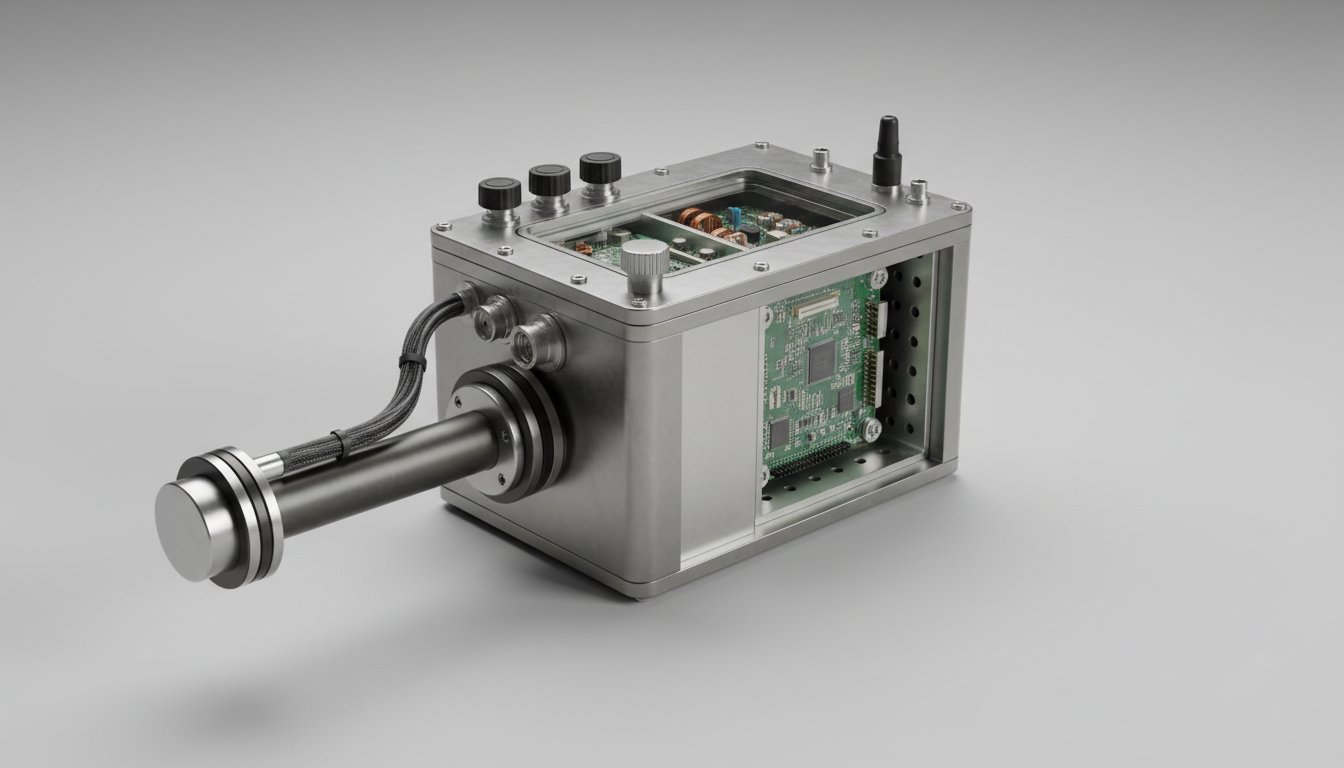
BLADE-MARITIME Governance Node: ruggedized IP68 enclosure with magnetometer boom, FPGA governance module, and maritime connectors
BLADE-MARITIME Governance Node: IP68 ruggedized 316L stainless steel / 6061-T6 aluminum enclosure with magnetometer boom, SubConn underwater connectors, passive seawater cooling, and Zynq UltraScale+ FPGA governance. 84 components, $43,477 total.

National Importance

Maritime autonomous systems are being deployed in contested, communication-degraded environments where adversarial spoofing (acoustic, AIS, GNSS) can compromise detection and navigation without proportional authority reduction. Current surveillance platforms lack formal governance mechanisms capable of dynamically regulating operational authority based on continuous multi-modal sensor trust fusion. An acoustic spoofing attack can create false submarine contacts while the detection pipeline maintains full confidence; sea-state degradation reduces hydroacoustic performance without proportional authority adjustment.

The BLADE-MARITIME Governance Node addresses this gap by applying the SATA-HMAA-MAIVA-FLAME-CARA pipeline demonstrated in defense weapons systems governance (BLADE-EDGE) to maritime autonomous surface vehicle governance, targeting MIL-STD-810G environmental qualification, MIL-STD-461G CE102 EMI compliance, IP68 immersion rating, and DoDD 3000.09 autonomous systems governance requirements.

Research Problem

Maritime autonomous systems operate in contested, communication-degraded environments requiring sub-second detection and authority-governed response. Three challenges distinguish the maritime domain: RF communication is precluded underwater (requiring acoustic modems with seconds of propagation delay), magnetic anomaly detection sensors require physical separation from ferrous materials, and sea-state dynamics introduce platform motion artifacts requiring dynamic authority compensation.

Acoustic spoofing creates false submarine contacts without cross-validation
AIS spoofing creates phantom vessel tracks to mask hostile approach
Sea-state noise degrades hydroacoustic detection without authority adjustment
Acoustic modem loss isolates ASV nodes from Byzantine consensus
No hardware-enforced authority gate between perception and maritime surveillance actuators

Cross-Domain Pipeline Portability

The BLADE-MARITIME governance pipeline extends the BLADE-EDGE defense variant (DOI: 10.5281/zenodo.19177472) and the BLADE-AV automotive variant (DOI: 10.5281/zenodo.19232130) to the maritime domain. Four maritime-specific mathematical extensions (Dempster-Shafer hydroacoustic+MAD fusion, recursive AIS deception-risk, sea-state authority damping, acoustic-delay Byzantine consensus) are added while the core governance architecture remains identical.

BLADE-EDGE (Defense)

Directed-energy weapon governance. EFFECTOR = weapons release relay. MIL-STD-810G. Beam suitability (β_beam). Multi-effector WTA. ~$139K.

BLADE-MARITIME (Maritime)

Maritime surveillance governance. EFFECTOR = dual-GPIO SPDT relay. IP68 / MIL-STD-810G. Hydroacoustic + MAD fusion. Acoustic modem mesh. $43K.

9-Module Governance Pipeline

Every maritime governance decision passes through nine sequential modules. The pipeline targets sub-second end-to-end latency. Each stage can independently prevent commands from reaching actuators.

Sensor Inputs

G-882 MAD, AFE5805 Hydroacoustic (4-ch), Aquadopp ADCP, ZED-F9P GNSS, VN-300 IMU, XB-8000 AIS, Furuno Radar

1. SATA — Sensor Trust Attestation

Dempster-Shafer fusion over Θ = {threat, non-threat}; hydroacoustic + MAD trust with DEMON analysis. Zynq FPGA + Jetson.

2. ADARA — Adversarial Deception-Aware Risk Assessment

Recursive phantom vessel deception-risk estimator; AIS-radar gating (d_gate = 200m). Jetson Orin.

3. IFF — Identity Verification

AIS vessel identity verification; ATECC608B authentication; radar track correlation. Zynq FPGA.

4. HMAA — Authority Computation

Trust scalar → authority with sea-state damping α(H) (γ = 0.25 m⁻¹); dual-GPIO safety interlock. Zynq FPGA.

5. MAIVA — Byzantine Consensus

2-of-3 Byzantine fault-tolerant consensus on authority level. Zynq FPGA.

6. FLAME — Deliberation Windows

Mandatory deliberation window D(A, tier, domain) before authority-gated effector commands. Zynq FPGA.

7. CARA — Deterministic Recovery

GREP phases: Govern → Restrict → Execute → Persist. Mutual exclusion verified. Zynq FPGA.

8. BDA — Post-Maneuver Assessment

Trust revalidation after detection engagement, course change, or authority escalation. Sea-state re-assessment. Jetson AGX Orin.

9. EFFECTOR — Safety Relay Gate

Dual-GPIO SPDT relay (24VDC coil, normally-open). Closes ONLY when Zynq PASS ∧ Jetson APPROVE. TPS3823 watchdog (500ms) independent hard reset.

Authority State Machine

Four-level authority with asymmetric hysteresis: immediate downgrade, 5-15s delayed upgrade. CARA GREP phases provide graduated operational restrictions within authority levels.

A3: Full Autonomy

T_fused ≥ 0.80. Full autonomous authority. All effector commands authorized. HOTL advisory only.

A2: Constrained

0.50 ≤ T_fused < 0.80. Constrained operations, reduced engagement authority. CARA Govern phase active.

A1: Limited

0.15 ≤ T_fused < 0.50. Effector commands blocked except station-keeping. CARA Restrict phase.

A0: Safe Stop

T_fused < 0.15. Safety relay opens. Effector commands blocked. CARA Execute/Persist.

Hardware Architecture

84 components across a dual-compute platform. Jetson AGX Orin runs AI perception (ADARA, IFF, BDA). Zynq UltraScale+ FPGA runs deterministic governance (SATA, HMAA, MAIVA, FLAME, CARA) and relay control. PCIe Gen3 x4 inter-processor governance bus.

SubsystemComponentInterfaceRole
Main AI ComputeNVIDIA Jetson AGX Orin 64GBPCIe Gen3×4 / USBGovernance inference, AIS tracking, GNSS, modem mgmt
Governance FPGAZynq UltraScale+ ZU7EVPCIe / LVDS / SPI / GPIOSATA τ-chain, HMAA α(H), FLAME timing, CARA, interlock
Hydroacoustic AFETI AFE5805 (4-ch)LVDS → Zynq65 MSPS 12-bit; DEMON analysis 10–100 kHz
MAD Sensor (GFE)Geometrics G-882 Cesium VaporRS-232 → USB≤0.004 nT/√Hz; 1.5m carbon fiber boom
IMU / AHRSVectorNav VN-300RS-422 → USBDual GPS/INS; heave channel for α(H)
ADCP (GFE)Nortek AquadoppRS-422 → USBAcoustic Doppler current profiler
Dual GNSSu-blox ZED-F9P + SkyTraq DGPSUSB / UARTRTK + IALA DGPS beacon correction
AIS ReceiverVesper Marine XB-8000NMEA 0183 → USBClass A+B; ADARA phantom vessel detection
Acoustic Modem (GFE)EvoLogics S2CR 18/34 USBL100BASE-T / RS-23231.2 kbps; MAIVA acoustic mesh
Radar (GFE)Furuno DRS6A-NXT1000BASE-TSolid-state Doppler; external unit
Safety RelaySPDT 24VDC (N/O)Zynq GPIO + Jetson GPIODual-GPIO interlock; TPS3823 500ms watchdog
HSM (×2)Microchip ATECC608BI2C (Jetson + Zynq)FIPS 140-2; SATA τ-chain signing
TPMInfineon SLM76CF3200PSPITPM 2.0; platform attestation; secure boot
Satellite SBDIridium 9523RS-232 → USBOffshore heartbeat; C2 dead-man switch
Ethernet SwitchNetgear M4250 MarineRJ45 / SFPManaged marine switch; fiber uplink

Full 84-component BOM available as downloadable CSV. Internal BOM: $15,476.84. Government-Furnished Equipment: $28,000 (Geometrics G-882 $15K, Nortek Aquadopp $5K, EvoLogics S2CR $8K). Total: $43,476.84.

Power & Redundancy Architecture

The BLADE-MARITIME power architecture provides MIL-spec power conditioning from the 18-32VDC marine bus with MIL-STD-461G CE102 compliant EMI filtering, surge protection, and LiFePO₄ battery backup.

Primary Power

24VDC marine bus → TVS diode array → Schaffner FN2060-10-06 EMI filter → TI TPS2490 inrush limiter → reverse polarity MOSFET → Vicor DCM5614 300W bus converter → 12V/5V/3.3V rails. 32% margin at 180W load.

Backup / Redundancy

LiFePO₄ 12V 10Ah battery with MCP73871 UPS controller. Auto transfer switch (±200ms switchover). ~30 min backup at 120W load (80% DoD).

Power Protection

TVS diode array (SMDJ24A) for transient surge protection. Schaffner FN2060-10-06 EMI filter for MIL-STD-461G CE102. TI TPS2490 inrush limiter with soft-start. IRF4905 P-channel MOSFET reverse polarity protection.

Thermal Management

Passive conduction to 6061-T6 aluminum cold plate (280×230×10mm, ~167 W/mK) integrated into enclosure lid. Bergquist GP3000 TIM pads (3.0 W/mK). Seawater thermal contact at hull surface. Est. Tj ≈ 85°C at 25°C seawater.

Defense-in-Depth Security

Defense-in-depth security consistent with DoD Directive 3000.09, NIST AI RMF 1.0, and JAIC AI Ethics Principles.

Layer 1: Hardware Root of Trust

ATECC608B HSM (FIPS 140-2, dual I²C for independent Jetson + Zynq τ-chain attestation). TPM 2.0 SLM76CF3200P (Jetson platform attestation). Zynq eFUSE/BBRAM SecureBoot. JTAG isolation fuses blown post-commissioning.

Layer 2: Governance Enforcement

Dual-GPIO hardware safety interlock (normally-open SPDT relay, 24VDC coil). Zynq PASS AND Jetson APPROVE simultaneously required. TPS3823 watchdog (500ms). FLAME 5-state Circuit Breaker.

Layer 3: Audit Chain

SATA τ-chain tamper-evident attestation records signed by ATECC608B. Stored on encrypted Samsung 990 Pro NVMe (2TB). SHA-256 + ECDSA P-384 hash chain.

Bill of Materials: $43,477

SubsystemCost% of Total
Compute Core (Jetson AGX Orin + Zynq ZU7EV + NVMe + PCIe switch)$6,20014%
Sensors — Internal (VN-300 + Keller 21Y + ZED-F9P + AIS + AFE5805 + RTD)$3,3258%
Communications (Iridium 9523 + WiFi 6E + SFP + Marine switch)$9702%
Power Chain (Vicor DCM5614 + EMI filter + LiFePO₄ + UPS + ATS)$4401%
Security & Safety (ATECC608B ×2 + TPM + watchdog + relay)$102<1%
Enclosure & Mechanical (IP68 housing + mounts + cold plate + connectors)$2,6206%
Remaining Components (USB bridges, hub, ADC, voltage ref, misc)$1,8324%
Government-Furnished Equipment (G-882 $15K + Aquadopp $5K + S2CR $8K)$28,00064%

Internal BOM: $15,476.84. GFE: $28,000.00. Total: $43,476.84. Full 84-component BOM available as downloadable CSV.

Physical Specifications

ParameterValue
Operating temperature−20°C to +55°C
Storage temperature−40°C to +71°C
Enclosure ratingIP68 (1m continuous immersion); MIL-STD-810G Method 509.5 salt fog; Method 514.7 vibration
Depth ratingSurface vessel / splash zone; SubConn MCBH8FS rated to 200m
Power input18–32VDC, 15A continuous, 20A peak (inrush limited)
Continuous dissipation~180W (radar active); ~120W (radar standby)
Backup battery~30 min at 120W load (10Ah LiFePO₄, 80% DoD)
Power margin~32% at 180W vs 300W Vicor DCM5614
EMI complianceMIL-STD-461G CE102 (Schaffner FN2060-10-06)
SecurityFIPS 140-2 (ATECC608B); TPM 2.0; JTAG isolation
Governance pipelineSATA → ADARA → IFF → HMAA → MAIVA → FLAME → CARA → BDA → EFFECTOR

Dual-GPIO Hardware Safety Interlock

The dual-GPIO safety interlock requires both Zynq PASS and Jetson APPROVE signals simultaneously to close the normally-open SPDT relay (24VDC coil). The TPS3823 watchdog enforces a 500ms timeout hard reset on either processor — if either compute node fails to feed the watchdog, the relay opens and all effector commands are blocked.

Leg 1: Zynq FPGA GPIO

Zynq UltraScale+ GPIO → relay control line 1. SATA/HMAA/CARA governance pipeline asserts PASS when authority verified.

Leg 2: Jetson APPROVE Signal

Jetson AGX Orin GPIO → relay control line 2. Independent ADARA/IFF/BDA assessment confirms APPROVE.

Leg 3: TPS3823 Hardware Watchdog

TPS3823-33DBVR 500ms timeout. Independent of both processors. Watchdog starve → hard reset → relay opens.

Zynq PASS ∧ Jetson APPROVE → SPDT relay (24VDC coil, N/O) closes → Effector commands authorized | TPS3823 500ms watchdog independent reset

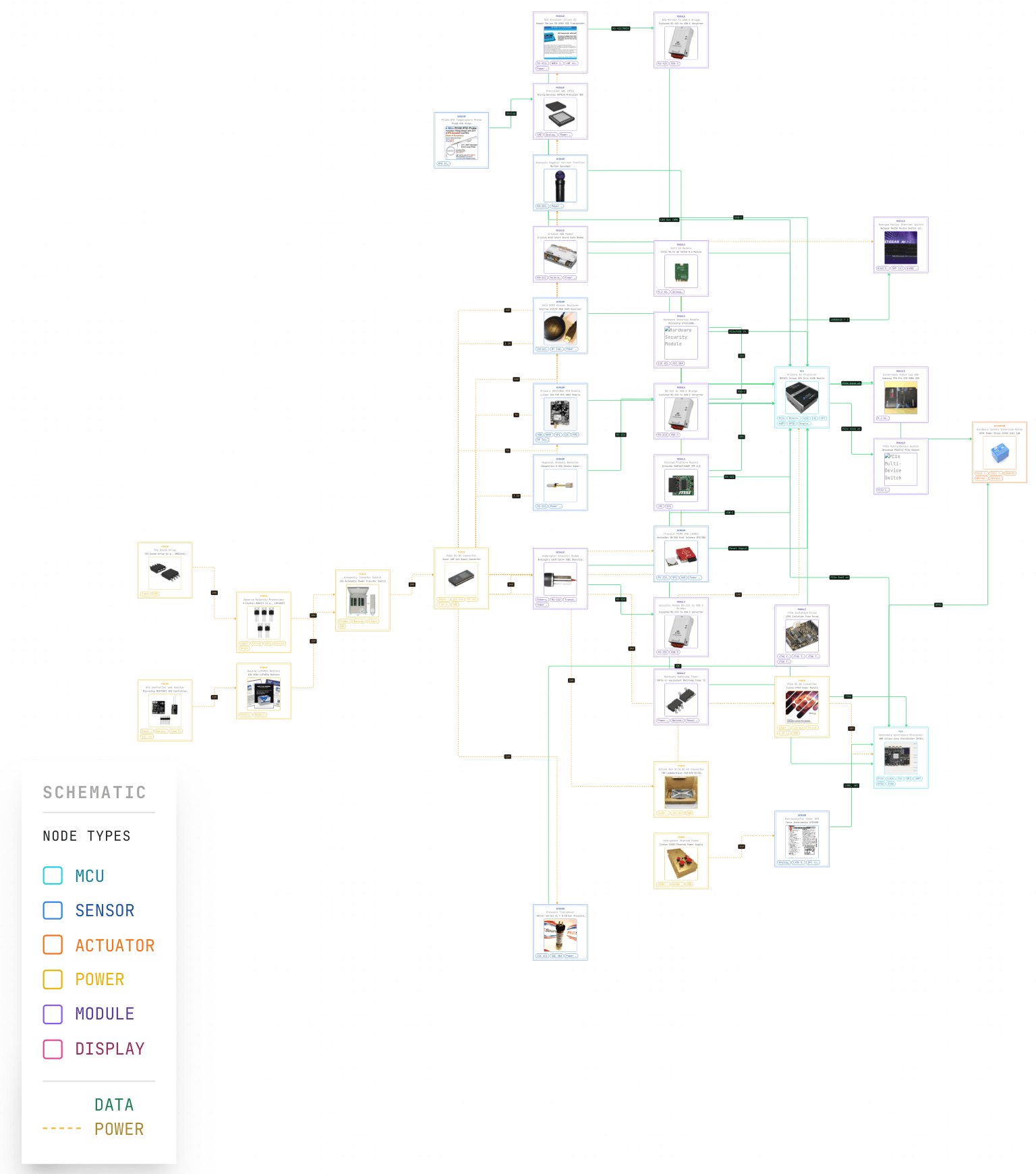
System Schematic

84 components, 84 electrical connections, 54 mechanical connections. Color-coded by node type.

BLADE-MARITIME full system schematic
Download Schematic (SVG) Download Blueprint (PDF)

Governance Simulation Environment

The BLADE-MARITIME simulator (v3.11, 4,897 lines) executes the complete 9-module governance pipeline with 13 fault injection scenarios, split-screen GIUK Gap mission map, COLREGs compliance, EEZ/UNCLOS boundaries, SVP/thermocline sonar model, 3-link comms model (SATCOM/HF/UHF), C2 dead-man switch, HOTL authority escalation, and HITL WebSocket bridge for MAVLink/ROS 2 integration.

13 Fault Scenarios

Submarine detection, AIS spoofing, acoustic spoofing, GNSS spoofing, sea-state noise, acoustic modem loss, compound attack, MAD jamming, CARA trigger, HOTL timeout, COLREGs violation, EEZ breach, C2 dead-man switch

HITL Bridge

WebSocket relay (blade_maritime_relay.py) bridges browser simulation to MAVLink/ROS 2 for hardware-in-the-loop integration.

Statistical Rigor

G*Power justified (α=0.05, power=0.80, d=0.80). Bonferroni correction. Shapiro-Wilk normality tests.

Launch Governance Simulator (v3.11)

Validation Metrics

84
Hardware nodes
13
Fault injection scenarios
4
Maritime math extensions
84
Electrical connections
54
Mechanical connections
2
Dual-GPIO interlock legs

Threat Scenario Performance Envelopes

Threat ScenarioDetection MethodEst. PdEst. PfaRangeLatency
Submarine (Sea State 1–2)Acoustic + MADPd 0.90–0.95Pfa <10⁻⁴1–2 km600–1,100ms
Submarine (Sea State 3–4)Acoustic (damped)Pd 0.70–0.80Pfa <5×10⁻³Reduced600–1,100ms
AIS Spoofing (d >200m)ADARA gatePd ~0.90Pfa <0.0254 nm AIS1–30s
Acoustic SpoofingD-S cross-validationMAD confirms<1s
GNSS SpoofingF9P vs DGPSCross-check<1s
Acoustic Modem LossCARA GREP5s timeoutCARA Phase I
Sea-State Noise (Beaufort 4+)α(H) dampingAuthority 50%Continuous
Compound AttackD-S collapseτ→A0EFFECTOR OPEN

Performance envelopes are design targets pending TEMP validation. Submarine detection requires MAD + hydroacoustic fusion (SATA D-S combination). All values from paper Tables 10–13.

Project Status

System architecture (84 components)
Electrical design (84 connections)
Mechanical design (54 connections)
BOM verified (~$43,477)
Governance simulator v3.11 (13 scenarios)
Zenodo publication (DOI assigned)
Dual-GPIO safety interlock design
Cross-domain portability validated
Custom carrier board fabrication
IP68 / MIL-STD-810G qualification testing
TLA+/UPPAAL formal verification
MAVLink/ROS 2 + ASV HIL integration
Current Limitations: Simulation-only evidence (no physical data). MIL-STD-810G qualification pending. Invariants simulation-checked but not formally proven. Custom carrier PCB not yet fabricated. Synthetic parameters uncalibrated against physical sensors. Browser JS engine provides no real-time guarantees.

Project Documentation

Complete engineering documentation for the BLADE-MARITIME Governance Node. All files are original work by Burak Oktenli. Published under CC BY 4.0.

Reproducible Research Artifacts

All data, simulation code, engineering artifacts, and the interactive governance simulator are openly available at DOI: 10.5281/zenodo.19246785 under CC BY 4.0. No access restrictions apply.

System Design

Research paper (20 pages), blueprint PDF, schematic SVG, 84-component BOM, electrical/mechanical JSON. Full engineering specification.

Simulation

v3.11 simulator with 13 fault injection scenarios, seeded PRNG (Mulberry32), dual-GPIO relay model, SHA-256 + ECDSA P-384 audit chain, HSM/TPM latency. 13 fault scenarios with HITL WebSocket bridge.

Statistical Methodology

G*Power sample size justification, Bonferroni correction, Shapiro-Wilk normality tests, paired t-tests, Wilcoxon signed-rank for non-normal data.

Standards Compliance

IP68 / MIL-STD-810G / MIL-STD-461G CE102 design targets. DoDD 3000.09 governance compliance. FIPS 140-2 key storage. SubConn underwater connectors.

Future Work

At-Sea Deployment Testing

At-sea deployment testing with acoustic modem mesh, hydrophone array calibration, and MAD boom integration

Formal Verification

TLA+/UPPAAL full verification of all design invariants and safety properties across all configurations

Carrier Board Fabrication

4-layer controlled-impedance PCB design, fabrication, and integration testing with all 84 components

Environmental Certification

MIL-STD-810G environmental qualification (salt fog, vibration, shock), MIL-STD-461G CE102 chamber testing, IP68 immersion validation

Role in the Governance Stack

The BLADE-MARITIME Governance Node demonstrates that the authority-governed autonomy pipeline is domain-agnostic. The same governance architectures (SATA, HMAA, ADARA, MAIVA, FLAME, CARA) demonstrated in defense (BLADE-EDGE, ~$139K) apply directly to maritime autonomous systems (~$43K) under different regulatory frameworks.

Related platforms: Rover Testbed (~$484) · UAV Platform (~$4,200) · BLADE-EDGE (defense, ~$139K) · BLADE-AV (automotive, ~$16K) · BLADE-MARITIME (maritime, ~$43K) · BLADE-INFRA (infrastructure, ~$12K). Six platforms demonstrating governance stack portability across four domains.

SDK Integration

The BLADE Governance SDK provides a unified API across all four domains. The same blade_governance library drives defense weapons governance (BLADE-EDGE), autonomous vehicle authority (BLADE-AV), maritime surveillance (BLADE-MARITIME), and critical infrastructure protection (BLADE-INFRA). Only the domain configuration file changes.

blade_maritime.yaml Maritime (ASV Surveillance)
domain: maritime
pipeline: SATA → ADARA → IFF → HMAA → MAIVA → FLAME → CARA → BDA → EFFECTOR

sensors:
  - id: hydroacoustic
    type: reson_tc4032_sonar
    weight: 0.30
    cross_validate: [mad_sensor, ais_receiver]
  - id: mad_sensor
    type: geometrics_g882_magnetometer
    weight: 0.25
    cross_validate: [hydroacoustic]
  - id: ais_receiver
    type: ais_dual_channel
    weight: 0.20
    cross_validate: [radar_nav, hydroacoustic]
  - id: radar_nav
    type: furuno_drs6a_x
    weight: 0.15
    cross_validate: [ais_receiver]
  - id: sea_state
    type: wave_height_sensor
    weight: 0.10
    authority_damping: true  # α(H) = exp(-γH)

effector:
  type: dual_gpio_spdt_relay
  relay: normally_open_24vdc
  safety_standard: MIL_STD_810G
  interlock: zynq_pass_AND_jetson_approve
  fail_safe: station_keeping

authority:
  A3_threshold: 0.80  # Full autonomous patrol
  A2_threshold: 0.55  # Reduced patrol area
  A1_threshold: 0.30  # Station-keeping only
  A0_action: all_stop  # Relay opens, drift
  hysteresis_up_s: 12
  hysteresis_down_s: 0
  sea_state_damping:
    gamma: 0.25       # m⁻¹ damping coefficient
    max_wave_m: 4.0   # Authority floor at Sea State 6+
integration_example.py Python
import blade_governance as bg

# Initialize with maritime domain config
pipeline = bg.GovernancePipeline("blade_maritime.yaml")

# In your ASV control loop (20Hz):
while patrol_active:
    sensors = get_maritime_sensors()
    sea_state = get_wave_height()
    
    result = pipeline.evaluate(sensors, sea_state=sea_state)
    # result.trust            → 0.78
    # result.authority        → "A2"  (sea-state damped)
    # result.ais_deception_p  → 0.12
    # result.damping_alpha    → 0.73  (1.2m waves)
    
    if result.ais_deception_p > 0.5:
        pipeline.flag_phantom_vessel(track_id)
ROS 2 Topic Map
# ROS 2 Topic Map — Maritime
/blade/sata/fused_trust          # Float64 τ ∈ [0,1]
/blade/sata/hydroacoustic_trust  # Float64 sonar channel
/blade/sata/mad_trust            # Float64 MAD channel
/blade/hmaa/authority_level      # UInt8 {A3,A2,A1,A0}
/blade/hmaa/sea_state_damped     # Float64 α(H) adjusted
/blade/adara/ais_deception_risk  # Float64 phantom vessel P
/blade/maiva/acoustic_consensus  # SwarmConsensus
/blade/cara/grep_phase           # String {GUARD,REDUCE,...}
/blade/effector/relay_state      # Bool (SPDT open/closed)
Unified API Surface SAME ACROSS ALL 4 DOMAINS
# Core API — domain-agnostic
pipeline = bg.GovernancePipeline(config)
result   = pipeline.evaluate(sensors)
recovery = pipeline.cara_recover()

# result object — universal fields
result.trust          # Float64  τ ∈ [0,1]
result.authority      # String   {A3,A2,A1,A0}
result.deception_p    # Float64  P(adversarial)
result.flame_hold_ms  # UInt32   deliberation window
result.execute        # Bool     action permitted
result.relay_state    # Bool     hardware interlock
result.grep_phase     # String   CARA state

# Lifecycle
pipeline.get_audit_chain()   # Hash-chained log
pipeline.export_forensics()  # BLADE-BLACKBOX
pipeline.get_config()        # Current domain cfg

Cross-Domain Portability: The blade_governance SDK uses the same evaluate()result API across all four domains. Switching from defense weapons governance to autonomous vehicle authority requires changing only the YAML configuration file — not the application code. This is how the same governance pipeline operates under DoDD 3000.09, ISO 26262 ASIL-D, MIL-STD-810G, and SIL 3 / NERC CIP simultaneously.

About This Project

The BLADE-MARITIME Governance Node is part of the authority-governed autonomy research program by Burak Oktenli at Georgetown University (M.P.S. Applied Intelligence). It is the third domain instantiation — extending the governance architectures demonstrated in defense (BLADE-EDGE) and automotive (BLADE-AV) to maritime autonomous surface vehicles, with four maritime-specific mathematical extensions.

Related architectures: SATA · HMAA · CARA · MAIVA · FLAME · ADARA

View full research portfolio →