BLADE-SPACE = Beam-Layer Authority for Directed Engagements, Space-Edge Node
A radiation-tolerant, hot-redundant orbital governance node that serves as the ethical decision-making authority for autonomous LEO platforms, determining in real-time whether systems should EXECUTE, DELAY, ABORT, or enter CARA safe-mode based on multi-sensor trust consensus - operating beyond ground-loop latency.
Preliminary Design Phase (TRL 2-3) · 15-Document Engineering Package · DOI 10.5281/zenodo.20183269This is NOT a weapon. It is a space-qualified governance layer - a radiation-tolerant, hot-redundant hardware-enforced ethical checkpoint between autonomous orbital platforms and authority-gated actions (propulsive maneuvers, payload firing, rendezvous-proximity operations). The platform extends DoD Directive 3000.09 and human-judgment governance into the space domain, beyond ground-loop latency.
Engineering Package: 15 engineering design documents in blade-space-repo.zip - System Requirements Document (25 traceable requirements), Requirements Traceability Matrix, FMEA (35 failure modes, 7 catastrophic), Hazard Analysis (10 hazards, 3 critical with three-fault-tolerant mitigations), V&V Plan (20-test campaign), Power / Mass / Thermal Budgets, 11 Interface Control Documents, Reliability Analysis, Radiation Analysis (30 krad TID, SEU/SEE), Assembly & Integration Plan, Configuration Management Plan. Published on Zenodo: DOI 10.5281/zenodo.20183269.
Autonomous orbital platforms - rendezvous-proximity operations spacecraft, satellite servicing systems, distributed-spacecraft constellations, and orbital defense platforms - must execute authority-gated decisions (propulsive maneuvers, payload firing, RPO maneuvers) beyond ground-loop latency. A LEO platform may have minutes between command opportunities; some maneuvers must be authorized in seconds.
The space governance problem is structurally identical to the terrestrial autonomous-weapons governance problem (DoD Directive 3000.09 "appropriate levels of human judgment") but with three additional constraints: radiation environment (Single-Event Upsets corrupt computation deterministically), thermal cycling (-40 °C to +60 °C operating), and absolute repairability (no field maintenance after launch). Software-only governance cannot meet these constraints.
The BLADE-SPACE Governance Node aligns directly with NASA SBIR 2026 Subtopic EXPAND.3.S26B (Autonomous Onboard Health Management for Small Spacecraft and Distributed Systems) and addresses the published Phase I expectation at TRL 3, with hot-redundant rad-tolerant compute, ECDSA-anchored audit chain, and three-fault-tolerant safety interlock on the payload/thruster firing path.
Autonomous orbital platforms operate beyond ground-loop latency yet must execute authority-gated decisions in real time. Existing approaches either delegate every decision to ground (incompatible with constellation-scale autonomy) or accept software-only governance that cannot survive SEU corruption, brown-outs, or radiation-induced compute path failures.
The BLADE-SPACE platform addresses five orbital governance gaps:
This platform demonstrates that the AUTHREX authority-governance stack ports cleanly from defense (BLADE-EDGE) to the orbital domain by addressing radiation, thermal, and reliability constraints with hot-redundant rad-tolerant compute, ECDSA-anchored audit, and three-fault-tolerant safety interlocks.
The BLADE-SPACE extends the authority-governance stack from terrestrial defense (BLADE-EDGE) to the orbital domain. The 9-stage pipeline is preserved; the difference is in the environmental envelope and the failure modes the hardware must tolerate.
Microchip RTG4 FPGA (part-level TID 100 krad per datasheet, SEL immune) primary + backup with lockstep voting; Aitech S-A1760 Venus SBC primary + backup with Latching Current Limiter trip on SEU latch-up; SEU monitor IP + scrubber re-loads bitstream on detected upset. System-level TID allocation is 30 krad after 3 mm Al equivalent shielding margin.
Payload/thruster firing line gated through two independent normally-open solid-state relays (path A and path B) that must both close to permit firing, plus pyrotechnic isolation circuit with hardwired safe-arm plug during ground handling (per SR-004, SR-401)
P-256 keypair anchored in rad-tolerant TPM signs every audit-chain entry; hash continuity maintained across reboots, brown-outs, and failover events (SR-008); ECDSA signature throughput ≥ 100/second (SR-105)
On ABORT verdict, system enters automatic magnetorquer detumble + sun-pointing safe-mode (SR-007). Backup IMU (Honeywell HG1700) provides ≤ 30 min dead-reckoning if GNSS lock lost; star-tracker correction observation update
The platform demonstrates that AUTHREX governance is domain-agnostic: the same 9-stage pipeline that governs ground-based directed-energy engagement on BLADE-EDGE governs propulsive maneuvers and payload firing on BLADE-SPACE, with environmental tolerances scaled to the orbital regime.
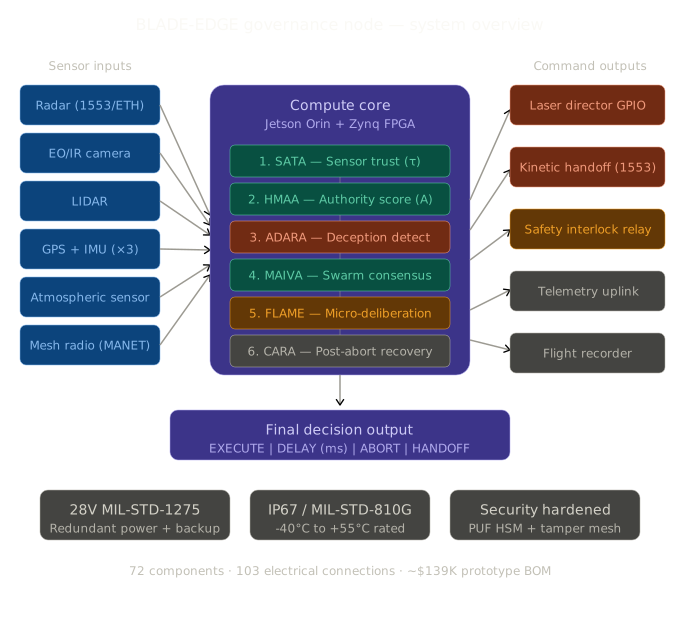
The BLADE-EDGE receives data from six sensor categories, processes it through a 9-stage governance pipeline on dual-redundant compute hardware, and outputs one of four decisions: EXECUTE, DELAY, ABORT, or HANDOFF.
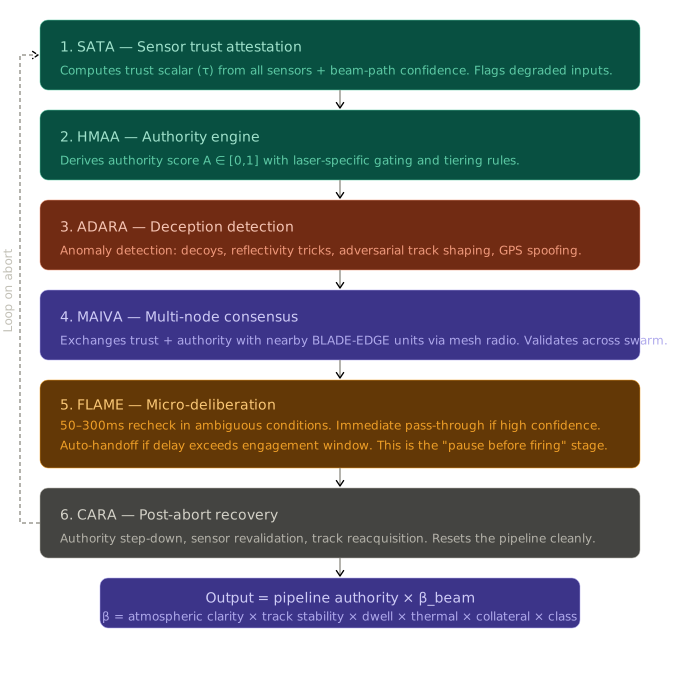
Every engagement decision passes through nine sequential modules targeting 50-300ms end-to-end latency. Each stage can independently trigger an ABORT, preventing downstream execution.
Computes trust scalar τ from ALL sensor inputs combined with beam-path confidence scoring. Atmospheric sensors measuring humidity, obscurants, and turbulence feed directly into trust computation because a clear sensor picture is useless if the beam cannot reach the target.
GPU-accelerated anomaly detection targeting decoys, reflectivity manipulation, adversarial track shaping, GPS spoofing, and sensor-to-sensor inconsistency. Any deception flag independently triggers ABORT.
Verifies target classification against known friendly signatures. Prevents fratricide through cryptographic IFF challenge-response before authority confirmation.
Derives authority score A with laser-specific gating: target classification tiers, engagement authorization levels, dwell feasibility, atmospheric propagation, and thermal management before granting authority.
Exchanges trust and authority values with nearby BLADE-EDGE units via encrypted MANET mesh radio. Byzantine fault-tolerant consensus ensures no single compromised node can fool the swarm.
Enforces 50-300ms recheck windows before firing in ambiguous conditions. Three modes: immediate pass-through (high confidence), micro-deliberation (ambiguous), auto-handoff (engagement window exceeded).
Post-abort recovery: steps authority to zero, revalidates all sensors from scratch, re-acquires target track, feeds back to SATA for fresh trust computation. Prevents false confidence buildup from abort cycling.
Post-engagement sensor revalidation. Confirms engagement outcome, updates target track state, and feeds back to SATA for trust recomputation before next engagement cycle.
Normally-open hardwired safety relay. Closes ONLY when the full 9-stage pipeline confirms authority. Physical circuit break prevents engagement without verified governance chain.
The BLADE-EDGE outputs one of four decisions based on pipeline authority and beam suitability. Unlike binary fire/no-fire systems, the governance model provides graduated response with automatic effector handoff.
Full pipeline authority confirmed. Beam conditions favorable (β_beam > threshold). Safety interlock relay closes. Engagement authorized.
Ambiguous conditions detected by FLAME. System holds for 50-300ms micro-deliberation, re-queries sensors, re-runs ADARA, re-checks MAIVA consensus.
Trust collapse, deception detected, or consensus failure. Safety interlock remains open. CARA recovery initiates: authority zeroed, sensors revalidated from scratch.
Pipeline authority confirmed but beam conditions unfavorable (atmospheric turbulence, thermal limits). Engagement transferred to kinetic interceptor via MIL-STD-1553.
The safety interlock relay is physically hardwired normally-open, the weapon literally cannot fire unless the BLADE-EDGE actively confirms full authority through all six pipeline stages. This is hardware-enforced governance, not software-only.
The BLADE-EDGE implements SATA trust evaluation across six sensor categories simultaneously. Each feed is independently evaluated for signal integrity, noise floor, expected pattern consistency, and cross-correlation with other sensors. The output is a single trust scalar τ ∈ [0,1].
Trust(s_i) = weighted belief function with beam-path confidence integration.
Cross-sensor validation: radar + EO/IR + LIDAR + GPS/IMU + atmospheric.
A degraded GPS signal reduces τ even if radar is strong.
Atmospheric sensors feed directly into trust computation (beam propagation feasibility).
Key innovation: beam-path confidence is integrated at the trust layer rather than post-pipeline. Atmospheric sensors measuring humidity, obscurants, and turbulence feed directly into SATA because a clear sensor picture is useless if the directed-energy beam cannot reach the target. This tight coupling between sensing and beam physics is unique to BLADE-EDGE.
BLADE-SPACE is built on rad-tolerant hot-redundant space-grade hardware. All compute paths are dual-string with SpaceWire bridge voting and < 200 ms failover. Sensors are independently dual-sourced (star tracker, GNSS, IMU, sun sensor, magnetometer) and cross-validated through the SATA sensor trust module and ADARA multi-constellation correlation.
| Component | Model | Qty | Role |
|---|---|---|---|
| Main Compute FPGA | Microchip RTG4 (RT4G150) | 1 | Rad-tolerant programmable logic, primary pipeline |
| Backup Compute FPGA | Microchip RTG4 (RT4G150) | 1 | Hot standby with SpaceWire bridge voting |
| Main Space SBC | Aitech S-A1760 Venus | 1 | Rad-tolerant PowerPC, primary application processor |
| Redundant Space SBC | Aitech S-A1760 Venus | 1 | Hot standby; LCL trip + failover < 200 ms |
| DDR4 ECC SDRAM | Rad-hard DDR4 ECC Module | 1 | Compute memory with ECC scrubbing |
| QSPI NOR Flash | Rad-hard QSPI NOR Flash | 1 | FPGA bitstream + boot |
| Secure Boot TPM | Microchip CEC1712 | 1 | Boot-chain attestation, key isolation |
| SpaceWire Transceivers | Cobham UT200SpW | 4 | Compute-to-subsystem high-speed bus |
| Component | Model | Qty | Role |
|---|---|---|---|
| Star Tracker (Main + Redundant) | Blue Canyon Technologies NST100 | 2 | ≤ 30 arcsec 3σ attitude knowledge (SR-102) |
| GNSS Receiver (Main + Redundant) | NovAtel OEM7600-RG | 2 | ≤ 5 m 1σ dual-fix position; ADARA spoof detection |
| Tactical IMU (primary) | Sensonor STIM-300 | 1 | ≤ 0.5 °/hr bias stability (SR-104) |
| Backup IMU | Honeywell HG1700 | 1 | 30-min dead-reckoning during GNSS lock loss |
| Sun Sensors | Adcole Micro Digital | 2 | Coarse attitude for safe-mode sun pointing |
| Magnetometers | ZARM 3-axis | 2 | Magnetic field reference for magnetorquer control |
| Radiation Dosimeter | RadFET / PiN-diode | 1 | TID accumulation tracking |
| PT1000 Thermistor Array | Custom array | 1 | Multi-point chassis + LRU temperature monitoring |
| Vacuum Pressure Sensor | Setra Model 712 | 1 | Outgassing monitoring |
| Component | Model | Qty | Role |
|---|---|---|---|
| S-band TT&C Transceiver | Syrlinks EWC27 (Main + Redundant) | 2 | Ground command/telemetry; hot redundant |
| Optical ISL Transceiver | Laser Light Communications | 1 | High-rate inter-satellite link |
| CAN Bus Transceivers | Rad-hard (Main + Redundant) | 2 | Low-rate subsystem bus |
| Link Encryptor | Microchip ATECC608B + AES-256-GCM FPGA IP (Main + Redundant) | 2 | RF link confidentiality + integrity |
| Security TPM Module | Space-grade Rad-tolerant TPM | 1 | ECDSA P-256 anchor for audit chain (SR-003) |
| Secure Boot/Key Flash | Macronix MX25L Rad-tolerant | 1 | Sealed key storage |
| Electronic Tamper Mesh Controller | Custom ASIC/FPGA | 1 | Tamper detection alarm |
BLADE-SPACE operates on a 28V regulated spacecraft bus with EMI filter, power sequencer, Latching Current Limiter array, and three VPT DC-DC converters producing 12 V, 5 V, and 3.3 V rails. Saft VES16 8S1P Li-Ion (135 Wh) provides eclipse + safe-mode ride-through; supercapacitor bank handles thruster-firing transients. 12 hot-redundant component pairs ensure no single point of failure on critical paths.
| Primary | Backup | Failover Strategy |
|---|---|---|
| RTG4 FPGA primary | RTG4 FPGA backup | SpaceWire bridge voting + bitstream scrubber |
| Aitech SBC primary | Aitech SBC backup | LCL trip + watchdog + auto-failover < 200 ms |
| Star Tracker main | Star Tracker redundant | Failover on CAN heartbeat loss |
| NovAtel GNSS main | NovAtel GNSS redundant | Cross-validation + ADARA spoof detection |
| Sensonor STIM-300 IMU | Honeywell HG1700 IMU | Cross-validate; 30-min HG1700 dead-reckoning |
| Sun Sensor 1 | Sun Sensor 2 | Independent attitude estimate |
| Magnetometer 1 | Magnetometer 2 | Independent magnetic field estimate |
| Syrlinks S-band TT&C main | Syrlinks S-band TT&C redundant | Independent RF chain |
| CAN transceiver main | CAN transceiver redundant | Bus A/Bus B redundancy |
| Link Encryptor main | Link Encryptor redundant | Independent crypto chain |
| Thruster SSR path A | Thruster SSR path B | Both must close for firing (SR-004) |
| Main Li-Ion battery | Redundant Li-Ion battery | BMS-controlled isolation |
| Mode | Load (W) | Conv. Loss (W) | Bus Draw (W) | Current @ 28V |
|---|---|---|---|---|
| Nominal cruise | 112.5 | 22 | 134.5 | 4.8 A |
| Pipeline active + comms TX | 145 | 26 | 171 | 6.1 A |
| Peak (comms TX + thruster prep) | 165 | 28 | 193 | 6.9 A |
| Eclipse safe-mode | 35 | 9 | 44 | 1.6 A |
PDR margin: 34% (193 W peak vs 250 W bus allocation). Battery cycle-life budget: ~30,000 cycles @ 20% DoD over 5 years - acceptable for design life.
Space-grade aluminum chassis with 3 mm Al equivalent shielding (30 krad TID); ASTM E595 outgassing-compliant materials (TML < 1.0%, CVCM < 0.1%); hardwired safe-arm plug for pyrotechnic isolation during ground handling.
Electronic tamper mesh controller raises alarm on probe attempt; LCL trip on SEU-induced latch-up < 1 ms; hardware watchdog forces reset on hang; SEU monitor IP + scrubber re-loads FPGA bitstream on detected upset.
ECDSA P-256 keypair anchored in rad-tolerant TPM; signs every audit-chain entry with hash continuity across reboots/brown-outs/failover (SR-003, SR-008); ≥ 100 signatures/sec throughput (SR-105); dual link encryptors for RF chain redundancy.
91 components consolidated from the 124-component pre-cleanup design. Cost reflects rad-tolerant and space-qualified parts at single-unit / engineering-model pricing. Full parts manifest with manufacturer, MPN, and source URLs is in the engineering package.
| Subsystem | Mass (kg) | Allocation |
|---|---|---|
| Compute (RTG4 ×2, Aitech ×2, memory, bridge) | 1.95 | 17.7% |
| Sensors (star tracker, GNSS ×2, IMU ×2, sun ×2, mag ×2, dosimeter, thermistor) | 2.30 | 20.9% |
| Communications (Syrlinks, optical ISL, antennas, transceivers, encryptors) | 1.30 | 11.8% |
| Power (Saft VES16, DC-DCs ×3, LCL, supercaps, EMI filter) | 1.60 | 14.5% |
| Mechanical / Thermal (chassis, radiator, LHP ×2, CCHPs, MLI, indium pads) | 2.20 | 20.0% |
| Actuation (SSRs, drivers, relays, servos) | 0.50 | 4.5% |
| Security (TPM, secure flash, tamper mesh, crypto coprocessor) | 0.25 | 2.3% |
| Connectors / harness / 12-layer PCB | 0.90 | 8.2% |
| Dry mass total | 11.00 | 100% |
Reference cost of $505,440 reflects rad-tolerant and space-qualified single-unit pricing. The top three cost drivers are typically the optical ISL transceiver, the dual-redundant SBC + FPGA compute stack, and the dual-redundant TT&C transceivers. The engineering package contains the full per-line BOM CSV with manufacturers, MPNs, export-control classifications, and source URLs.
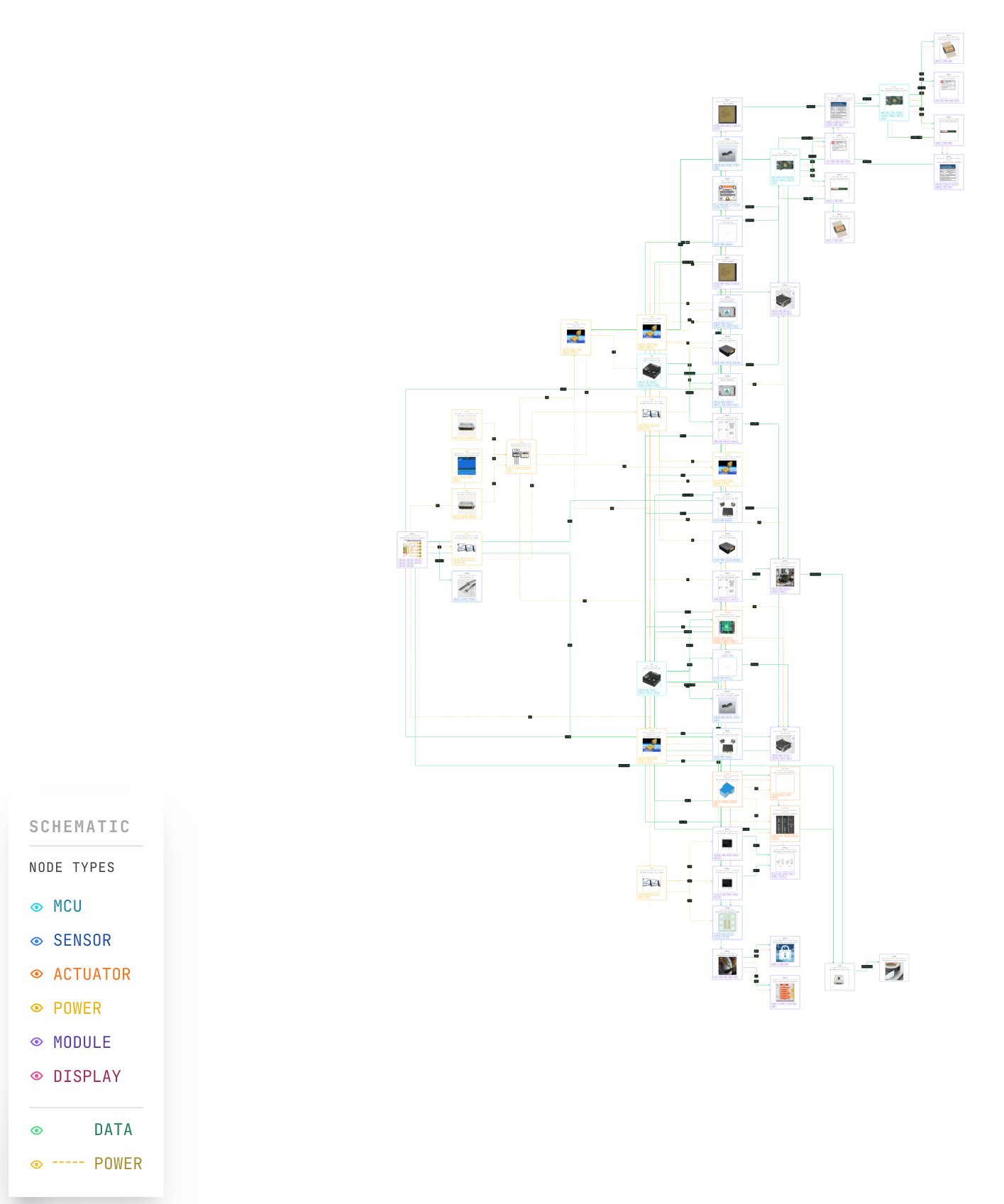
91 components, 134 electrical connections (53 power + 81 data), 117 mechanical connections. All critical paths hot-redundant with SpaceWire bridge voting and Latching Current Limiter trip on SEU latch-up.
The accompanying browser-based simulation implements the 9-stage governance pipeline (SATA → ADARA → IFF → HMAA → MAIVA → FLAME → CARA → BDA → EFFECTOR) with adversarial scenarios including GNSS spoofing, SEU compute upset, sensor degradation, and consensus-fault injection. The simulator executes the actual pipeline algorithms specified in the Preliminary Design data package.
The BLADE-EDGE Governance Node represents the defense-grade implementation of the authority-governed autonomy framework. All seven governance architectures (SATA, HMAA, ADARA, MAIVA, FLAME, CARA, ERAM) are specified for hardware implementation within this platform design, extending the research from simulation to a detailed reference architecture (TRL 2-3) intended for testbed-grade implementation in contested-environment scenarios.
Related platforms: Rover Testbed (~$484) · UAV Platform (~$4,200) · BLADE-EDGE (defense, ~$139K) · BLADE-AV (automotive, ~$16K) · BLADE-MARITIME (maritime, ~$43K) · BLADE-INFRA (infrastructure, ~$12K) · BLADE-AGENT-HSM (agentic AI, ~$199). Nine platforms demonstrating governance stack portability across seven domains (including the orbital BLADE-SPACE Preliminary Design, TRL 2-3).
The BLADE-SPACE V&V Plan specifies a 20-test verification campaign with pass/fail criteria, equipment lists, and method per test. The plan covers functional, performance, environmental, reliability, and safety requirements from the SRD.
Three open Critical Items List entries (DC-DC single-string failures) require redundant converter addition before Critical Design Review. Vibration/TVAC/EMC qualification reports do not yet exist; V&V Plan specifies the campaign that will produce them.
Complete BLADE-SPACE Governance Node Preliminary Design Phase data package (15 engineering design documents). All files are original work by Burak Oktenli (Georgetown University, M.P.S. Applied Intelligence).
This project provides complete reproducible artifacts enabling independent verification of the system design, component selection, and governance architecture.
Full schematic SVG (200 KB), CONFIG.json master configuration, ELECTRICAL_CONNECTIONS.json (134 connections), MECHANICAL_CONNECTIONS.json (117 attachments), all originals in the engineering package.
91-component PARTS.csv with manufacturer, MPN, description, export-control classification, cost, and source URL. Open the file in any spreadsheet tool; values reproduce the BOM table on this page.
VV_PLAN.md specifies the 20-test campaign with pass/fail criteria, equipment lists, and method per test. RTM.md links every SRD requirement to the test that verifies it.
DoDD 3000.09 (autonomy authority), NASA SBIR EXPAND.3.S26B (spacecraft health management), GEVS vibration, ASTM E595 outgassing, NIST AI RMF.
The BLADE-SPACE Preliminary Design represents TRL 2-3. The roadmap below progresses through Critical Design Review (TRL 4), engineering-model fabrication (TRL 5), relevant-environment qualification (TRL 6), and operational infusion paths aligned with active U.S. Government programs. Each milestone is mapped to a specific funding vehicle or research initiative where the design is positioned to compete.
Submit Phase I proposal to EXPAND.3.S26B - Autonomous Onboard Health Management for Small Spacecraft and Distributed Systems under the NASA SBIR/STTR Program Year 2026 BAA (released 17 April 2026, valid through 30 September 2027). The subtopic explicitly accepts terrestrial Earth-analog testbed demonstrations in Phase I, with Phase II advancing to flight-hardware validation and Phase III to operational infusion. BLADE-SPACE's 9-stage governance pipeline maps directly to the subtopic's call for "continuous on-board health management capabilities to detect anomalies, diagnose, isolate" faults - particularly the unknown-fault response requirement (up to 40% of failure modes go unidentified through Key Decision Point E).
Surface the 11 Interface Control Documents publicly (currently in ZIP only); add Requirements Traceability Matrix excerpt; declare NASA-STD-8739.8 software safety class (Class B target for firing-path firmware); add NASA-STD-8719.27 lithium-battery hazard analysis for Saft VES16; build ESATAN-TMS network thermal model with worst-hot / worst-cold orbital cases; publish AP9/AE9 or SPENVIS orbit-environment run output backing the 30 krad TID system-level allocation; add ITAR USML Category XV(e) export-control flag on documentation cover.
Class V QML / Class S parts procurement (12-18 month lead time for rad-hard T2080 and RTG4); flight-harness fabrication per NASA-STD-8739.4; ESD-controlled clean-room assembly per ISO 14644 Class 8. Engineering Model build with single-string electrical functional validation, then assembly to flight-hardware-equivalent (FHE) configuration with full hot-redundant pairs.
Integrate the AUTHREX 9-stage authority pipeline with AFRL's STARS (Safe Trusted Autonomy for Responsible Spacecraft) Run-Time Assurance framework (an AFRL Seedlings for Disruptive Capabilities program). This is a proposed research-alignment target; no affiliation, sponsorship, or funding relationship exists. Map the HMAA authority-graduation model onto the published STARL (Space Trusted Autonomy Readiness Levels) scale. The HMAA hardware-enforced authority gating is complementary to STARS RTA safety-filtering and provides the physical-layer enforcement that RTA assumes but does not implement.
Vibration to GSFC-STD-7000A GEVS qualification levels (14.1 g_rms random, 5 minutes/axis); 1000 g half-sine pyrotechnic shock per MIL-STD-810G Method 516.7; TVAC across -55°C to +85°C at <10⁻⁵ Torr; ASTM E595 outgassing (TML <1.0%, CVCM <0.1%); MIL-STD-461G EMC against CE102 / CS101 / RE102 / RS103 / CS114; helium leak per pressurized vessel applicable items.
Single-event characterization at TAMU Cyclotron Institute or LBNL 88-Inch Cyclotron over LET 0.5-80 MeV·cm²/mg per JESD57. Measure FPGA configuration upset cross-section, SBC latch-up threshold, DDR4 ECC scrub margin. Validate the 100 krad part-level / 30 krad system-level TID allocation through Co-60 gamma ray test at AFRL or DTRA-approved facility.
Align with the four 2026-2028 on-orbit servicing demonstrations: USSF/AFRL Tetra-5 (autonomous RPO + docking + inspection + refueling), Astroscale U.S. Provisioner (GEO hydrazine refueling, USSF SSC), SpaceLogistics MRV (Northrop Grumman, NRL robotic arm, DARPA-funded RSGS), and Astroscale ELSA-M (multi-client servicing/debris removal). Each demonstration requires hardware-enforced authority gating for proximity-operations maneuvers; BLADE-SPACE provides exactly that governance layer.
Position the MAIVA cross-string Byzantine consensus layer for integration with DARPA Oversight - autonomous constant custody of up to 1,000 targets with operator at aggregate level, not per-target. The BDA stage's post-event trust revalidation provides the "continual assurance" framework that DARPA Assured Autonomy specifies for Learning-Enabled Cyber-Physical Systems. Submit white-paper response to next Oversight BAA opening.
Position as the governance layer for the USSF Maneuverable GEO program (competition opened January 2026) and the broader USSF Race to Resilience initiative (FY2026 Space Force baseline appropriation $26.3B, approaching $40B with reconciliation funding via the "One Big Beautiful Bill Act"). Small / medium maneuverable commercial satellites in GEO require authority-graduated decision-making for autonomous orbit changes - the HMAA + FLAME + CARA stack is positioned for direct integration.
Multi-node MAIVA Byzantine consensus across N≥3 BLADE-SPACE governance nodes over inter-satellite optical link (Mynaric CONDOR Mk3); cross-satellite audit-chain hash continuity via ECDSA P-256 chain-of-trust; demonstrate authority-graduated decision-making across a constellation with degraded-node ride-through, swarm continuity under one-node-loss, and cross-satellite health exchange - all four primary capabilities called out in EXPAND.3.S26B.
This roadmap is contingent on funding, partnership, and procurement-pathway availability. Realistic flight-build cost (parts + AI&T NRE + flight qualification) for a 91-component rad-tolerant Class V LEO node is in the $1.5M-$2.5M range, not the $505,440 parts-only reference BOM. ITAR USML Category XV applies to multiple line items and constrains foreign-collaboration pathways. The 12-18 month lead times on Class V rad-hard parts (RTG4, Aitech S-A1760 Venus) drive Phase 2 timing. No NASA, USSF, or DARPA endorsement of BLADE-SPACE is claimed or implied; programs cited are real and current as of May 2026 and represent targeted submission vehicles, not awarded contracts.
The BLADE Governance SDK provides a unified API across all seven BLADE domains. The same
blade_governance
library drives defense weapons governance (BLADE-EDGE), autonomous vehicle authority (BLADE-AV),
maritime surveillance (BLADE-MARITIME), critical infrastructure protection (BLADE-INFRA), orbital
autonomy (BLADE-SPACE), and counter-UAS authority (BLADE-CUAS). Only the domain configuration file changes.
Cross-Domain Portability:
The blade_governance SDK
uses the same evaluate() →
result API across all seven domains.
Switching from orbital governance (BLADE-SPACE) to defense weapons authority (BLADE-EDGE) or any of the five requires changing only the YAML
configuration file, not the application code. This is how the same governance pipeline operates under
NASA-STD-5017 / NASA-STD-8739.8 / ECSS-Q-ST-30C (orbital), DoDD 3000.09 / MIL-STD-810G (defense),
ISO 26262 ASIL-D (automotive), IMO MSC.1/Circ.1455 (maritime), and SIL 3 / NERC CIP (critical infrastructure)
simultaneously, each with its domain-specific config.
The BLADE-SPACE Governance Node is part of the authority-governed autonomy research program by Burak Oktenli at Georgetown University (M.P.S. Applied Intelligence). It demonstrates mastery across 12 technical domains: radiation-tolerant FPGA design (Microchip RTG4), space-qualified compute architecture (Aitech S-A1760 Venus SBC), multi-sensor fusion under orbital conditions, NASA/ECSS standards compliance, hardware security architecture (TPM 2.0 + ECDSA P-256 secure boot), distributed consensus with SpaceWire cross-string voting, thermal-vacuum design, space power systems engineering (28V bus, eclipse-aware battery management), TID/SEU/SEL radiation hardening, real-time flight software (bare-metal RTOS), autonomous systems ethics in orbital contexts, and three-fault-tolerant safety interlock architecture for propulsive maneuvers and payload firing.
Related research architectures:
SATA (sensor trust),
HMAA (authority computation),
CARA (recovery),
MAIVA (multi-agent trust),
FLAME (latency control),
ADARA (deception-aware risk).
Companion BLADE hardware platforms:
BLADE-EDGE (defense),
BLADE-AV (automotive),
BLADE-MARITIME (maritime),
BLADE-INFRA (critical infrastructure). BLADE-SPACE (orbital) is the fifth domain instantiation of the AUTHREX governance stack.