BLADE-FINANCE = Boundary-Layer Authority for Decision Enforcement, Financial-Sector Node
A simulation-validated, software-enforced authority-arbitration reference architecture for financial-sector AI decision systems. It places a hardware-anchored governance layer between automated transaction-decision models and consequential financial actions, determining in real time whether a transaction is cleared autonomously, sent to supervised review, escalated for elevated confirmation, or placed on manual hold.
Design and Simulation Complete · Published on Zenodo · DOI: 10.5281/zenodo.20374692This is a governance layer, not a trading system or a fraud product. It is an auditable, tamper-evident checkpoint that applies the same AUTHREX authority pipeline used across the BLADE platform family to the economic-security domain, aligned to the implementation framing of the U.S. Treasury Financial Services AI Risk Management Framework and the NIST AI Risk Management Framework.
Financial institutions are deploying AI decision systems at the core of payments, lending, and fraud operations faster than assurance practice has matured. The U.S. Treasury has identified AI-specific risks to the financial system, and in 2024 issued the Financial Services AI Risk Management Framework (FS AI RMF) building on the NIST AI Risk Management Framework. The open question is not whether financial AI should be governed, but how to enforce that governance at decision time, with evidence an examiner can verify after the fact.
BLADE-FINANCE addresses that gap as fundamental research. It extends the AUTHREX authority-governed autonomy architecture, already instantiated across nine other operational domains in the BLADE platform family, into the economic-security domain. The same governance core that arbitrates authority for directed-energy, automotive, maritime, infrastructure, orbital, counter-UAS, agentic-AI, and swarm systems is applied to the financial transaction-decision loop, producing an auditable, tamper-evident record of every automated decision.
A reusable, standards-aligned method for placing a hardware-anchored authority checkpoint in front of financial AI decisions, so that consequential actions are gated by an explicit four-tier authority model and appended to a cryptographic evidence chain rather than executed silently inside a model.
Three failure modes motivate the design. First, deepfake and synthetic-identity attacks defeat authentication that trusts a single channel. Second, AI-agent coordinated attacks spread small, individually unremarkable actions across many accounts, devices, and payees so that no single transaction looks anomalous. Third, low-and-slow rings deliberately stay under per-transaction thresholds, so a real-time path that clears each transaction in isolation never sees the pattern.
A model score alone cannot answer the governance question, which is not only is this transaction risky but who is authorized to let it proceed, and what is the auditable record. BLADE-FINANCE separates the decision from the model: a transaction-decision model proposes, and an explicit authority pipeline disposes, recording its reasoning to a hash-chained ledger.
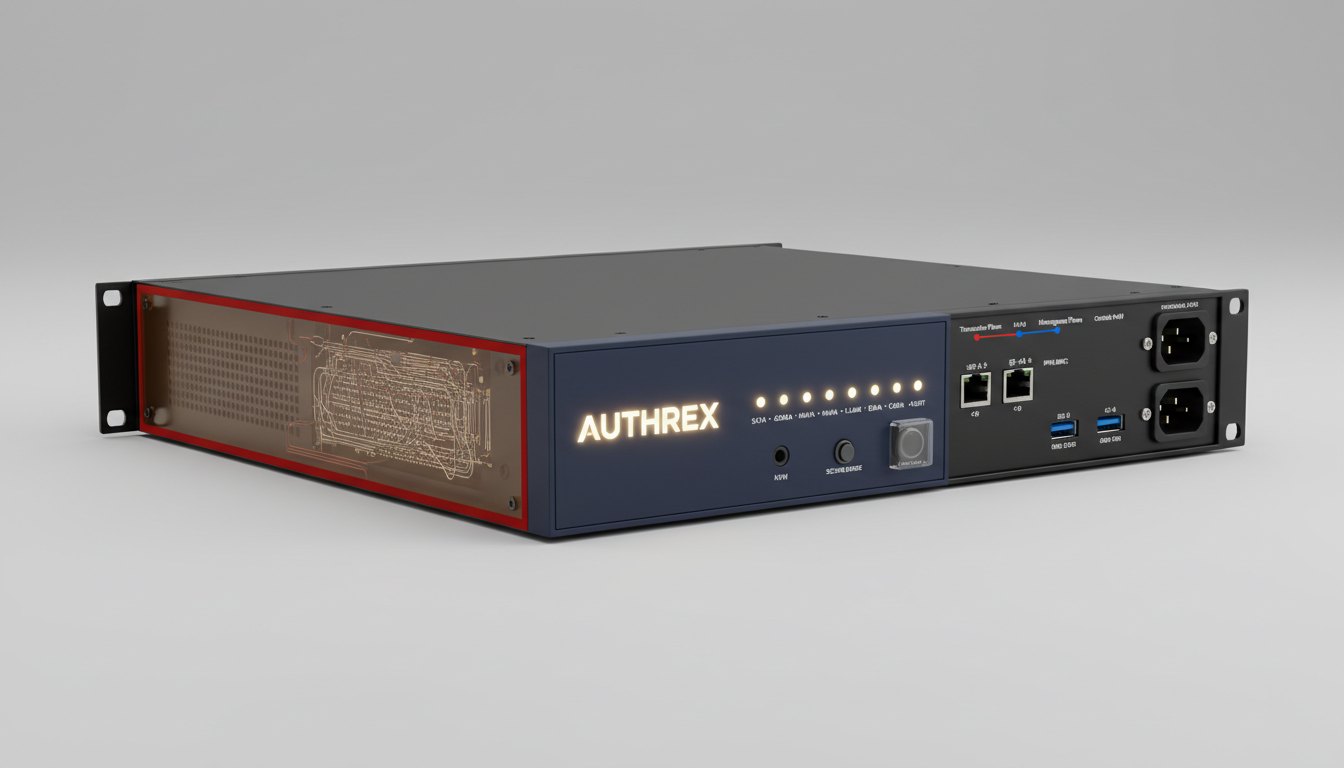
BLADE-FINANCE is a software-enforced authority-arbitration reference architecture with an accompanying reference hardware node. The software is exercised by a deterministic, fully offline browser simulator; the hardware is a 1U rack-mount reference design specified down to a complete bill of materials, but not yet built.
Every decision passes through an eight-stage AUTHREX pipeline (VALIDATE, SATA, ADARA, MAIVA, HMAA, FLAME, ERAM, CARA) and is appended to a SHA-256 evidence chain over a canonical-form serialization. A four-tier Hierarchical Multi-Attribute Authority (HMAA) model routes each transaction to one of four dispositions. A population-state coordination model scores correlated behaviour across account, device, payee, and IP-cluster history, and a retrospective stigmergic swarm-review module re-examines cleared traffic to recover coordinated rings the per-transaction path lets through.
Each transaction enters the same authority pipeline that AUTHREX applies in every BLADE domain. VALIDATE checks schema and canonical form; SATA scores input integrity and authentication trust; ADARA assesses adversarial and deepfake signals; MAIVA aggregates multi-signal agreement; HMAA computes the authority tier; FLAME enforces a latency budget; ERAM gates residual risk; and CARA defines the recovery and hold path. The decision and its inputs are signed and appended to the evidence chain.
Hierarchical Multi-Attribute Authority computes a single authority tier from the upstream stage outputs and the population-state coordination score. The tier, not the raw model score, determines the disposition, and the tier assignment is itself recorded.
| Tier | Disposition | Meaning |
|---|---|---|
| T3 | Autonomous clearance | High trust, no coordination signal, within latency budget. The transaction proceeds and is logged. |
| T2 | Supervised review | Moderate residual risk. The transaction is queued for a human reviewer with the full evidence record attached. |
| T1 | Elevated confirmation | Elevated risk or coordination signal. A stronger, out-of-band confirmation step is required before the action can proceed. |
| T0 | Manual hold | Adversarial pattern, integrity failure, or fail-closed condition. The action is blocked pending manual disposition. |
When any stage cannot reach a confident decision, when input integrity fails, or when the latency budget is exceeded, the node fails closed to a more restrictive tier rather than defaulting to clearance. Safety is the default, not an exception.
A purely per-transaction path is structurally blind to coordinated low-and-slow rings, because each transaction, examined alone, looks acceptable. BLADE-FINANCE adds a second path: a retrospective stigmergic swarm-review module that re-examines cleared traffic, scoring correlated behaviour across account, device, payee, and IP-cluster history to surface rings the real-time path lets through. The retrospective module claims ensemble agreement and ring detection, not Byzantine fault tolerance.
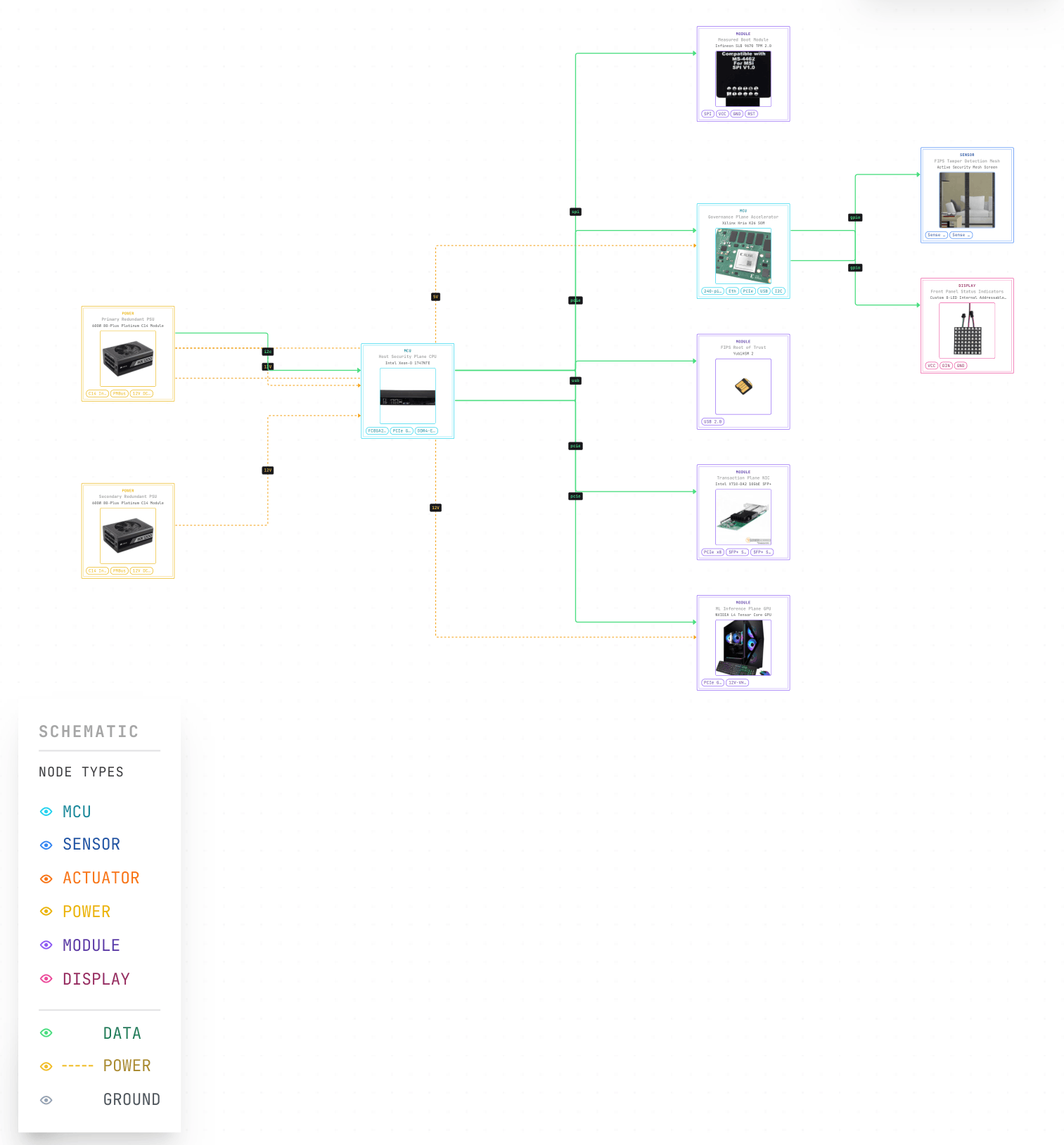
The reference authority node separates the governance plane from the inference plane so that the authority pipeline cannot be bypassed by the model it governs. A Xilinx Kria K26 System-on-Module runs the AUTHREX governance pipeline and emits ECDSA-signed per-stage audit entries; an NVIDIA L4 GPU hosts the transaction-decision model on a separate inference plane; an Intel Xeon-D host processor coordinates the transaction and management planes; and a YubiHSM 2 within a FIPS 140-2 Level 3 tamper-evident enclosure holds signing keys, with an Infineon TPM 2.0 providing measured boot.
Governance plane (Kria K26), inference plane (NVIDIA L4), host security plane (Xeon-D, TPM 2.0), and key-custody plane (YubiHSM 2, FIPS 140-2 L3 enclosure). Transactions arrive over dual 10GbE SFP+; management is isolated on 1GbE.
The reference node is fully specified: 36 components, 33 electrical connections, and 32 mechanical connections, totalling approximately US$9,228. The table lists representative high-value items; the complete bill of materials, electrical connection list, mechanical connection list, and node configuration are published as downloadable artifacts below.
| Component | Role | Cost (USD) |
|---|---|---|
| Xilinx Kria K26 SOM | Governance plane accelerator (AUTHREX pipeline, signed audit) | 3,000 |
| NVIDIA L4 Tensor Core GPU | Inference plane (transaction-decision model) | 2,500 |
| Intel Xeon-D 1747NTE | Host security plane processor | 1,200 |
| YubiHSM 2 (FIPS 140-2 L3) | Key custody and signing | 950 |
| Intel X710-DA2 10GbE SFP+ | Transaction-plane network interface | 400 |
| 2 x 600W 80-Plus Platinum PSU | Redundant power (N+1) | 400 |
| SuperChassis 512L-200B 1U | Rack-mount enclosure | 150 |
| Infineon SLB 9670 TPM 2.0 | Measured boot | 15 |
| Full reference node (36 components, 91 units) | ~9,228 | |
A 1U rack-mount server chassis (19 inch EIA-310) with a custom anodized bezel and redundant 600W C14 power supplies houses the four planes. Cooling uses six 40mm N+1 redundant hot-swap fans. The YubiHSM 2 is housed within a FIPS 140-2 Level 3 tamper-evident enclosure with epoxy potting and a screw-continuity zeroization circuit. The design targets a standard data-center rack; it is a reference specification at TRL 2, and no prototype has been built.
The reference wiring schematic captures the four planes, the hardware root of trust, the redundant power tree, and the tamper and zeroization circuit. It is provided as a scalable vector schematic and as a print-ready PDF.
A deterministic, fully offline simulator demonstrates the complete eight-stage governance pipeline on a transaction stream, with no network access and no real financial data. It steps each transaction through VALIDATE, SATA, ADARA, MAIVA, HMAA, FLAME, ERAM, and CARA, assigns a four-tier authority disposition, and appends the decision to a SHA-256 evidence chain. Six scenarios exercise the full range of behaviour.
The interface steps the eight-stage pipeline per transaction, supports schema-malformed and adversarial injection, reports triage metrics with Wilson score intervals, runs a Monte Carlo control and an external-dataset benchmark, and records every decision to a seed-deterministic, SHA-256 hash-chained audit ledger with golden-trace export and nine self-tests. The reported recall is an actionable-risk triage measure, not an empirical fraud-detection rate.
BLADE-FINANCE is not a separate codebase. It reuses the same seven AUTHREX governance architectures, SATA, HMAA, CARA, MAIVA, FLAME, ADARA, and ERAM, that anchor every BLADE platform, and adds a domain-specific VALIDATE stage and the financial population-state and swarm-review modules. The diagram shows the shared core feeding the BLADE platform family across ten domains, with BLADE-FINANCE as the economic-security instantiation.
Related platforms: Rover Testbed (~$484) · UAV Platform (~$4,200) · BLADE-EDGE (defense, ~$139K) · BLADE-AV (automotive, ~$16K) · BLADE-MARITIME (maritime, ~$43K) · BLADE-INFRA (infrastructure, ~$12K) · BLADE-SPACE (orbital, ~$505K) · BLADE-CUAS (counter-UAS, ~$43.5K) · BLADE-AGENT-HSM (agentic AI, ~$199) · BLADE-SWARM (swarm autonomy, ~$1,333/node) · BLADE-INFRA-OT (IT/OT bridge governance, 1U fanless) · BLADE-FINANCE (financial-sector governance, ~$9K). Twelve research platforms demonstrating governance-stack portability across ten domains.
Validation is simulation-based and reproducible. The self-test suite reports nine of nine passing. Stepping the deterministic stream to 1,000 records at seed 42 fixes the audit-ledger head hash to 7d5aaab4... and the running checksum to 0x06acd6be; any divergence indicates a modified engine or a non-conforming SHA-256 implementation. Triage confidence intervals are Wilson score intervals over a 2,000-trial run.
The reported recall is an actionable-risk triage measure, not an empirical fraud-detection rate. The retrospective swarm review claims ensemble agreement and ring detection, not Byzantine fault tolerance, and no quorum-intersection safety bound is claimed. Per-record ECDSA P-256 signing and HSM key custody are design-specified, not exercised in the browser. All inputs are synthetic.
BLADE-FINANCE is framed against published U.S. guidance for financial-sector AI risk, as an independent research mapping rather than any claim of endorsement or compliance certification.
| Guidance | How BLADE-FINANCE relates |
|---|---|
| U.S. Treasury Financial Services AI RMF | Implementation framing for govern, map, measure, and manage functions at transaction-decision time. |
| NIST AI Risk Management Framework | Foundation for the authority-tiering and evidence requirements. |
| Executive Order 14179 | Implementation-framing context for the deposit; cited as policy context, not as endorsement. |
TRL 3-4 for the simulation and TRL 2 for the hardware reference design. No prototype has been built. All data are synthetic. The work has not been deployed in any financial institution, and the author has not been engaged by any institution to provide AI-governance services. It is published as fundamental research under CC BY 4.0.
Complete engineering and research documentation for the BLADE-FINANCE Governance Node. All files are original work by Burak Oktenli, published under CC BY 4.0.
BLADE-FINANCE shares the unified AUTHREX governance interface used across the BLADE family: a transaction-decision proposal enters the pipeline, and the node returns an authority tier, a disposition, and a signed evidence record. The complete deposit, including the paper, the simulator, the bill of materials, the connection lists, the node configuration, and the schematic, is openly published on Zenodo under CC BY 4.0.
The BLADE-FINANCE Governance Node is part of the authority-governed autonomy research program by Burak Oktenli (AUTHREX Systems; Georgetown University, M.P.S. Applied Intelligence). It is the tenth BLADE platform and the first to apply the AUTHREX governance architecture to the economic-security domain, demonstrating the reuse of one validated governance core across many operational domains.
Related research architectures: SATA (sensor and input trust), HMAA (authority computation), CARA (recovery), MAIVA (multi-signal trust), FLAME (latency control), ADARA (deception-aware risk), ERAM (risk gating).